
Sarvam AI: Powering a Developed India with Indigenous Artificial Intelligence
As the world steps deeper into the digital era, India is striving not merely to remain a consumer of technology but to emerge as an innovator. After achieving significant milestones in internet penetration, mobile technology and digital payments, the country now faces an urgent need to build indigenous capabilities in artificial intelligence (AI). From governance to industry, education to healthcare, and public services to security systems, AI’s influence is expanding rapidly. In this context, the need for sovereign AI systems that reflect Indian languages, Indian society and India’s developmental priorities without overdependence on foreign technologies has become increasingly evident. Sarvam AI has emerged as a response to this need.
The idea behind Sarvam AI is clear: “AI built in India, for India.” While global AI models are available, they often fail to fully understand India’s linguistic diversity, regional accents, rural–urban realities and complex governance systems. With 22 official languages and hundreds of dialects, the company aims to ensure that citizens can access government services in their mother tongues. Its AI models are trained on Indian data and contextual realities, laying the foundation not only for technological innovation but also for linguistic equity and digital inclusion .
Sarvam AI distinguishes itself as more than a software company. From computing infrastructure and foundational AI models to application platforms and citizen-facing solutions, it has developed a full-stack AI ecosystem within India. The principle of data sovereignty—ensuring that data does not leave the country and remains subject to domestic regulations—lies at the heart of its approach. This is not merely a security measure but a strategic step toward enabling India to independently determine its digital policies in the future, reinforcing the broader objective of technological self-reliance .
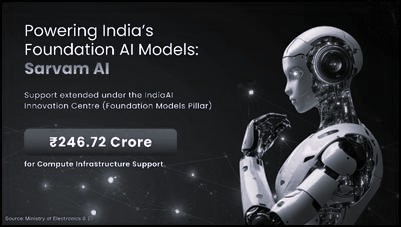
Under the Government of India’s IndiaAI Mission, aimed at building a globally competitive indigenous AI ecosystem, Sarvam AI has been selected among 12 institutions in the Innovation Centre category. With financial and computing support of ₹246.72 crore, the company is developing large language models and speech models focused on Indian languages. These models are designed not just for experimentation but for direct deployment in public services, positioning the initiative as a strong example of public–private collaboration.
Among the systems developed by Sarvam AI are Bulbul, Saras and Vision, which mark a new chapter in Indian language technology. These include capabilities such as converting text into natural human-like voices, developing voice models aligned with Indian accents, and enabling speech-to-text systems capable of understanding code-mixed languages. Their use in government offices, call centres and digital service centres could significantly expand access for millions who face language barriers in availing services.
The company’s platforms extend beyond language translation. Through conversational AI, citizens can interact directly with government services. Enterprise solutions such as “Sarvam for Work” allow organisations to operate flexibly with their own data and models. Features including video dubbing, document translation and voice cloning are driving change across media, education and content sectors. The availability of these capabilities within a unified ecosystem strengthens Sarvam AI’s position in the domestic AI landscape.
Recognising the uneven availability of high-speed internet and cloud access across India, the company has prioritised edge intelligence. By developing AI models that function with low latency and minimal power consumption, it is extending services into rural regions. Real-time translation, on-device voice assistants and AI tools for field-level officials are expected to support grassroots governance and rural development.
Government partnerships form a core strength of the initiative. Voice-based AI in Aadhaar services, fraud-detection systems and multilingual support are enhancing efficiency in public service delivery. The Sovereign AI Compute Hub being established in Odisha and the Digital Sangam Research Park under development in Tamil Nadu reflect efforts to move AI from laboratories into citizens’ daily lives. In governance, AI adoption signifies not just automation but improved reliability, transparency and speed.
Sarvam AI’s open ecosystem approach is also creating opportunities for startups, academic institutions and researchers. The ability to experiment with indigenous models rather than relying solely on foreign systems is considered critical for India’s AI research growth and for retaining domestic talent. For India to move from being an AI consumer to a global leader, such platforms are seen as essential.
Sarvam AI is the principal architect of this indigenous AI system. Developed under the leadership of co-founders Vivek Raghavan and Pratyush Kumar, the design focuses on Indian languages, public services and sovereign data security. Development began during 2023–24 and was brought to a stage suitable for public service deployment by 2025–26. Following the announcement of the IndiaAI Mission, the models were refined to meet government requirements and a scalable design was completed. The system entered pilot implementation in late 2025 and became ready for full-scale deployment in public services by early 2026, with central government support accelerating implementation.
Future plans include expanding AI models to cover all Indian languages, scaling edge AI services in rural areas, extending applications across healthcare, education and governance, forging new partnerships with state governments, and positioning India as a global sovereign AI hub.
Similar sovereign AI initiatives exist in other countries. In China, Baidu’s ERNIE model has been developed in alignment with Chinese language and regulatory frameworks and is widely used in government and business sectors. France-based Mistral AI develops open-weight AI models aligned with European languages and data privacy regulations, contributing to European AI sovereignty efforts. In the UAE, G42 has developed the Jais AI model tailored to the Arabic language and regional needs. In Japan, the government, in coordination with industry, is developing domestic large language models suited to the Japanese language for governance, industrial automation and service digitisation.
However, India’s effort stands out for its scale and diversity. Serving 22 official languages, hundreds of dialects and millions of citizens simultaneously, Sarvam AI represents one of the most ambitious attempts globally to integrate inclusive, public-oriented artificial intelligence into national development.