
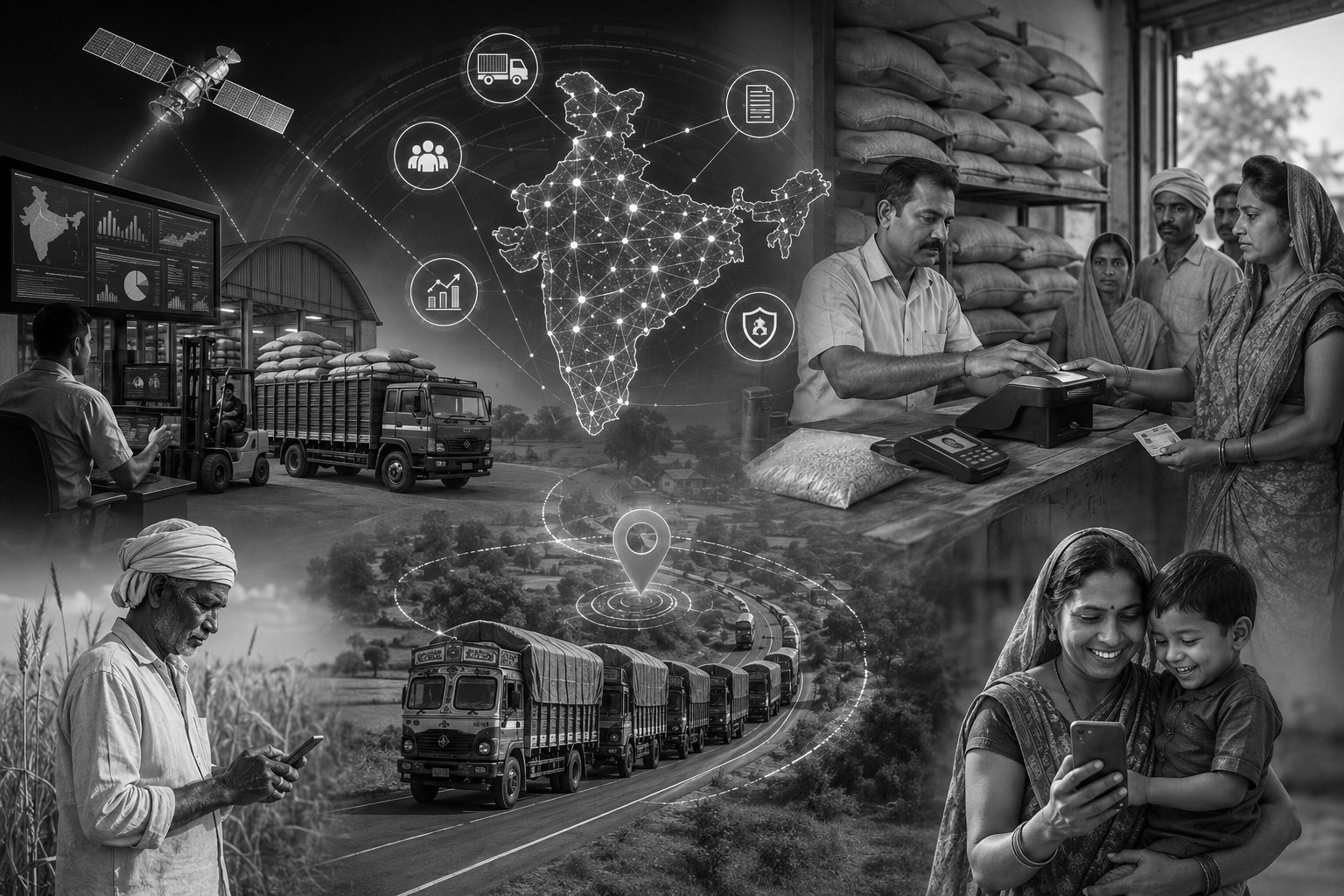
SARTHAK-PDS Aims to Bring Real-Time Intelligence to India’s Food Security Network
India’s vast ration distribution network, often described as the world’s largest food security system, is preparing for one of its biggest technological transformations yet. With the Union Cabinet approving the ambitious SARTHAK-PDS scheme, the government is attempting to convert the country’s decades-old Public Distribution System into a digitally integrated welfare infrastructure powered by Artificial Intelligence (AI) , real-time analytics and advanced monitoring technologies.
The newly approved programme, backed by a massive Rs. 25,530 crore Central investment over the next five years, is not merely another welfare extension. It represents a strategic attempt to modernize how subsidized food reaches more than 81.35 crore beneficiaries under the National Food Security Act (NFSA) while addressing long-standing challenges such as leakages, corruption, transport inefficiencies and fake ration cards.
Approved by the Cabinet Committee on Economic Affairs (CCEA) chaired by Prime Minister Narendra Modi , the scheme will remain operational until March 31, 2031 during the 16th Finance Commission cycle. The Centre believes SARTHAK-PDS could become a foundational part of India’s growing Digital Public Infrastructure (DPI) ecosystem alongside platforms such as Aadhaar, UPI and DigiLocker.
What is SARTHAK-PDS?
SARTHAK-PDS stands for “Scheme for Assistance in Ration Transport and Handling-Income with Automation in PDS.” At its core, it is an umbrella programme that merges two key existing schemes — financial assistance for intra-state movement and handling of foodgrains along with support for Fair Price Shop (FPS) dealer margins, and the technology-focused SMART PDS reform programme.
By integrating these schemes into one framework, the government aims to create a unified national system that combines logistics, technology, monitoring and welfare delivery under a single digital architecture. Officials say the scheme is designed to make the ration ecosystem “citizen-centric, intelligent and interoperable,” with the long-term goal of ensuring seamless and transparent foodgrain distribution across India.
Moving Beyond Simple Digitization
India’s PDS modernization journey did not begin with SARTHAK-PDS. Over the last decade, the government has already implemented several reforms including End-to-End Computerization of TPDS , the Integrated Management of PDS (IM-PDS) system, Aadhaar-linked ration cards, electronic Point of Sale (e-PoS) devices at ration shops and online foodgrain allocation systems. These initiatives laid the foundation for a more transparent and digitally connected ration network.
The government also introduced citizen-facing platforms such as Mera Ration , Anna Mitra , Anna Sahayata and the Rightful Targeting Dashboard to improve accessibility and beneficiary engagement. Since April 2023, the SMART PDS programme has served as the backbone of technology-led ration reforms by enabling complete digitization of ration cards and computerized supply-chain management across all 36 States and Union Territories .
However, SARTHAK-PDS represents a shift from simple digitization toward a more intelligent governance model. Rather than only storing records digitally, the new scheme aims to build a smart welfare network capable of predictive analytics, live monitoring and automated decision-making.
AI, Blockchain and Smart Monitoring
One of the most striking aspects of SARTHAK-PDS is the government’s plan to integrate advanced technologies into food distribution operations. The Centre intends to deploy Artificial Intelligence (AI) , Machine Learning (ML) , Natural Language Processing (NLP) and Blockchain-based systems to create a more efficient and transparent ration ecosystem.
Under the proposed framework, the system will feature real-time monitoring dashboards, predictive analytics tools, AI-powered grievance redressal mechanisms, GPS-linked transport tracking and centralized databases. State-level Command and Control Centres will also be established to monitor operations using live data and analytics.
The idea is to enable authorities to track the movement of foodgrains across the country in real time — from Food Corporation of India (FCI) warehouses to state depots and ultimately to local ration shops. Officials believe AI-driven analytics can help identify unusual stock movement, supply shortages, duplicate beneficiaries and delivery delays far more efficiently than traditional manual systems.
Blockchain technology is expected to further improve transparency by creating tamper-resistant digital records that reduce opportunities for manipulation or diversion of foodgrain data. Collectively, these systems are intended to transform India’s ration network into an intelligent and data-driven welfare infrastructure.
Strengthening Last-Mile Delivery
One of the biggest challenges facing India’s Public Distribution System has always been ensuring that allocated foodgrains actually reach the final beneficiary. Problems such as transportation delays, weak logistics, corruption, leakages, low dealer incentives and inadequate monitoring have often disrupted last-mile delivery, especially in rural and remote regions.
SARTHAK-PDS attempts to address these structural problems through both financial and technological interventions. A significant portion of the Rs. 25,530 crore allocation will continue supporting the intra-state transportation and handling of foodgrains. The Centre has also revised assistance norms to help States and Union Territories manage rising logistics and operational costs more effectively.
Another major focus is improving the financial sustainability of Fair Price Shops , which serve as the final distribution point for beneficiaries. FPS dealers have long complained about low commissions despite increasing operational expenses related to electricity, internet connectivity, biometric devices and manpower. Under SARTHAK-PDS, the government plans to continue supporting higher dealer margins in order to strengthen the ration distribution chain.
Technology will also play a key role in improving last-mile efficiency. GPS tracking systems, AI-based route optimization and computerized supply-chain monitoring are expected to reduce delays, improve accountability and ensure smoother transportation of foodgrains from warehouses to ration shops.
A Boost for Migrant Workers
SARTHAK-PDS is also expected to significantly strengthen the One Nation One Ration Card (ONORC) system, which allows beneficiaries to access subsidized foodgrains anywhere in the country.
The importance of ration portability became especially visible during the COVID-19 pandemic, when millions of migrant workers faced difficulties accessing food support outside their home states. By creating interoperable databases and integrated digital systems, SARTHAK-PDS aims to make ration access smoother and more reliable for migrants, daily wage workers and other vulnerable populations.
The government believes a centralized and technology-enabled framework will reduce administrative barriers and improve food security access for mobile populations across India.
A Government-Led Digital Welfare Infrastructure
Despite its strong emphasis on technology, SARTHAK-PDS remains fundamentally a government-operated welfare programme. Policy decisions, subsidy management, foodgrain allocation and beneficiary databases will continue to remain under the control of the Union government, State governments and agencies such as the Food Corporation of India (FCI) .
No major private MoUs or PPP agreements linked specifically to SARTHAK-PDS have been announced so far. However, experts believe the implementation phase is likely to involve public procurement contracts and partnerships with technology vendors for AI systems, cloud infrastructure, e-PoS devices, cybersecurity solutions and logistics management technologies.
Much like India’s broader Digital Public Infrastructure ecosystem, the model is expected to combine government ownership of core welfare infrastructure with technology support from private sector vendors and system integrators.
The Larger Significance
The significance of SARTHAK-PDS goes far beyond ration distribution alone. India’s welfare architecture is increasingly moving toward digital governance systems supported by centralized data infrastructure, real-time monitoring and interoperable platforms.
Through SARTHAK-PDS, the government is attempting to position food security within this broader digital transformation agenda. If implemented successfully, the scheme could help reduce leakages, improve transparency, optimize logistics and strengthen portability across the world’s largest food subsidy programme.
At the same time, the increasing use of AI-driven systems, Aadhaar-linked verification and centralized databases may also renew debates around data privacy, exclusion risks and digital dependency in welfare delivery.
Nevertheless, the government’s broader vision is becoming increasingly clear — the future of India’s food security network will depend not only on subsidy allocations and foodgrain stocks, but also on intelligent digital infrastructure capable of delivering welfare more efficiently, transparently and at scale.