
‘Sarkar’ in Reality: Vijay Scripts Historic Win, TVK No.1 as Stalin Loses Bastion
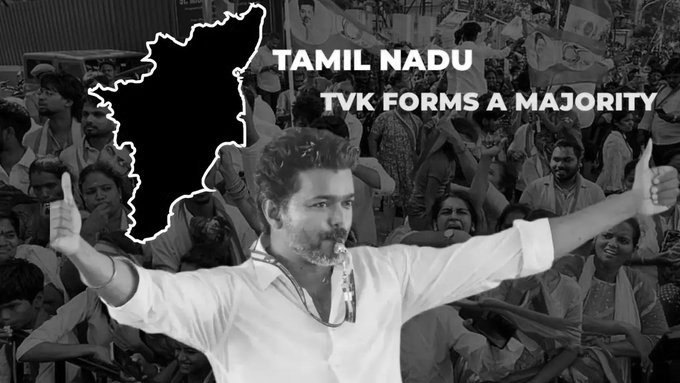
In a political earthquake that has redrawn Tamil Nadu’s electoral map, actor-turned-politician Joseph Vijay Chandrasekhar led the Tamilaga Vettri Kazhagam to a stunning debut performance in the 2026 Assembly elections, emerging as the single-largest party and ending decades of dominance by the Dravidian majors. In the 234-member Tamil Nadu Legislative Assembly, TVK secured around 107 seats , falling just short of the majority mark of 118 but delivering what observers are calling an unprecedented first-entry victory in the state’s political history.
In one of the biggest shocks of the election, M. K. Stalin , the face of the ruling Dravida Munnetra Kazhagam , lost his stronghold Kolathur seat to a TVK candidate, symbolising a dramatic collapse of DMK’s urban dominance. While DMK managed to retain pockets of influence, including Udhayanidhi Stalin holding Chepauk-Thiruvallikeni , the party’s overall tally dropped sharply to around 59 seats, marking a significant reversal from its earlier position.
The results reflect a deeply split electorate, with vote shares distributed across three major poles. TVK secured roughly 34-36 per cent of the vote, followed by the All India Anna Dravida Munnetra Kazhagam with about 26-29 per cent, while DMK trailed with around 24-27 per cent. Other parties and independents together accounted for approximately 8-12 per cent, underscoring a decisive shift from Tamil Nadu’s traditional bipolar contests to a triangular political battle.
AIADMK secured around 45-47 seats, retaining influence in select western and rural belts but failing to mount a statewide challenge. For the first time in decades, neither DMK nor AIADMK dominates the Assembly, marking a historic break from the state’s entrenched two-party system and signalling the rise of a new political force.
On the ground, TVK’s surge was particularly visible in urban and semi-urban constituencies, including a near sweep of Chennai’s seats. The party also made inroads into western Tamil Nadu, traditionally an AIADMK bastion, while DMK held on to parts of the Cauvery delta, reflecting a shifting political geography across the state.
TVK’s campaign combined populist welfare promises with governance reform, resonating strongly with voters. The party promised ₹2,500 monthly assistance for women , financial aid for unemployed youth , crop loan waivers for farmers , the creation of an Artificial Intelligence ministry , and a strong anti-corruption framework . These pledges, coupled with Vijay’s mass appeal, galvanised first-time voters and urban youth, creating a wave rarely seen in Tamil Nadu elections.
With 107 seats, TVK now stands on the cusp of power but requires the support of around 10-12 additional MLAs to cross the majority mark. The most likely scenario is a minority government with outside support from smaller parties or independents, as both DMK and AIADMK alliances remain numerically distant from forming a government on their own.
The 2026 verdict is widely being described as a generational shift in Tamil Nadu politics, driven by youth voters, urban aspirations, and a demand for alternatives to legacy parties. For Vijay and TVK, the challenge now lies in converting electoral success into stable governance, while for DMK and AIADMK, the outcome signals an urgent need to recalibrate strategies in a rapidly evolving political landscape.