
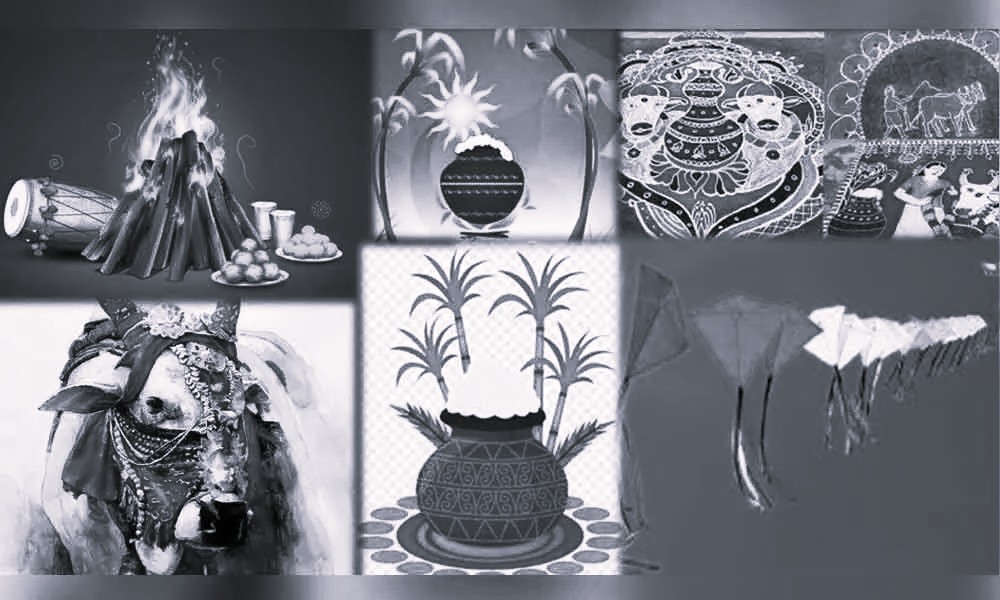
“Sankranti Calls You Home!”
In the hearts of Telugu people, Sankranti is not merely a festival. It is a season, an emotion, a memory, a bond. No matter how fast time moves forward or how much life changes, when Sankranti arrives, the mind instinctively searches for an unchanging path, the road to the village, the road to one’s hometown. Bhogi, Makara Sankranti, and Kanuma, these three days together reflect the essence of Telugu life, culture, and roots like a mirror.
Throughout the year, people living busy lives in cities, caught up in jobs, studies, and responsibilities, also slow down the moment Sankranti approaches. Will train tickets be available? Will there be space on the bus? Will the holidays be enough? Along with these thoughts, one longing echoes in every household, “This time, at least, we must go to the village.” That very longing defines the greatness of Sankranti. It draws us back toward our roots.
Bhogi morning… a misty dawn in the final phase of winter. From the moment Bhogi bonfires are lit in villages, the festival comes alive. Family members gathered around the fire, the words of elders, children’s laughter, and the warmth of flames rising through the cold air, all come together to create an indescribable feeling. Bhogi symbolizes letting go of the old and welcoming the new. Not just useless objects, but even the burdens accumulated in our hearts are symbolically offered to the fire through this ritual.
Elders often say that the warmth of Bhogi bonfires comforts not only the body but also the soul. Preparing garlands of dried cow-dung cakes in advance for children coming from cities, joyfully lighting those bonfires with them, sharing conversations, old memories, and family stories around the fire, these moments act as a bridge between generations. The colorful rangoli designs and gobbemma decorations in courtyards add a special charm to Bhogi. Colors dance in the hands of young girls, and every rangoli looks like a piece of art, a symbol of hope.
New clothes, favorite traditional snacks like garelu, burelu, and ariselu double the festive joy on Bhogi day. In rural areas, Bhogi is celebrated with even greater enthusiasm, songs, games, and celebrations around the bonfire make it a day that reflects family unity and the fragrance of village life.
Makara Sankranti, which follows Bhogi, is one of the most important days in Telugu culture. According to Hindu tradition, this auspicious moment marks the Sun’s transition from Sagittarius to Capricorn and the beginning of Uttarayana. It is a day that welcomes change in nature, light, and new hope.
Makara Sankranti is a festival dedicated to farmers’ hard work. After enduring rain, heat, and hardship, the joy of harvested crops reaching home is celebrated as a festival. On this day, farmers express gratitude to nature and God for the fruits of their labor. The aroma of dishes prepared with new rice, pongali, payasam, sakinalu, and garelu, announces the arrival of the festival even before one steps into the house. Mixed vegetable feasts, lentil curries, ceremonial offerings remembering elders, gifting new clothes to loved ones, family conversations, colorful rangoli and gobbemma decorations, all enhance the festive beauty. Haridasu songs and Gangireddula performances bring unique charm to villages. Children fill the sky with colorful kites, while elders exchange greetings, blessings, smiles, and contentment. All these together make Makara Sankranti a beautiful experience.
This festival is not limited to feasts alone. Its true meaning lies in sharing, togetherness, and strengthening relationships. That is why visiting relatives’ homes, seeking elders’ blessings, and giving gifts to children have become traditions. Entire villages organize rangoli competitions, girls joyfully participate and win small prizes, and children revel in festive excitement. Girls wear traditional half-sarees, boys don dhotis, honoring customs through new attire. The playful banter of brothers-in-law and sisters-in-law, children’s games, and laughter add new charm to the celebration. Sankranti teaches us one simple lesson, to express gratitude to every hand behind our growth, to bring generations together, to share feelings warmly, and to pass on our heritage and traditions to the next generation through joyful celebration.
Across India, Sankranti is celebrated with the same spirit but under different names. In Tamil Nadu, it is a four-day Pongal festival, Bhogi Pongal, Surya Pongal, Mattu Pongal, and Kanum Pongal, where Pongal made with new harvest is offered to the Sun God in gratitude. In Karnataka, sharing “Ellu-Bellu” symbolizes sweet relationships. In Maharashtra, people exchange tilgul saying, “Til gul ghya, goad goad bola,” encouraging sweetness in words and bonds. In Punjab and Haryana, Lohri is celebrated around bonfires. In Assam, it is Bhogali Bihu; in West Bengal, Poush Sankranti; and in Gujarat, it becomes a kite festival. Everywhere, Sankranti reflects the bond between humans and nature.
In the Telugu states, the Sankranti celebrations conclude with Kanuma. Kanuma mirrors rural life and is dedicated to livestock. It reminds us of the vital role played by bulls, cows, and buffaloes in agriculture.
On Kanuma morning, farmers bathe their cattle, paint their horns, adorn them with flower garlands, tie new ropes and bells, and perform rituals. Offering special food to cattle is customary. Bull races held on this day are a major attraction in rural areas, reflecting farmers’ enthusiasm and village unity.
In some regions, like in Andhra Pradesh, cockfighting (locally known as Kodi Pandalu ) reaches its peak on Kanuma , with the undivided West Godavari and East Godavari districts serving as the historic epicenters. Bhimavaram in West Godavari is globally recognized as the primary hub, often likened to the "Super Bowl" of the sport, alongside other major centers like Amalapuram in Konaseema, Tadepalligudem , and Tanuku . While traditionally a rural pastime rooted in the coastal belt, the practice has significantly expanded into districts like Krishna (specifically near Vijayawada and Gudivada), Eluru , NTR , and Anakapalle , where high-tech arenas now feature VIP galleries and LED screens. Despite legal bans and police surveillance using drones, these districts remain famous for the sport during Kanuma due to deep-seated cultural beliefs, high-stakes betting involving hundreds of crores, and the rigorous breeding of prized roosters such as the Dega and Nemali .
These cockfights were traditionally part of Kanuma celebrations, once considered symbols of courage and rural entertainment. Though regulated today due to legal restrictions, the festive spirit of Kanuma remains undiminished.
Special non-vegetarian dishes mark Kanuma, chicken curry, mutton dishes, and jaggery-based sweets add richness to the feast. Relatives and friends gathering for shared meals strengthen bonds. Laughter, games, and songs turn the entire village into a festive stage.
After these three days end, a sudden silence descends upon villages. The warmth of Bhogi bonfires, the bustle of Sankranti, and the games of Kanuma remain only as memories. Homes that were alive with activity quietly return to routine. Laughter in village lanes, children’s footsteps, and relatives’ conversations slowly fade into silence.
Then begins the return journey. Buses and trains heading toward cities carry not just passengers, but also the memories of their villages filled in their hearts. The taste of mother’s cooking, father’s blessings, the touch of village breeze, all are carried within. Looking back, a silent question lingers in every heart, “When will we return again?”
Yet, this journey is not a farewell. It is a pause filled with hope. A belief that the village has given the strength to move forward in life’s struggles, and the hope that the same path will be taken again next Sankranti. Wherever we may be, the village remains our root. Until the next festival arrives, memories become our companions.
Even when Sankranti ends, the warmth it leaves within us never fades. Though the return journey begins, the heart remains in the village. That is Sankranti’s true gift, a festival that reminds us of who we are. Sankranti is, indeed, the most heartfelt celebration of all.