
Sagarmala Emerges as Game-Changer for India’s Ports, Logistics and Coastal Growth
India’s ambitious Sagarmala Programme , launched in March 2015 after being first conceptualised in 2003 , has emerged as a transformative force in the country’s maritime sector, significantly improving port efficiency, logistics networks, and coastal economic development . Designed as a port-led development strategy , the initiative aims to reduce logistics costs, boost trade, and position India as a global maritime hub, with public-private partnerships (PPP) playing a central role in its execution.
India’s maritime sector handles nearly 95% of trade by volume and 70% by value , supported by a coastline of 11,099 km and about 14,500 km of navigable waterways . The country operates 12 major ports and over 200 non-major ports , forming the backbone of its trade infrastructure. Under Sagarmala, these ports are being integrated into a multimodal logistics ecosystem , connecting road, rail, coastal shipping, and inland waterways.
At the core of the programme are its five pillars port modernization , connectivity enhancement , port-led industrialization , coastal community development , and coastal shipping & inland waterways aimed at transforming ports into engines of economic growth rather than mere transit points.
The scale of implementation has been substantial. A total of 845 projects worth ₹6.06 lakh crore have been identified, with 315 projects worth ₹1.57 lakh crore completed , 210 under implementation , and 320 in the planning stage . In the last five years, around ₹14,080 crore has been spent , combining government support and investments from ports and private stakeholders, while direct central allocations remained modest at about ₹2,000 crore , highlighting the programme’s reliance on private capital.
Private sector participation has been pivotal in bridging this investment gap. Leading companies such as Adani Ports and Special Economic Zone (APSEZ) , JSW Infrastructure , DP World , PSA International , and Essar Ports have secured major contracts to develop and operate port terminals and logistics infrastructure. These projects are typically awarded through competitive bidding under long-term concession agreements, enabling private players to build and manage terminals while sharing revenue with port authorities.
Importantly, India has adopted a “landlord port model” , under which ports remain publicly owned while private firms handle operations. Major ports such as Jawaharlal Nehru Port , Cochin Port , and Visakhapatnam Port have multiple privately operated terminals, while some non-major ports like Mundra and Krishnapatnam are fully private under state jurisdiction. This hybrid approach ensures efficiency without compromising strategic control .
The impact on port performance has been significant. India’s major ports handled a record 915.17 million tonnes of cargo in FY 2025–26 , registering over 7% annual growth . Operational efficiency has improved sharply, with vessel turnaround time reducing from 96 hours in 2014 to about 49.5 hours , while nine Indian ports now rank among the world’s top 100 , including Visakhapatnam Port among the top 20.
Sagarmala has also driven a structural shift in logistics. Increased reliance on coastal shipping and inland waterways has reduced pressure on road transport, lowering congestion and fuel consumption. Cargo movement through inland waterways has surged from 18.10 MTPA to 145.50 MTPA , reflecting nearly 700% growth , while logistics savings are estimated at ₹35,000–40,000 crore annually , enhancing India’s export competitiveness.
Passenger and urban connectivity have improved through 29 Ro-Pax and ferry projects , with 17 completed , benefiting more than 35 lakh passengers . Key routes such as Ghogha–Hazira have reduced travel time from 10 hours to 4 hours , while the Mumbai–Mandwa ferry has eased congestion by replacing long road journeys with shorter sea routes.
The programme has also delivered strong socio-economic outcomes, with an estimated employment potential of 1 crore jobs , including 40 lakh direct and 60 lakh indirect employment opportunities across port operations, logistics, industrial clusters, and allied sectors. Skill initiatives have trained over 7,600 candidates , with more than 3,100 placements , while 30,000 fishermen have benefited from modernised harbour infrastructure.
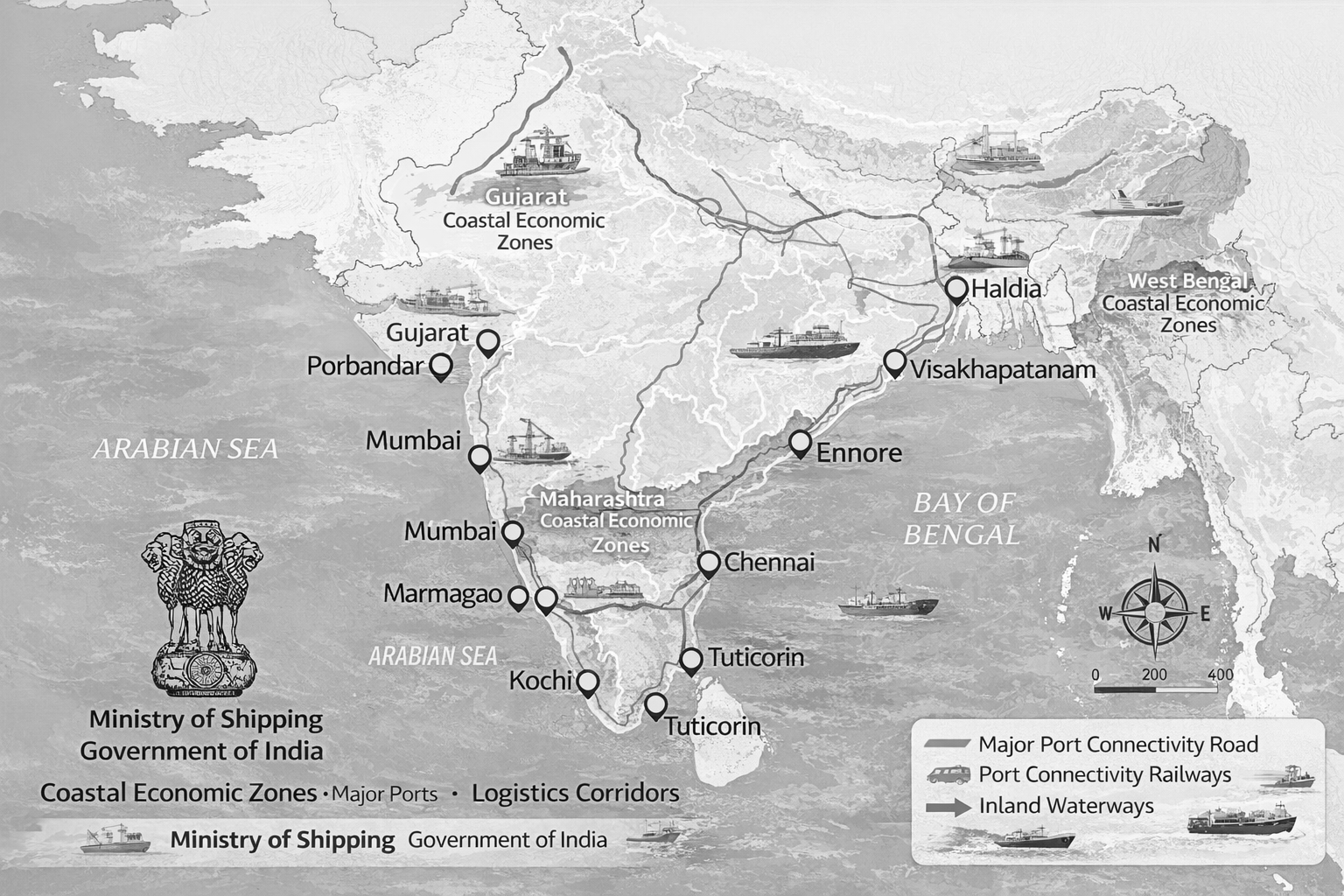
Geographically, Sagarmala spans all major coastal regions, integrating ports such as Visakhapatnam, Paradip, Chennai, Kolkata, JNPT, Mumbai, Kandla, Cochin, and Tuticorin with Coastal Economic Zones (CEZs) across Gujarat, Maharashtra, Tamil Nadu, Andhra Pradesh, Odisha, and West Bengal. These zones are catalysing industrial growth in sectors including petrochemicals, steel, automobiles, and manufacturing.
Institutionally, the programme is supported by bodies such as the National Sagarmala Apex Committee , Maritime States Development Council , and State Sagarmala Committees , ensuring coordinated implementation. Financial backing has been strengthened through the creation of the Sagarmala Finance Corporation Limited (SMFCL) , which has sanctioned around ₹4,300 crore to support maritime infrastructure development.
Looking ahead, the proposed Sagarmala 2.0 envisions a more advanced maritime ecosystem, with planned investments of ₹3.6 lakh crore and budgetary support of ₹85,482 crore , focusing on sustainability, innovation, and green port development in line with Viksit Bharat 2047 .
Experts note that without Sagarmala, India would likely have continued to face high logistics costs, congested ports, and limited coastal development , constraining its global trade potential. Instead, the programme supported by a balanced mix of public oversight and private efficiency has transformed India’s maritime sector into a modern, competitive, and globally integrated system , positioning ports as key drivers of economic growth.