
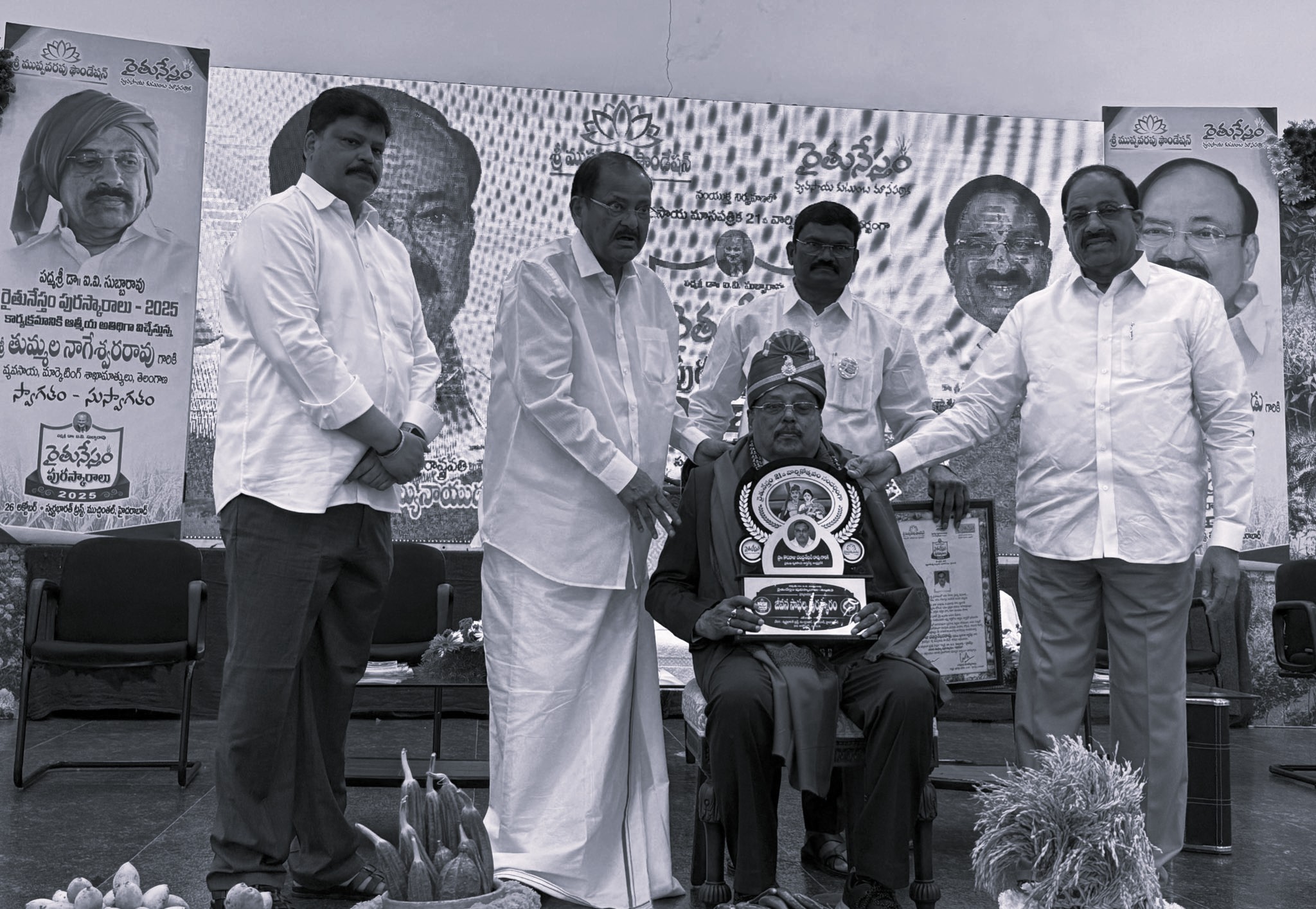
Rythu Nestham awards 2025 celebrate innovation and service in Indian agriculture
The “Rythu Nestham Awards 2025,” organized jointly by Rythu Nestham and the Muppavarapu Foundation, celebrated individuals who have made outstanding contributions to the agricultural sector. Former Vice President M. Venkaiah Naidu, who attended the event, congratulated all the awardees and appreciated Yadlapalli Venkateswara Rao for sustaining this initiative for the past 15 years, with continued support from Muppavarapu Harshavardhan.
Among the awardees were noted agricultural scientist Dr. Kosaraju Chandrasekhar Rao, who received the Lifetime Achievement Award; Telangana-based land rights activist M. Sunil Kumar, honored with the title Bhoomi Ratna; and Dr. Jonnalagadda Chandrasekhar Rao, CEO of the Chhattisgarh State Medicinal Plants Board, who received the Krishi Ratna award.
Venkaiah Naidu personally congratulated each award recipient, emphasizing that farmers’ hard work benefits not only themselves but society as a whole. However, he noted that farmers often lack collective strength and lobbying power, which makes it essential for governments to extend the same importance given to cities and industries to villages and agriculture-related sectors.
He urged governments to take up the responsibility of educating and empowering farmers through effective extension activities. Referring to the late Dr. M.S. Swaminathan, the pioneer of India’s Green Revolution, Venkaish Naidu stressed the importance of ensuring not just food security but also nutritional security.
He called for promoting the cultivation of millets such as ragi, bajra, jowar, korra, and foxtail millet - crops that are both eco-friendly and highly nutritious. He also encouraged governments to launch awareness campaigns, especially targeting the youth, to highlight the benefits of millet-based agriculture.
Venkaiah Naidu emphasized that farmers should not rely solely on crop production but also explore allied sectors such as dairy, fisheries, and food processing, as these provide sustainable income and resilience. Collaboration among scientists, policymakers, and farmers, he said, is crucial to identifying challenges, sharing insights, and finding collective solutions.
“Only through cooperation and diversification can farmers achieve true self-reliance,” the former Vice President concluded.