
Russia’s Big Industries Cut Work Hours as Economy Feels Ukraine War Pressure
Russia’s major industrial companies, from railways and carmakers to coal, metals, diamonds, and cement producers, are cutting work hours and furloughing employees as Russia’s war economy slows down. Falling domestic demand, weak exports, and rising imports are straining the country’s non-military sectors, showing the wider impact of the conflict in Ukraine and Western sanctions.
For example, Cemros, Russia’s largest cement maker, switched to a four-day workweek until the end of the year. The company, which employs 13,000 people across 18 plants, hopes the move will save costs without layoffs. “This is a necessary anti-crisis measure,” said Cemros spokesman Sergei Koshkin. Reduced demand for cement, driven by fewer new housing projects and cheaper imports from China, Iran, and Belarus, is forcing such steps.
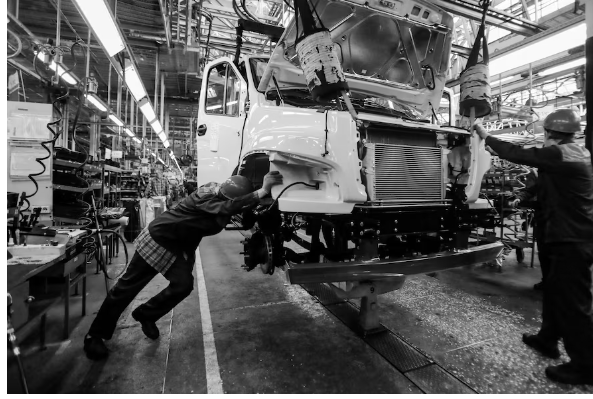
Other major companies have taken similar measures. Russian Railways, which employs 700,000 people, asked central office staff to take three unpaid days off each month due to declining coal, metal, and oil shipments. Truckmakers like Kamaz and carmakers including Avtovaz and Gorky Automobile Plant (GAZ) also reduced workweeks to preserve jobs. Some companies, like GAZ, later returned to a five-day week, while Kamaz kept the four-day schedule.
Even Russia’s diamond giant Alrosa has cut payrolls by 10% for non-mining staff and paused work at less profitable deposits. Timber and paper company Sveza closed a plywood mill in Tyumen, costing over 300 jobs, after furniture demand fell sharply. Across the metals, mining, coal, and timber sectors, shorter workweeks and staff reductions are increasingly common.
Economic data shows the scale of the strain. Russia’s non-military sectors have shrunk 5.4% since January, and GDP growth is forecast to slow to around 1% this year. While unemployment remains low at 2.1%, overdue salary payments hit 1.64 billion rubles by August, over three times last year’s level. Analysts say Russia’s war economy, coupled with high interest rates, a strong ruble, and cheap Chinese imports, is pressuring businesses and workers alike.
Coal, a key employer in Siberia’s Kuzbass region, has been particularly hard hit. Nearly 19,000 coal workers lost jobs in the first half of 2025 as mines shut or scaled back operations. Steelmakers are also feeling the pinch, with many plants reducing auxiliary staff while avoiding outright layoffs. The government is considering measures such as a moratorium on bankruptcies in the metals sector and other interventions to stabilize employment and output.
Historically, Russia has bailed out major employers during economic downturns to prevent social unrest, as seen in the 2008-2009 global financial crisis and in 2022 when car factories were asked to furlough instead of fire staff. Today, state support is again being extended across sectors, from coal and metals to shoes and transport, reflecting the importance of heavy industry to regional economies. If we look back, we see that Russia has long supported major employers during downturns to prevent social unrest, from the 2008–2009 financial crisis to 2022 car factory furloughs. In May 2025, President Putin approved emergency aid for the struggling coal sector, as state support spreads across coal, metals, footwear, and transport, highlighting heavy industry’s role in regional economies.
Overall, yet again, Russia’s industrial landscape is under mounting pressure. Companies are making difficult choices to reduce costs while trying to retain workers, showing how deeply the war and sanctions are affecting the broader economy.