
Russia witnesses growing interest in Hindi
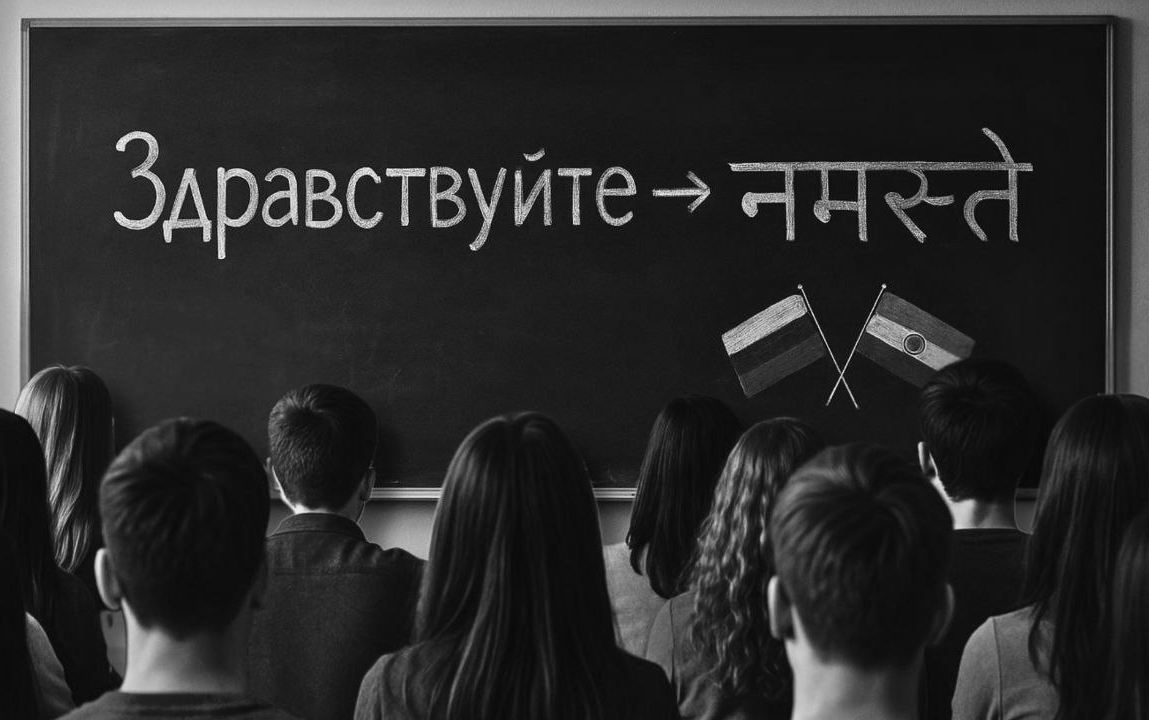
Three decades after the Soviet Union’s collapse, Russia is experiencing an unexpected cultural revival: a surge in interest among students eager to learn Hindi, India’s vibrant and widely spoken language. This growing fascination with Hindi reflects a broader curiosity about India’s ancient civilization and its modern global influence, prompting the Russian government to expand opportunities for studying the language across the country.
Konstantin Mogilevsky, Russia’s Deputy Minister of Science and Higher Education, recently told the Russian News Agency TASS, “We want more of our students to learn Hindi.” He emphasized India’s rising prominence as the world’s most populous nation, noting that Hindi is increasingly becoming the language of choice for millions of Indians over English. “To engage with India, we need to learn Hindi and other Eastern languages,” Mogilevsky said, signaling a shift in Russia’s educational priorities.
The Ministry of Education and Science has reported a significant uptick in student demand for Hindi courses, leading to plans to increase the number of institutions offering the language. In Moscow, prestigious institutions like the MGIMO School of International Relations, the Russian State University of Humanities (RSUH), the Institute of Asian and African Studies at Moscow State University, and the Moscow State Linguistic University already offer Hindi programs. Beyond the capital, universities like St. Petersburg State University and Kazan Federal University have also seen growing enrollment in Hindi courses, with class sizes doubling or tripling in recent years.
This renewed interest marks a stark contrast to the post-Soviet era, when Hindi studies faced a steep decline. In the 1990s, Moscow’s oldest boarding school teaching Hindi was shuttered, deemed unnecessary after Radio Moscow ceased its Hindi broadcasts and publishers like Progress and Raduga stopped translating Russian literature into Hindi. Yet, today’s Russia is witnessing a cultural reawakening, driven by a younger generation eager to explore India beyond the lens of Western narratives.
Indira Gaziyeva, a scholar at RSUH, observes that Russian media often portrays India through a Western perspective, which fails to capture the depth of its modern realities and ancient heritage. “The younger generation is taking a deeper interest in studying India—its history, its traditions, and its contemporary role on the global stage,” she said. This curiosity is fueling demand for Hindi, seen as a gateway to understanding India’s rich cultural tapestry.
The recent Moscow International Book Fair underscored this growing connection, with India invited as the “Guest of Honour Country.” A highlight of the event was the release of the groundbreaking “Hindi-Russian Idioms Dictionary”, a collaborative effort by Indian scholars and translators. Containing around 2,000 Hindi idioms, the dictionary is designed to bridge linguistic and cultural gaps for Russian learners. Pragati Tipnese, one of the lead compilers, explained, “We crafted this dictionary with Russian students in mind, ensuring each idiom’s meaning is clear and contextual, despite the differences in language, traditions, and geography.”
The dictionary has sparked excitement among Russian institutions teaching Hindi, with the Indian Council of Cultural Relations (ICCR) exploring ways to make it widely available. Tipnese noted the enthusiasm from educators, who see the dictionary as a vital tool for deepening cross-cultural understanding.
This Hindi renaissance reflects a broader desire in Russia to forge stronger ties with India, a nation increasingly seen as a global powerhouse. As Mogilevsky put it, “Young people today have more opportunities than ever to study Hindi.” With universities expanding their programs and cultural exchanges like the book fair gaining momentum, Russia’s embrace of Hindi signals a new chapter in the enduring friendship between the two nations, one rooted in mutual curiosity and respect for each other’s heritage.