
RTI Flags 57% Unspent Pollution Funds in Delhi, Raises Governance Questions
The utilisation of pollution control funds in the national capital has come under renewed scrutiny after an RTI revelation showed that a significant portion of collected environmental penalties remains unspent. The findings have sparked questions not only about governance under the Delhi government but also about the broader coordination between central and local authorities in tackling the city’s persistent air pollution crisis.
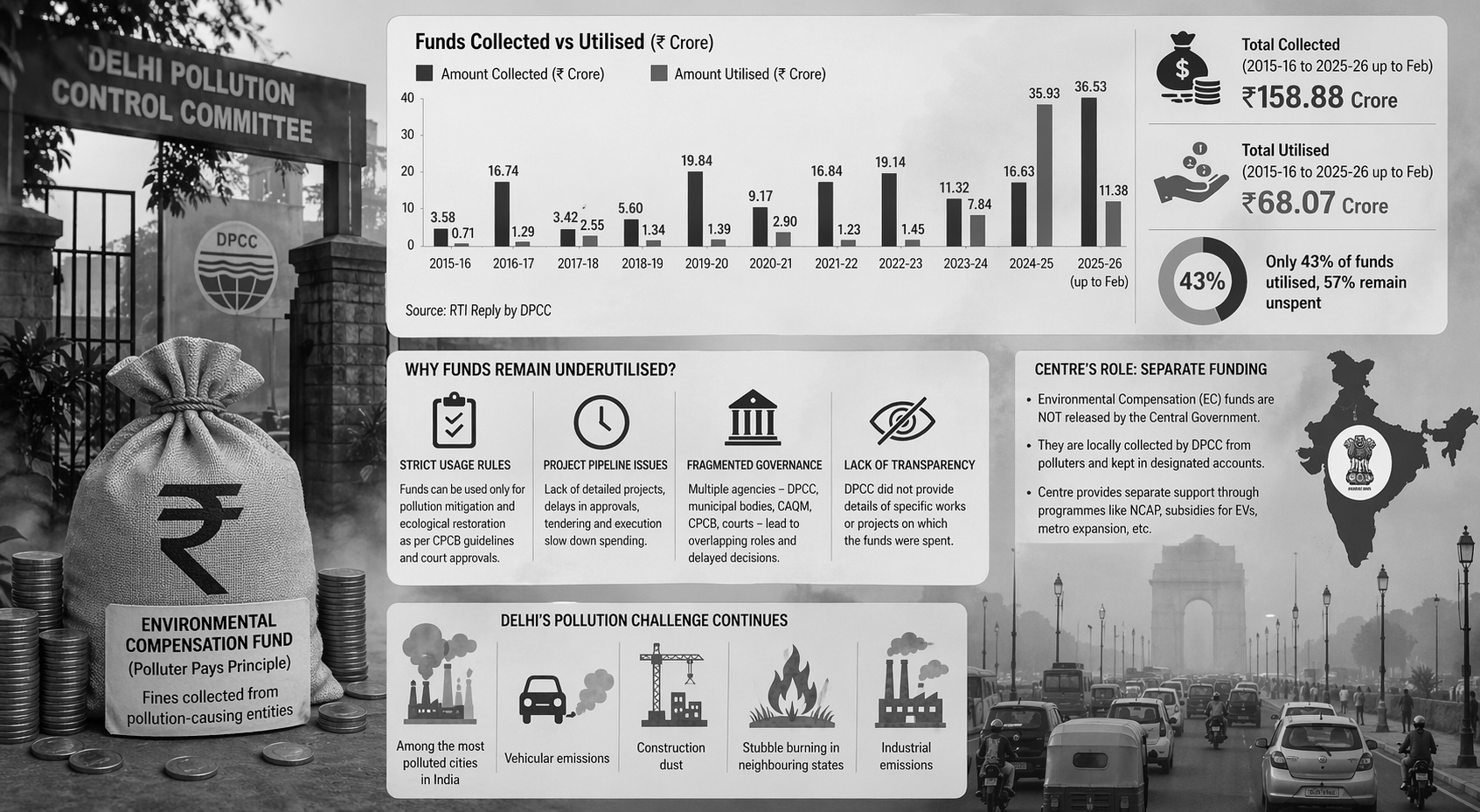
According to data obtained from the Delhi Pollution Control Committee (DPCC), only ₹68.07 crore out of ₹158.88 crore collected as Environmental Compensation (EC) between 2015-16 and 2025-26 has been utilised. The fund generated through fines imposed on polluting entities under the “Polluter Pays Principle” is intended for ecological restoration and pollution mitigation. However, nearly 57 per cent of the amount remains unspent , raising concerns over planning and execution.
The RTI, filed by environmental activist Amit Gupta, also highlighted the absence of detailed disclosures on how the spent funds were actually used. The lack of transparency has intensified criticism, especially as Delhi continues to rank among the most polluted cities in the country.
Year-wise data shows a pattern of low utilisation despite steady collections. In several years, including 2016-17 and 2019-20, spending remained below ₹2 crore even when collections exceeded ₹15 crore. A sharp rise in expenditure was seen only in 2024-25, when ₹35.93 crore was utilised , suggesting that funds accumulated over previous years were spent in bulk after delays in approvals or project execution.
Experts note that the issue is not merely financial but structural. The EC funds are controlled by the DPCC under the Delhi government, led by Chief Minister Arvind Kejriwal and the Aam Aadmi Party. However, Delhi’s governance framework complicates implementation, as multiple agencies including municipal bodies, central authorities, and judicial institutions share overlapping responsibilities in pollution control.
Importantly, officials clarify that the EC fund is not released by the Central government . Instead, it is locally collected by the DPCC from polluters and must be used strictly for approved environmental purposes, often requiring compliance with guidelines from the Central Pollution Control Board. This regulatory framework can slow down spending due to the need for clear project proposals, inter-agency coordination, and, in some cases, judicial approvals.
While the Centre does provide financial assistance for pollution control through separate programmes such as the National Clean Air Programme (NCAP), these funds are distinct from the EC pool and are routed through different channels. The Commission for Air Quality Management also plays a coordinating role in the Delhi-NCR region, further adding to the multi-layered governance structure.
Despite these complexities, critics argue that the underutilisation reflects gaps in long-term planning and execution. Gupta questioned why substantial funds remain idle even as the capital grapples with severe air quality issues. He emphasised that the problem is not a lack of resources but the absence of a clear and sustained strategy.
The Delhi government, on its part, has undertaken several policy measures to address pollution including promoting electric vehicles, implementing the odd-even traffic scheme, and deploying dust control mechanisms though not all of these initiatives are funded through the EC account.
The controversy underscores a broader challenge in India’s environmental governance: ensuring that available financial resources translate into measurable improvements on the ground. As Delhi continues to battle hazardous pollution levels, the spotlight is now firmly on accountability, transparency, and the effective utilisation of funds meant to clean its air.