
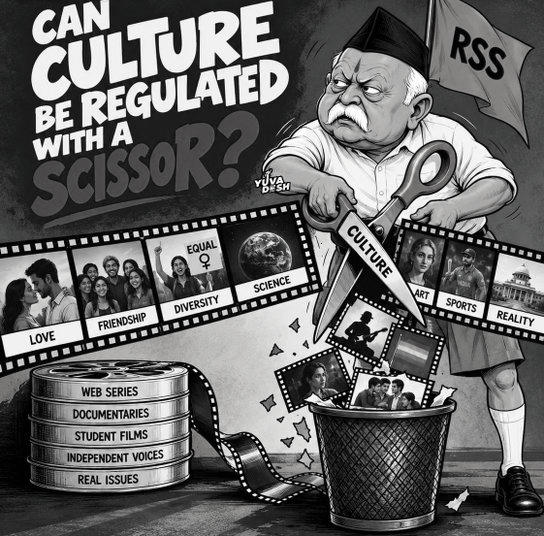
RSS Wants An OTT Censor Board: But Who Gives The Sangh The Power To Decide?
The Rashtriya Swayamsevak Sangh (RSS) has stepped into the growing debate over OTT content by setting up an informal panel to examine what it describes as “cultural pollution” on streaming platforms and consider whether India needs a censor board-like mechanism. The move, however, brings the Sangh’s growing cultural influence into an area where the legal authority rests with the government.
The panel, comprising former vice-chancellors and RSS pracharaks associated with education and culture, held its first meeting last month. It is expected to prepare recommendations for the Union Ministry of Culture and other government stakeholders, with legal experts also likely to be consulted.
The significance of the proposal lies in what happens next. The RSS itself cannot certify, ban or order an OTT programme to be removed. Its panel has no statutory powers and cannot function as a parallel regulator. Its role is to put forward a view and seek government action.
That makes the proposal notable because OTT platforms are already covered by a government-created regulatory framework. In December 2025, the government told the Lok Sabha that OTT content remains outside the jurisdiction of the Central Board of Film Certification (CBFC) but is regulated under Part III of the Information Technology Rules, 2021. The framework provides for age classification, grievance redressal and a three-tier mechanism with Central Government oversight.
The government has also used the existing framework against platforms. It said 43 OTT platforms had been blocked by July 2025 for displaying obscene content, demonstrating that authorities already have mechanisms to act against content alleged to violate the law.
The proposed intervention also raises the question of consistency. If concerns centre on obscenity, morality or the impact of entertainment on young people, theatrical films across Bollywood and regional cinema already pass through the statutory CBFC certification system, while OTT follows a separate regulatory route.
For the RSS, whose own public description of its work centres on social and cultural values, seeking tighter controls is part of its broader advocacy. But an organisation’s influence does not itself create legal authority. Any new censor-like system would ultimately require government action, a legal framework and constitutional safeguards, leaving the RSS with the power to influence the debate, but not to decide what India watches.