
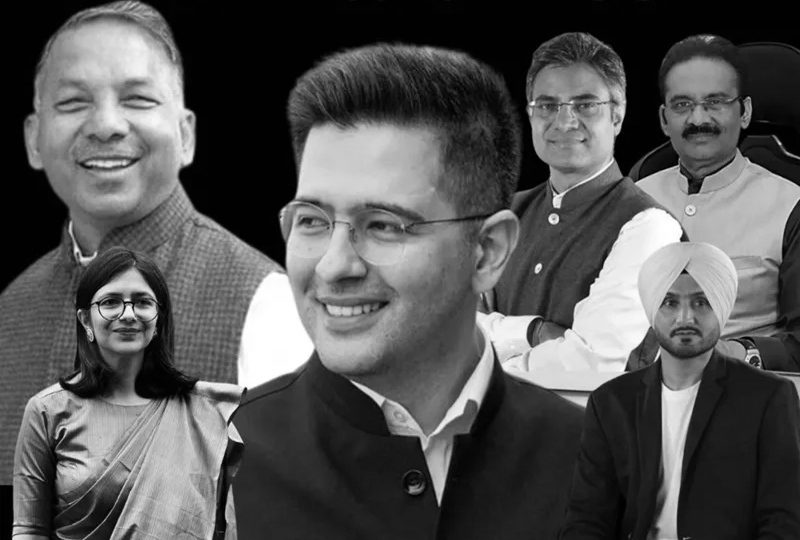
RS Chairman Accepts Merger of 7 AAP MPs with BJP, Upper House Equations Shift
A dramatic political shift unfolded in the Rajya Sabha on Monday, as a mass defection from the Aam Aadmi Party (AAP) reshaped the numbers game in the Upper House and triggered a fierce constitutional and political battle.
Rajya Sabha Chairman C. P. Radhakrishnan formally accepted the merger of seven AAP MPs with the BJP , delivering a significant setback to the party led by Arvind Kejriwal . With this move, AAP’s presence has reduced to just three members , while the BJP’s tally has climbed to 113 , further strengthening its legislative influence.
The leaders who switched sides include Raghav Chadha, Sandeep Pathak, Ashok Mittal, Harbhajan Singh, Swati Maliwal, Rajinder Gupta and Vikramjit Singh Sahney . Their transition is now officially reflected on the Rajya Sabha website, confirming their inclusion in the BJP’s parliamentary ranks.
The sequence of events unfolded rapidly. On Friday, the seven MPs submitted a formal petition to the Chairman seeking recognition as BJP members after announcing their merger. By Monday, the request was accepted , completing the transition within days. The MPs justified their move by claiming that the Kejriwal-led party had strayed from its founding principles, values and core ideals.
Reacting to the development, Union Minister Kiren Rijiju welcomed the MPs into the NDA, stating that they had “not resorted to abusive language” and maintained “parliamentary discipline”. He added that they have bid goodbye to the “Tukde-Tukde INDI Alliance” and joined the BJP for “nation building under the leadership of Prime Minister Narendra Modi.”
However, the development has sparked a sharp backlash from within the AAP. The party has termed the merger “unconstitutional” and moved swiftly to challenge it. Senior leader Sanjay Singh has filed a petition seeking disqualification of the seven MPs under anti-defection provisions, arguing that their switch violates parliamentary norms and party mandate.
The episode marks one of the most significant jolts for AAP in recent years, particularly in the Rajya Sabha, where numbers play a crucial role in legislative strategy. What makes the development politically sensitive is the claim by the defecting MPs that more than two-thirds of AAP’s Upper House members supported the merger , a key condition under constitutional provisions to avoid disqualification.
Beyond the immediate numbers, the shift signals a deeper churn within opposition politics . It raises questions about internal cohesion, ideological consistency, and the durability of alliances in a rapidly evolving political landscape.
As the BJP consolidates its position and the AAP mounts a legal and political challenge, the issue is far from settled. The coming days are likely to see intense debate, not just over the legality of the merger, but over what it reveals about the shifting ground beneath India’s parliamentary politics.