
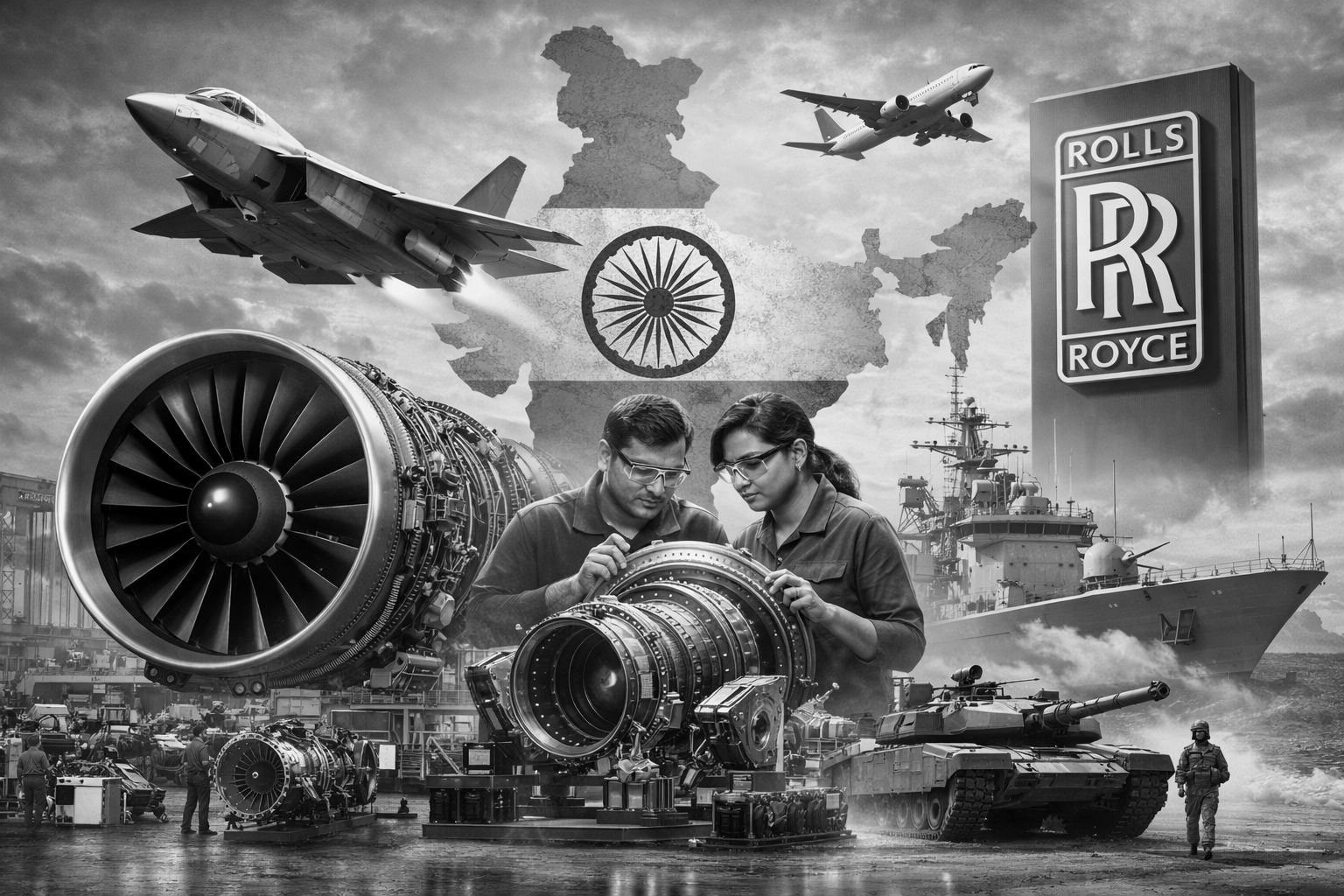
Rolls-Royce Prepares Big Investment to Build Aircraft Engine Ecosystem in India
When British aero-engine major Rolls-Royce announced its intention to make India its next “home market,” the statement went far beyond a routine investment pitch. Speaking in an interview to PTI, Sashi Mukundan , Executive Vice President of Rolls-Royce India, made it clear that the company is looking at India as a long-term strategic base rather than just a sales destination. The move signals a potential shift in how India approaches one of the most complex and strategically sensitive technologies in modern defence aircraft engine design and manufacturing. For a country that has long depended on foreign suppliers for fighter jet engines, the implications are significant.
For decades, India has assembled aircraft, built airframes, and integrated avionics, but true engine design authority has remained elusive. Rolls-Royce’s proposal, particularly in the context of India’s Advanced Medium Combat Aircraft (AMCA) programme , therefore carries meaning beyond a single platform. Mukundan has indicated that Rolls-Royce is open to conducting full engine design work in India, transferring relevant technology, and jointly owning intellectual property. Such an arrangement would represent a shift from licensed production toward shared design ownership, an area where India has historically struggled.
Rolls-Royce’s confidence rests on its recent and ongoing aircraft engine programmes globally. The company powers the Eurofighter Typhoon with its EJ200 engine , has jointly developed the F136 engine for the F-35 programme alongside GE, and currently leads the engine development for the Global Combat Aircraft Programme (GCAP), a sixth-generation fighter initiative involving the UK, Japan, and Italy. In civil aviation, its Trent family of engines including the Trent XWB for the Airbus A350 and the Trent 1000 for the Boeing 787 forms the backbone of long-haul fleets worldwide. These programmes underpin the company’s claim of developing and certifying new engines roughly every 18 months.
Despite the emphasis on naval propulsion in recent discussions, the proposed Rolls-Royce manufacturing and design hub in India is not a Navy-only initiative. The company’s approach is centred on a common aero-engine core that can be adapted across multiple domains. This includes powering next-generation fighter jets for the Indian Air Force, marine gas turbines and electric or hybrid propulsion systems for the Indian Navy, and engines for armoured platforms used by the Indian Army. Mukundan has also highlighted Rolls-Royce’s rare capability to “marinise” aero engines , allowing the same core technology to serve both air and naval requirements.
Such a multi-domain approach is critical. Defence engine programmes worldwide suffer from low production volumes and high development costs. By spreading the same core technology across air, sea, and land platforms, India can achieve scale, reduce unit costs, and sustain a long-term industrial ecosystem rather than a one-off programme. For Rolls-Royce, this also makes the supply chain commercially viable, particularly when combined with export potential.
Government budget involvement in this effort will be indirect but decisive. There is unlikely to be a single, standalone allocation for Rolls-Royce in the Union Budget . Instead, funding will flow through multiple channels, including Ministry of Defence capital outlays for AMCA, naval propulsion, and armoured vehicles, as well as allocations to DRDO and the Aeronautical Development Agency for research, testing, certification, and co-development. Mukundan has acknowledged that large engine programmes require sustained government backing, particularly in the early development stages.
Public sector undertakings partnering with Rolls-Royce may also receive approvals and financial backing to upgrade facilities and tooling. This mirrors India’s existing defence innovation model, where the government acts as an anchor customer and risk absorber, while industry executes manufacturing and lifecycle support. Rolls-Royce has already indicated that it will firm up MoUs with two Indian defence PSUs one for engines used in Arjun tanks and another for future combat vehicles.
Importantly, this will not be a traditional government-run project, nor is it likely to be led by a general engineering PSU such as BHEL , which lacks experience in aero-engine certification and fighter integration. The emerging model points to a government-anchored, industry-led structure, with Rolls-Royce as the technology partner and Indian PSUs such as HAL and defence DPSUs acting as integrators and manufacturers. Private Indian companies are also expected to play a significant role as tier-1 and tier-2 suppliers , expanding the domestic aerospace and defence supply chain.
While Rolls-Royce has deliberately avoided disclosing the size of its proposed investment, Mukundan has described it as “significant” and “big enough that people will notice.” Public information does not yet specify land acquisition details or acreage allocation by the government, but the company has signalled plans to expand its existing Indian footprint, particularly in southern India, where it already has engineering and manufacturing partnerships.
The employment impact of such a hub could be substantial. Although no official job numbers have been announced, global aerospace benchmarks suggest that a full-scale engine manufacturing and design facility can generate thousands of direct high-skill jobs, along with many more indirect roles across suppliers, logistics, and services . More important than sheer numbers is the creation of specialised skills in metallurgy, precision machining, digital design, and advanced propulsion technologies.
Engines manufactured in India would primarily meet domestic military requirements, especially in the early stages. Over time, however, exports are likely to become an integral part of the model. Civil aviation engines and components would be freely exportable, while defence exports would remain subject to Indian government approval particularly if the engines are jointly designed and intellectual property is co-owned. Such control would give India a strategic voice in global defence supply chains.
At its core, the Rolls-Royce proposal is not merely about attracting foreign investment. It is about whether India can finally close one of the most persistent gaps in its defence industrial base. If executed with genuine technology transfer, shared design authority, and long-term commitment, this partnership could mark a turning point placing India closer to becoming a true aircraft engine power rather than a perpetual buyer.