
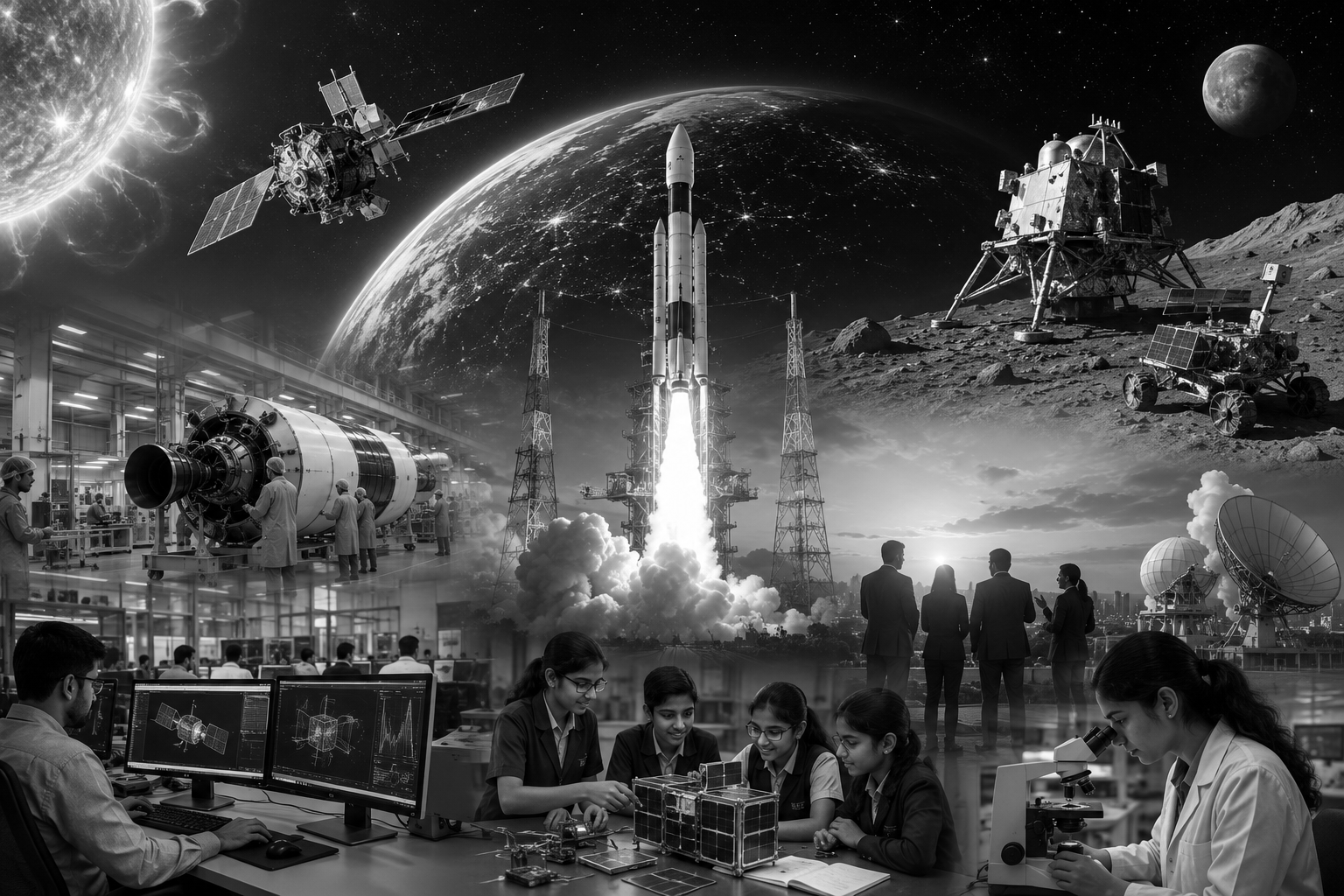
Rockets, Rupees and Research: The Making of India's USD 44-Billion Space Dream
For decades, India's story in space belonged almost entirely to one institution, the Indian Space Research Organisation. From the country's first satellite to the triumphs of Chandrayaan and Mangalyaan, ISRO was the sole author of every milestone. That chapter is now giving way to a more crowded one. India's space programme is undergoing its biggest transformation since ISRO's founding in 1969, evolving from a government-run enterprise into a public-private ecosystem where startups, industrial giants, universities and regulators all have a stake in the outcome.
The Numbers Behind the Shift
The scale of change is visible in the balance sheets. Union Minister Dr. Jitendra Singh recently told the Rajya Sabha that private investment in India's space sector has crossed USD 618.5 million as of March 2026 nearly six times the 2021-22 level. Regulatory approvals have kept pace: 105 authorisations have gone to non-government entities through IN-SPACe, with USD 187 million in fresh investment during 2026 alone.
These figures trace back to the 2020 reforms, which opened commercial space activity to private players and created IN-SPACe as an independent regulator. The Indian Space Policy of 2023 then drew clear lines: ISRO would push the frontiers of science, NewSpace India Limited (NSIL) would commercialise mature technologies, and IN-SPACe would authorise and oversee private players.
The ambition is sizable. India currently holds barely 2% of the global space economy, valued at nearly USD 630 billion. The government wants to grow the domestic sector from roughly USD 8-9 billion today to around USD 44 billion by 2033.
Opening the Door to Global Capital
A turning point came in February 2024, when India liberalised foreign investment rules for space: 100% automatic FDI for satellite components, 74% for satellite manufacturing and operations, and 49% for launch vehicles and spaceports. Alongside this, the government rolled out a ₹1,000-crore Venture Capital Fund, a ₹500-crore Technology Adoption Fund and the IN-SPACe Seed Fund Scheme, plus easier access to ISRO's testing facilities all aimed at lowering barriers for entrepreneurs.
From Supplier to Space Entrepreneur
The private sector's growth has been dramatic: from a single startup in 2014 to more than 400 today. Skyroot Aerospace has flown Vikram-1, India's first privately built orbital launch vehicle; Agnikul Cosmos is developing the 3D-printed Agnibaan rocket; Bellatrix Aerospace works on advanced propulsion; and Pixxel, GalaxEye, SatSure, Digantara and Dhruva Space are building expertise in hyperspectral imaging, Earth observation and space situational awareness. Established names like Larsen & Toubro, Hindustan Aeronautics and Tata Advanced Systems now manufacture launch vehicle stages and satellite electronics once made almost exclusively inside ISRO.
This shift is visible in flagship programmes too. The Earth Observation Public-Private Partnership, backed by nearly ₹1,200 crore in private capital, aims to build India's first privately owned Earth observation constellation, with the government acting as anchor customer rather than sole owner. Production of the PSLV is increasingly handled by an HAL-L&T-led consortium, the Small Satellite Launch Vehicle is being transferred to industry for commercial operation, and a new Satellite Bus as a Service model aims to standardise satellite platforms and cut supply-chain costs. Even as commerce expands, security stays non-negotiable: every private application is screened under IN-SPACe's Norms, Guidelines and Procedures, with dedicated Safety and Security Guidelines being prepared for strategic technologies and launch operations.
ISRO's Next Frontier
Freed from routine manufacturing, ISRO is climbing the value chain much as NASA has done, ceding commercial launches to industry while concentrating on deep-space science. Aditya-L1, parked 1.5 million kilometres away at the Sun-Earth L1 point, delivered the world's first spectroscopic observations of a coronal mass ejection's onset and analysed photospheric iron fluorescence across 47 X-class solar flares data that will feed India's own space-weather forecasting capability. Chandrayaan-3, meanwhile, has turned its south-pole landing into a stream of peer-reviewed discoveries: a layered, "cake-like" lunar regolith profile from the ChaSTE instrument, magnesium-rich minerals supporting the Lunar Magma Ocean hypothesis, and more than 250 seismic events recorded at the Shiv Shakti site. These technologies autonomous navigation, hazard avoidance, deep-space communication will carry directly into the Venus Orbiter Mission, Chandrayaan-4 and LuPEX.
Building Scientists Before Building Spacecraft
None of this is sustainable without people, and ISRO has quietly widened its engagement with students to build that pipeline. The flagship YUVIKA (Young Scientist Programme), for Class IX students, drew over a lakh applications for its 2026 edition, a fully sponsored residential course introducing schoolchildren to rocket technology, satellite systems and astronomy. For university students, the START programme offers intensive instruction in satellite technology, remote sensing and astrophysics, run with universities nationwide. ISRO has also expanded internships and collaborative research for undergraduate, postgraduate and doctoral students; though currently unpaid, these placements remain among the country's most sought-after opportunities for the direct exposure they offer to flagship missions.
The ecosystem extends beyond ISRO's own campuses. Through Space Technology Cells and Regional Academic Centres for Space, the agency partners with universities on research spanning propulsion, materials science, AI and navigation systems, with students building CubeSats, CanSats and space applications of their own. The Indian Institute of Space Science and Technology in Thiruvananthapuram remains the country's premier dedicated space institution, while IISc Bengaluru, the IITs and the IISERs have all strengthened programmes in aerospace engineering and planetary science feeding graduates into ISRO, NSIL and the expanding private sector alike.
Challenges That Could Shape the Future
For all this momentum, India's space sector faces real structural strain. The most immediate is talent retention: as startups offer higher salaries and entrepreneurial freedom, experienced ISRO scientists have moved to the private sector Skyroot Aerospace, Bellatrix Aerospace and Dhruva Space were all founded by former ISRO hands. That has strengthened private industry but raised concerns about preserving institutional knowledge just as ISRO pursues complex programmes like Gaganyaan and Chandrayaan-4.
Manufacturing self-reliance is another gap. Despite strong launch capabilities, India still imports critical components: radiation-hardened electronics, advanced semiconductor chips, specialised sensors and high-end optical systems. The regulatory framework must also mature alongside the industry: as private players move into launch vehicles, Earth observation and defence-adjacent applications, questions of insurance, intellectual property, export controls, liability and space-debris management need firmer legal footing, something the proposed Space Activities Bill is expected to address. Cybersecurity adds a further concern, given how much of the country's banking, navigation and disaster-management infrastructure now runs through satellites. And India must contend with intense global competition SpaceX, Blue Origin, Rocket Lab and Arianespace already dominate large segments of the commercial launch market, meaning India will need to keep cutting launch costs and investing in reusable technology while protecting its reputation for reliability.
A Nation Reaching for the Stars
India's space programme is no longer defined solely by spectacular launches or historic planetary firsts. It is becoming a genuine ecosystem of government agencies, private industry, universities, startups and young innovators all pulling in the same direction. The reforms of the past few years have unlocked unprecedented private investment, drawn global interest and pulled hundreds of startups into a field once reserved for the state, even as ISRO keeps pushing the boundaries of science through missions like Aditya-L1 and Chandrayaan-3.
The next chapter of this journey won't be measured only in the number of rockets launched or the value of investment attracted. It will depend on how well India balances commercial expansion with scientific excellence, private innovation with national security, and entrepreneurial energy with sustained public investment in research. Strike that balance, and India will emerge as more than a commercial space power, it will stand among the world's foremost centres of scientific discovery and space exploration.