
Rewriting Indian history - Giving South India its due
History, it is often said, is written by the victors. In India’s case, however, much of what we call “history” in classrooms reads more like a ledger of defeats than a celebration of continuity and creativity. As South Indian scholar Mohan Guruswamy argues, until it is rewritten, Indian history will “remain just what it is, a compendium of defeats.”
The problem is not absence of facts; archaeology and literature reveal plentiful evidence of human depth across India. Rather, the issue lies in perspective and emphasis. Romila Thapar and other mainstream historians, while methodical and respected, largely structured their narratives around Aryavarta, the Indo-Gangetic heartland defined in Brahmanical texts as the center of civilization. The Vindhyas became boundaries not of topography but of imagination: everything beyond was relegated as “marginal” or “regional.”
And so it happened that the vast southern half of the subcontinent, representing nearly 40% of India’s population, entered textbooks only as side notes. Andhra Pradesh’s Amaravati Stupa, as grand as Sanchi; Tamil Nadu’s Sangam age, contemporaneous with Greece’s Homer; Karnataka’s Vijayanagara, richer than Lisbon; Kerala’s Muziris, India’s first global port these are diminished to footnotes while centuries of Delhi’s defeats fill pages.
This imbalance is not innocence. As Guruswamy notes, history has long served the purposes of ruling elites, colonial administrators, then nationalist intellectuals, and later ideological schools. The result is what one might call the Great Loophole of Indian History: a North-centric telling that misrepresents the diverse origins of Indian civilization.
This article, restructured into four parts, seeks to restore balance by presenting Andhra Pradesh & Telangana, Tamil Nadu, Karnataka, and Kerala as civilizational equals to the north and to the ancient world while critically engaging both Thapar’s omissions and Guruswamy’s call for rewriting.
Part I: Andhra Pradesh and Telangana rivers of civilization
The story of Andhra Pradesh and Telangana begins far earlier than the Mauryas or Mughals. Prehistoric cave tools in Kurnool, Neolithic art in Bellampalli, and dolmens across Nalgonda testify to human presence deep into antiquity. The granite hills here nurtured mankind long before Vedic hymns echoed in the Ganga plains.
The Krishna and Godavari rivers served as lifelines for a vast civilizational thread. The famed Gudimallam lingam (3rd century BCE) is among the earliest iconic representations of Shiva anywhere in India. The Satavahanas (1st century BCE–3rd century CE), ruling from Amaravati and Pratishthana, issued India’s earliest silver and copper coins at Kotilingala and turned Andhra’s ports like Ghantasala into emporiums connecting Rome and Southeast Asia. Their inscriptions in Prakrit reflect an early stage of Telugu linguistic identity, showing a culture advancing hand in hand with the rest of India.
Most spectacularly, the Amaravati Stupa was one of the world’s largest Buddhist monuments. Its limestone panels are today scattered in London, Chennai, and New Delhi colonial dispersal reflecting not just plunder but also neglect of Telugu heritage. Nagarjunakonda, named after the philosopher Nagarjuna, was a bustling university city attracting monks from across Asia. If Nalanda is honored as India’s Buddhist beacon, Amaravati and Nagarjunakonda deserve equal billing.
Modern historiography downplays this. Romila Thapar, in works like Early India, credits Ashoka’s inscriptions in Andhra but spends few pages on Satavahana political culture or Amaravati’s global influence. This, as Guruswamy reminds us, is the core loophole: the civilizational prime of the Deccan is reduced to interludes between northern empires.
Yet, for Andhras and Telanganites, their land is not a derivative culture, it is one of humanity’s ancient centers, a civilizational equal to Harappa or the Nile.
Part II: Tamil Nadu - The World of Sangam and Cholas
If Andhra and Telangana flourished with Buddhist cosmopolitanism, Tamil Nadu nurtured the world’s oldest continuous secular literature: the Sangam corpus (circa 500 BCE–300 CE). These poems, compiled in Ettuthokai and Pattupattu, describe love, war, trade, and kingship with a sophistication rivaling Homer’s epics. That they are scarcely treated as “classical” texts in mainstream Indian history is telling of the northern bias Guruswamy criticizes.
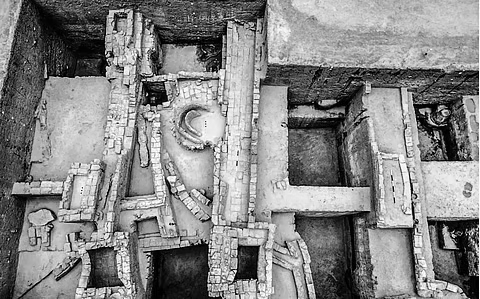
Archaeological revelations at Keezhadi, near Madurai, further challenge old assumptions: urban settlements flourishing in the Sangam era, complete with drainage and inscriptions, parallel the early Ganga plains. Yet, rarely have they been integrated into larger “national history.”
The Chola empire embodied Tamil genius. Rajendra Chola’s navy sailed across the Bay of Bengal to Southeast Asia, establishing colonies and cultural influence. Brihadeeswarar temple at Thanjavur, built in the 11th century, stands as one of the most spectacular stone monuments in the world. The Chola bronzes, with their graceful Nataraja forms, remain unmatched in sculpture.
Despite such civilizational scale, Romila Thapar and Percival Spear’s History of India assign Tamil Chola heritage only a handful of chapters, compared to dozens on Delhi Sultanate battles and Mughal emperors. Guruswamy rightly notes this as another loophole: the literature, art, and maritime power of Tamil Nadu gets diminished to “regional achievements” instead of integrated into India’s classical zenith.
For the record, the Sangam and Chola corpus represent as much “India’s classical antiquity” as the Guptas and far more successful than the repeated defeats of Delhi to Central Asian warlords.
Part III: Karnataka - Rocks, Royalty, and Resilience
Karnataka’s contribution to world civilization is carved in stone. From Neolithic petroglyphs at Kupgal to iron-age dolmens across Chitradurga, prehistory here is rich but underrepresented. The temples at Aihole, Pattadakal, and Badami UNESCO sites were laboratories where architects experimented with structural forms that later defined Indian temple-building.
The Hoysalas, with their soapstone temples at Belur and Halebidu, pioneered star-shaped plans and friezes so intricate that they rival Europe’s Gothic cathedrals. At Hampi, the Vijayanagara empire constructed one of the grandest cities on earth. By the 15th century, foreign travelers described Vijayanagara as larger and wealthier than Lisbon or Constantinople. Its bazaars were global, its temples monumental.
And yet, Guruswamy points out: while battles of Panipat receive entire chapters, the Battle of Talikota (1565) which shattered Vijayanagara is reduced to a passing mention. Visitors to Talikota will find none of the memorials that blanket Panipat. This illustrates how even modern tourism policy, driven by northern bias, sidelines Karnataka’s heritage.
In Romila Thapar’s canonical works, Delhi Sultanate rulers receive meticulous analysis; the Hoysala star temples are mentioned in passing. The Delhi-centric loophole of history writing strikes again.
Part IV: Kerala - Ports and Pluralism
Kerala, nourished by the Periyar and its coastline, pioneered an alternate form of civilization: maritime, pluralist, and globally networked. The ancient port of Muziris (Muchiri) thrived over 2,000 years ago as India’s Rome-facing harbor. Archaeological digs at Pattanam reveal Roman amphorae, West-Asian coins, and Mediterranean glass, underscoring Kerala’s place in world trade centuries before Vasco da Gama “rediscovered” India.
Jewish and Christian communities settled in Kerala as early as the 1st century CE, long before they made inroads into North India. By the 7th century, Arab traders brought Islam making Kerala’s Malabar home to one of the oldest Muslim communities in the world. Kerala’s matrilineal traditions and vibrant mural art form part of a distinctive socio-cultural evolution.
Yet, Guruswamy laments, textbooks gloss over Muziris while celebrating Mughal Agra. The spice routes of Kerala shaped global history: they motivated Roman merchants, sustained Arab navigators, and eventually triggered the European age of exploration. That Kerala’s story is marginal in national history exposes another loophole: ignoring coastal and maritime legacies of the South.
Weighing the critique - Thapar and Guruswamy
Romila Thapar deserves her reputation: she secularized Indian historiography, avoided myth as history, and gave space to social change beyond dynasties. Yet, her structuring of ancient India remains Ganga-centric. Works like Early India
start with Harappa, pivot to Aryan/Vedic society, analyze Mauryas and Guptas, and end with Delhi-centered medieval kingdoms. Andhra, Tamilakam, Karnataka, and Kerala appear only when northern empires interacted with them.
Mohan Guruswamy strikes harder. He shows that history as taught is essentially “the tale of defeats in North India”: Huns, Turks, Afghans, Mongols overwhelming Delhi again and again. By contrast, the South nurtured civilizations that were not defined by foreign conquest but by longevity and continuity. Cholas expanding overseas, Vijayanagara dazzling foreigners, Sangam poets building literary tradition; these have no equivalent in the perpetual invasions of the north. And yet, only three chapters out of 24 in Thapar and Spear’s History of India focus on the South.
For Guruswamy, this is not simply academic imbalance; it shapes economics and tourism too. Delhi-Agra-Jaipur circuits receive global promotion, while Warangal, Belur, Hampi, Amaravati, and Kanchipuram lack even basic tourist infrastructure. Battles like Talikota and Saraighat (in Assam) go unmarked; instead Panipat is memorialized endlessly. The danger is not just distortion but erasure of regional pride, and hence of India’s full civilizational identity.
Towards a rewritten civilizational map
Both Thapar’s omissions and Guruswamy’s call for rewriting converge on one conclusion: Indian history remains incomplete.
What needs redress?
• Amaravati and Nagarjunakonda must be discussed alongside Nalanda.
• Sangam literature and Keezhadi must be acknowledged as part of India’s classical antiquity.
• Hoysalas and Vijayanagara must feature centrally in medieval history, not as “appendices to Delhi.”
• Muziris and Malabar must be placed in global maritime discourse on par with Alexandria.
• Battles like Talikota and Saraighat must be remembered as pivotal, not peripheral.
Only then will the South and East emerge not as provinces but as equal pillars of Indian antiquity.
From compendium of defeats to civilizational symphony
Mohan Guruswamy says: “So, by all means rewrite our history. That task is long overdue. Till then Indian history will remain just what it is, a compendium of defeats.” Romila Thapar brought rigor but left loopholes. Guruswamy exposed the imbalance but left a challenge: who will rewrite?
If history is the mirror of a people, then India’s mirror is cracked. It reflects invasions over creativity, defeats over resilience, Delhi over the Deccan. To mend it, we must expand the canvas: let the Krishna-Godavari, Kaveri, Tungabhadra, and Periyar rivers stand equal to the Ganga and Indus. Let Amaravati and Hampi shine beside Harappa and Pataliputra. Let Sangam and Chola bronze share the stage with Gupta Sanskrit and Mughal marble.
For Andhra Pradesh, Telangana, Tamil Nadu, Karnataka, and Kerala to be recognized as ancient and globally significant is not regional pride it is historical justice. Once rewritten, Indian history will no longer be a tale of defeats. It will be a symphony of civilizations, north and south, inland and maritime, diverse but united. And that, finally, will be India’s true story.