
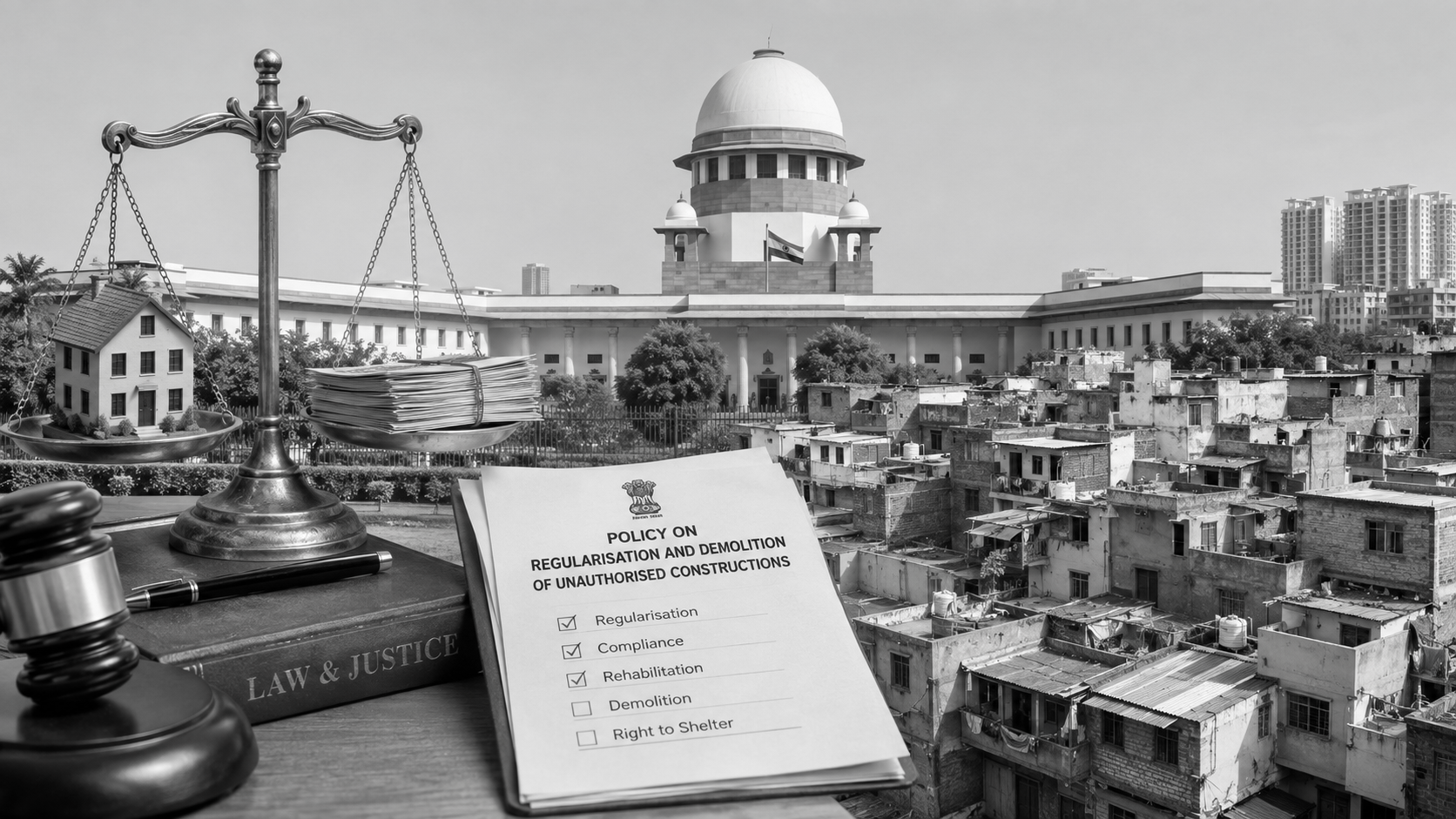
Regularise or Demolish? SC Leaves States to Decide Fate of Long-Standing Illegal Structures
The Supreme Court’s August 12, 2026 order has stopped short of creating a formula for dealing with unauthorised colonies. Instead, it has asked states and Union territories to consider concerns raised in the plea seeking policies that balance enforcement with rights.
State approaches differ significantly. Some governments, including Andhra Pradesh, Telangana and Delhi, have introduced settlement or regularisation schemes for eligible unauthorised colonies or structures. Schemes can involve eligibility conditions, planning requirements and charges. Elsewhere, authorities may take a stricter approach where construction violates land-use rules or cannot legally be regularised.
The Supreme Court has stressed that mere passage of time does not legalize an unauthorised structure. Long occupation, payment of municipal taxes or access to civic services cannot, by themselves, create a legal right to retain illegal construction. At the same time, demolition cannot become an automatic response, especially where vulnerable families could lose homes.
Its earlier safeguards require due process before demolition, including proper notice and an opportunity to respond. The Court’s 2024 directions generally require at least 15 days’ notice, consideration of whether violations are compoundable or can be partly removed, and a further opportunity to challenge a final demolition order. Detailed inspection and documentation are required.
For residents of old colonies, the latest order could encourage states to create clearer, more predictable policies on regularisation, demolition and rehabilitation. Governments may examine whether old settlements can meet planning standards, whether vulnerable families need alternative accommodation, and whether enforcement should distinguish residential hardship from commercial or profit-driven violations.
However, residents should not interpret the order as an automatic amnesty. The Court declined to impose a uniform national framework because local conditions and state policy powers differ. The impact will depend on governments and municipalities.
The broader message is balance: authorities retain the power to enforce planning laws, but should do so through transparent rules, procedural safeguards and proportionate action. For long-standing residents, the order offers a possible route toward greater policy clarity and humane rehabilitation, not guaranteed legalisation.