
Rediscovering the forgotten frontiers - A History of North-East India
For centuries, the writing of Indian history has been dominated by narratives that orbit around foreign invasions or the dynastic politics of the Gangetic plains. The Deccan, the deep South, and especially the North-East India’s emerald frontier have often been treated as footnotes to a larger political story. This neglect has created an incomplete picture of India’s civilizational journey. It is time to change that attitude. The North-East, with its rich ancestry, archaeological depth, and cultural luminosity, deserves recognition as one of the oldest and most dynamic contributors to the subcontinent’s history. This article attempts to illuminate that forgotten legacy linking myth, archaeology, and historical evolution to tell the story of India’s most diverse region.
Ancestral roots - The cradle of Eastern civilizations
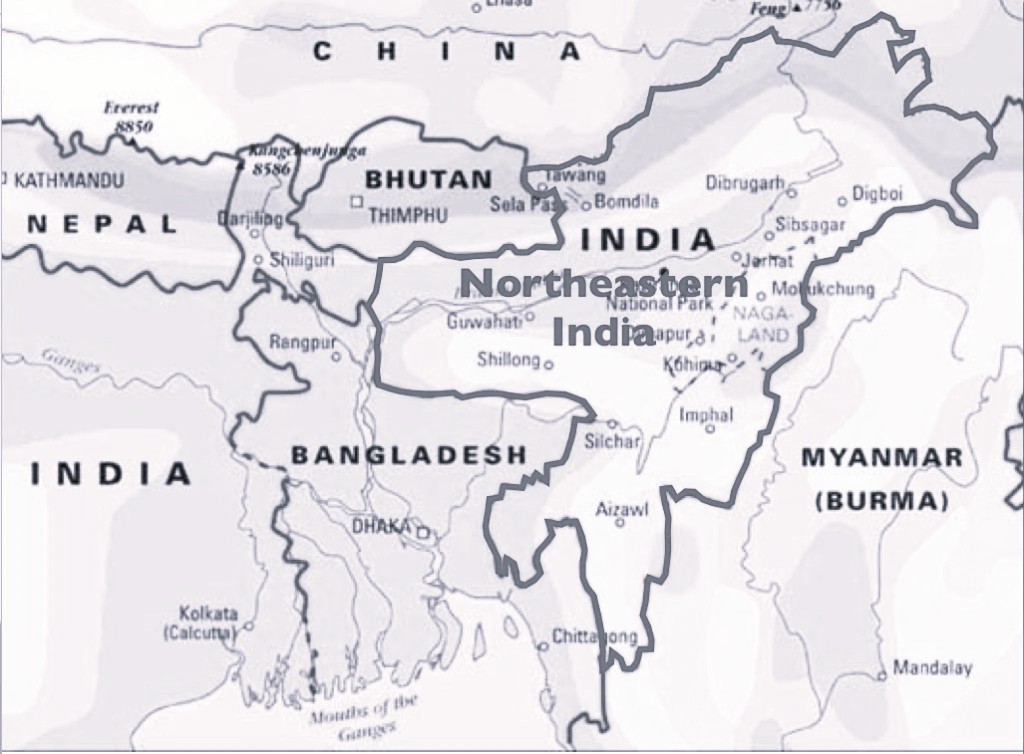
The North-East comprising Assam, Arunachal Pradesh, Manipur, Meghalaya, Mizoram, Nagaland, Tripura, and Sikkim has for millennia served as a gateway between India and East Asia. This region is where the Indo-Aryan, Austroasiatic, Tibeto-Burman, and Tai civilizations met, intermingled, and evolved. Genetic studies indicate that the Brahmaputra and Barak valleys were ancient corridors of migration, linking the Ganges basin with Southeast Asia and China.
Prehistoric remains found in the region such as Neolithic tools from Daojali Hading (Assam), the megalithic structures of Khasi Hills (Meghalaya), and Neolithic settlements in Arunachal Pradesh and Manipur suggest that organized agrarian communities thrived here by 2000 BCE, contemporaneous with early Harappan settlements.
The pottery fragments, polished stone axes, and terracotta beads discovered in these areas reveal a vibrant civilization that understood agriculture, metallurgy, and trade long before written history emerged. These findings challenge the assumption that the Gangetic plains alone were the centers of ancient progress.
Echoes in the epics: The North-East in ancient Indian literature
Contrary to popular belief, the North-East was not isolated from the broader Indian civilization. The region finds glowing references in the Mahabharata, Ramayana, and the Puranas. Pragjyotisha modern-day Assam is mentioned as the kingdom of Bhagadatta, a valiant ally of the Kauravas in the Kurukshetra war. His father, Narakasura, is remembered for his valor and for establishing the Pragjyotishpur Kingdom, whose capital was in present-day Guwahati. The legend of Narakasura and his defeat by Lord Krishna, celebrated as Naraka Chaturdashi during Deepavali, links Assamese history directly to the pan-Indian mythic tradition.
The Kalika Purana describes the land of Kamarupa (Assam) as sacred to Goddess Kamakhya, whose temple remains one of the most revered Shakti Peethas. The Mahabharata’s Kirata Kingdom ruled by the indigenous Kiratas is located in what is today Arunachal Pradesh and Nagaland. These references show that the North-East was not on the periphery but very much a part of India’s civilizational imagination.
Archaeological windows into antiquity
Modern archaeology has increasingly confirmed the antiquity of civilization in the North-East. Excavations at Ambari near Guwahati unearthed terracotta plaques, beads, and coins dating from the early centuries BCE, suggesting urban life in the early Common Era. Mahasthangarh (in present-day Bangladesh, part of ancient Kamarupa influence) and Sri Surya Pahar have revealed Buddhist stupas, votive tablets, and monastic ruins, establishing the spread of Buddhism here from as early as the 4th century BCE.
The Itanagar Fort in Arunachal Pradesh, with its massive stone ramparts and intricate drainage system, points to organized polity and military engineering between the 10th and 14th centuries. The Dambuk and Pasighat sites indicate continuous habitation since Neolithic times. In Manipur’s Kangla Fort and Luwang sites, pottery and ritual artifacts reveal the existence of a distinct Meitei culture that predates written records.
Meghalaya’s monoliths, erected by the Khasi and Jaintia tribes, stand as silent markers of a complex socio-religious order that revered nature and ancestors. Archaeological trails along the Brahmaputra also reveal Indo-Roman trade links, attesting that the region was not cut off but connected to trans-Asian networks through riverine and overland routes.
The glorious kingdoms of the North-East
From the early historical period, the region witnessed the rise of powerful indigenous kingdoms. The Varman dynasty of Kamarupa (4th–8th centuries CE) unified much of Assam and defended it from foreign incursions. King Bhaskaravarman was a contemporary of Harshavardhana and maintained diplomatic ties with the Gupta Empire and China. Chinese traveler Xuanzang visited his court and described Kamarupa as a flourishing land of scholars, artisans, and temples.
Following the Varmans, the Pala and Koch dynasties ruled large parts of Assam, while in Manipur, the Meitei Kingdom consolidated power and culture. The Ahom dynasty, established by Sukaphaa in 1228 CE, marked the region’s most enduring political power. Migrating from the Tai-Shan world of Southeast Asia, the Ahoms assimilated local tribes and built a powerful state that lasted six centuries—resisting Mughal invasions and maintaining independence until the advent of the British.
The Ahoms perfected wet-rice cultivation, introduced efficient land revenue systems, and developed sophisticated metallurgy and architecture. The Rang Ghar, Talatal Ghar, and Kareng Ghar stand as testaments to their grandeur. Their chronicles, the Buranjis, written in the Ahom language, are among the earliest systematic records of regional history in India.
Cultural and spiritual tapestry
North-East India’s cultural contribution extends far beyond politics. Its classical dance forms Manipuri and Sattriya have enriched India’s artistic heritage. The Bhakti movement found profound expression here through saints like Srimanta Sankardev, who in the 15th century unified Assamese society through Vaishnavism, creating a humanistic synthesis of devotion, art, and social reform.
Tribal traditions across Nagaland, Mizoram, and Meghalaya upheld egalitarian governance through village councils and community resource sharing—systems that modern democratic structures could learn from. Their oral epics, folk dances, and weaving traditions echo ancient philosophies of coexistence with nature. The bamboo and cane artistry of the region remains unparalleled.
Role in India’s freedom and modern history
During the colonial era, the British annexed the North-East in phases but failed to completely subdue its spirit. The region was a key theatre of the World War II Imphal-Kohima battle, where Indian soldiers fought valiantly against Japanese forces. The Indian National Army (INA), led by Subhas Chandra Bose, made its historic advance through these hills.
Freedom leaders like Rani Gaidinliu of Nagaland and Tirot Sing of Meghalaya led local resistance against British rule. After independence, despite challenges of insurgency and integration, the region’s people have contributed immensely to India’s defense, education, culture, and sports. From literary figures like Indira Goswami to Olympians like Mary Kom, the North-East continues to define India’s modern identity.
Archaeology meets identity: Preserving a living past
Recent archaeological initiatives such as the excavations at Bhaitbari (Meghalaya), Wokha (Nagaland), and Bongaigaon (Assam) are unveiling the region’s continuous habitation since prehistoric times. These findings reinforce the fact that the North-East was not an isolated backwater but a thriving cradle of civilization interacting with the rest of India and Southeast Asia.
However, the need of the hour is greater academic attention. History textbooks must move beyond Delhi-centric narratives to include the contributions of the Ahoms, the Meiteis, the Khasis, and the Arunachali tribes. The inclusion of archaeological data, linguistic studies, and oral traditions can help restore the North-East’s rightful place in India’s historiography.
Conclusion: From the margins to the heart of India’s story
The history of North-East India is not a separate chapter, it is a vital strand in the fabric of Indian civilization. From ancient mythological references to archaeological confirmations, from mighty kingdoms to spiritual reformers, the region has always illuminated India’s frontier with resilience, innovation, and inclusivity.
Reclaiming this legacy is more than an academic exercise; it is a moral imperative. To understand India’s soul, one must look beyond its plains and palaces, into the misty hills and valleys where legends still live. The North-East, once treated as a frontier, must now be recognized as the cradle of ideas, traditions, and courage that helped shape the Indian subcontinent.