
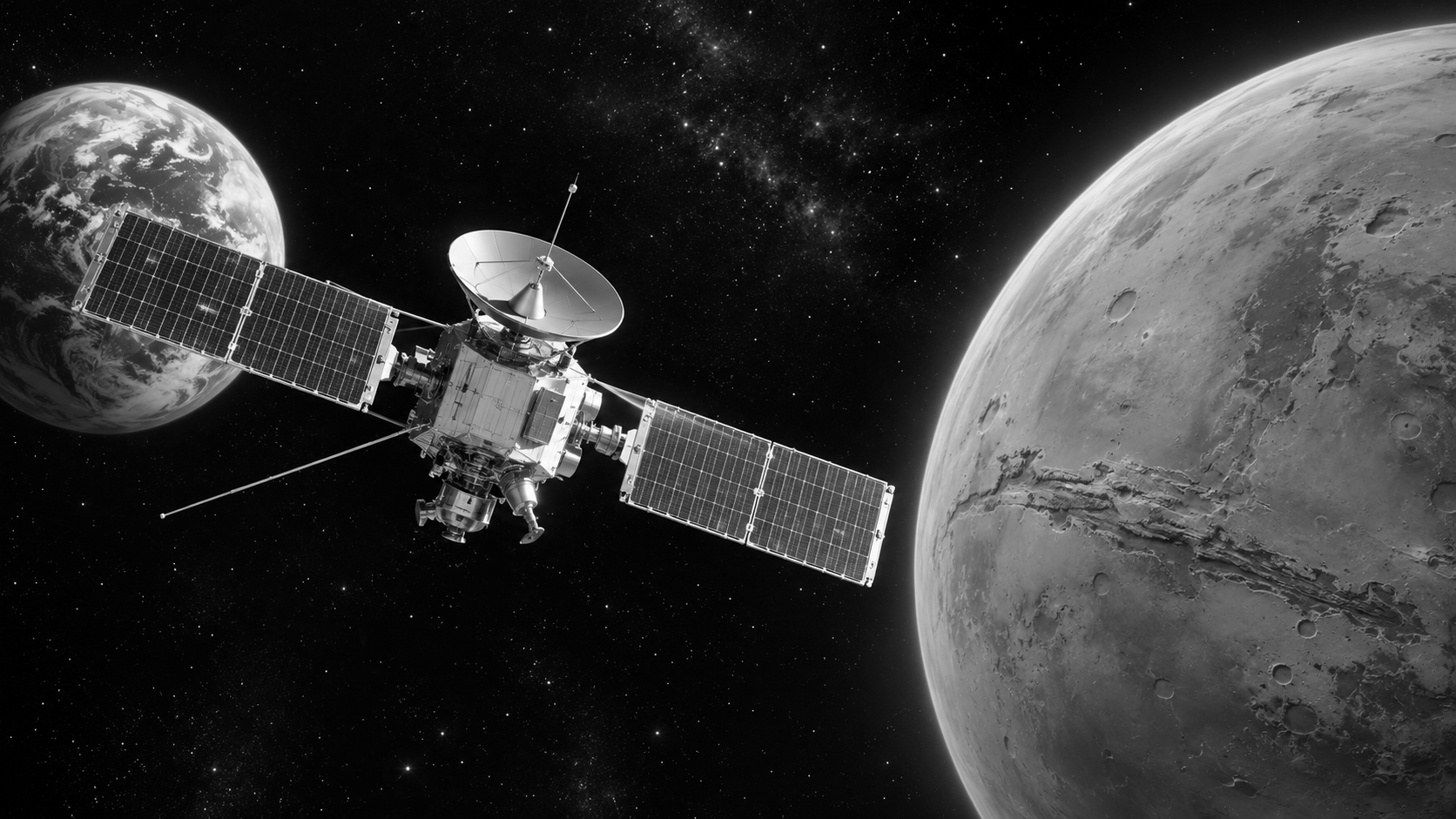
Red Planet Day: Celebrating The Mission That First Brought Mars Closer To Earth
Today marks Red Planet Day, an annual observance commemorating one of the most significant milestones in the history of space exploration – the launch of NASA's Mariner 4 spacecraft on November 28, 1964. The mission opened a new chapter in humanity's efforts to understand Mars, becoming the first successful spacecraft mission to fly past the planet and transmit close-up photographs of its surface to Earth.
Observed today, Red Planet Day celebrates scientific achievements and highlights humanity's continuing interest in exploring Mars, commonly known as the Red Planet because of its distinctive reddish appearance. The colour comes primarily from iron oxide, commonly known as rust, present in the planet's surface materials. Although it is an unofficial observance, the day provides an opportunity to reflect on the progress of planetary science and the technological achievements that have made distant worlds accessible to human observation.
Mariner 4 was launched from Cape Canaveral, Florida, on November 28, 1964, aboard an Atlas-Agena D rocket. Developed and managed by NASA's Jet Propulsion Laboratory (JPL), the spacecraft was designed to study Mars during a close flyby, examine its atmosphere and surface, and collect information about the conditions of interplanetary space. Weighing approximately 260.8 kilograms, the spacecraft was powered by solar panels and carried a television imaging system alongside several scientific instruments.
The mission followed an unsuccessful attempt by its predecessor, Mariner 3, which was launched on November 5, 1964. A technical failure prevented the protective shroud covering the spacecraft from separating properly. As a result, its solar panels could not deploy, leaving the spacecraft unable to generate sufficient power to carry out its mission. It continued into solar orbit without reaching Mars.
Learning from the failure, engineers redesigned the protective shroud for Mariner 4, replacing the earlier arrangement with an improved all-metal structure. The modifications allowed the spacecraft to separate successfully from its launch vehicle and begin its journey towards Mars. Mariner 4 was launched successfully just three weeks after the earlier mission, demonstrating how engineering improvements and lessons from setbacks played an important role in early space exploration.
The spacecraft travelled for approximately 228 days before reaching Mars. During its journey, it collected information about the interplanetary environment and transmitted scientific measurements to Earth. On July 14, 1965, Mariner 4 made its historic closest approach to Mars, passing approximately 9,846 kilometres (6,118 miles) above the planet's surface. The encounter marked the first successful close-up exploration of Mars by a spacecraft.
One of the mission's most important achievements was capturing the first close-range photographs of another planet from space. Its onboard television camera recorded 22 images, including 21 complete photographs and a partial final image. The pictures covered only a small portion of the Martian surface, but they provided scientists with an unprecedented view of a world that had previously been studied mainly through telescopes.
The images revealed a heavily cratered, barren landscape resembling the surface of the Moon. The discovery challenged earlier expectations that Mars might have a more Earth-like environment and could support conditions suitable for life. The photographs also weakened popular ideas about the planet having extensive Earth-like landscapes and possible signs of advanced life. However, the limited coverage meant that scientists still had much to learn about Mars's geology, climate and environmental history.
An interesting chapter in the mission's history was the way scientists and engineers first viewed the photographs. At NASA's Jet Propulsion Laboratory, the spacecraft's digital image data was converted into numbers and printed on strips of paper. Eager to see the results, team members did not wait for the computer to produce the processed images. Instead, they arranged the printed strips side by side and used coloured pastels to recreate the different shades of the Martian surface, much like completing a paint-by-numbers picture. This hand-coloured reconstruction became one of the memorable moments associated with the mission and demonstrated the excitement surrounding the first images of Mars.
Beyond photography, Mariner 4 carried several scientific instruments to investigate the planet and its surrounding environment. These included a cosmic dust detector, cosmic-ray telescope, ionization chamber, helium magnetometer, trapped radiation detector and solar plasma probe. The spacecraft also conducted a radio occultation experiment as it passed behind Mars from Earth's perspective. By studying changes in the radio signals passing through the Martian atmosphere, scientists could estimate atmospheric conditions and understand more about its density and structure.
The findings indicated that Mars had an extremely thin atmosphere and much lower surface pressure than Earth. This was an important discovery for future missions because it showed that spacecraft attempting to land on the planet would face different atmospheric conditions from those on Earth. The observations also provided valuable information about temperatures and radiation around Mars, helping researchers understand the challenges involved in sending future landers and other scientific equipment to its surface.
Although Mariner 4 was originally designed primarily for its Mars flyby, it continued operating after completing the encounter. The spacecraft travelled beyond Mars into solar orbit and carried out additional observations of the solar wind and interplanetary environment. It also made coordinated measurements with the later Mariner 5 spacecraft. Its operations continued until December 1967, far exceeding the expectations for its original mission.
The success of Mariner 4 laid the foundation for subsequent missions to Mars. NASA's later Mariner missions provided additional information about the planet, while the Viking missions of the 1970s took exploration further by placing landers on the Martian surface and conducting experiments on its soil. Over the following decades, orbiters, landers and robotic rovers expanded scientific understanding of the planet's atmosphere, geology, weather patterns and evidence of ancient water.
Mars continues to attract scientific attention because of questions surrounding its past environment and the possibility that microbial life may once have existed there. Modern robotic missions, including NASA's Curiosity and Perseverance rovers, have been investigating rocks, soil and geological formations to understand whether the planet once had conditions suitable for life. These missions also collect information that could support future human exploration.
The Red Planet itself remains an important subject of astronomical research. It is the fourth planet from the Sun and has two small natural satellites, Phobos and Deimos. A day on Mars is slightly longer than an Earth day, lasting approximately 24 hours and 37 minutes, while a Martian year is equivalent to about 687 Earth days. The planet is also home to Olympus Mons, the largest known volcano in the solar system, highlighting its remarkable geological features.
Red Planet Day is therefore more than a commemoration of a spacecraft launch. It recognises the curiosity, scientific ambition and engineering efforts that transformed Mars from a distant point of light in the night sky into a world that could be photographed and studied directly. The achievement of Mariner 4 demonstrated the possibilities of robotic exploration and encouraged further efforts to investigate the solar system.
Nearly six decades after the mission ended, its contribution remains an important milestone in planetary science. The photographs and scientific measurements returned by Mariner 4 changed the way researchers viewed Mars and helped shape the direction of future exploration. As scientists continue searching for clues about the planet's ancient environment and potential habitability, the mission remains a reminder of how a single successful journey can expand humanity's understanding of the universe.