
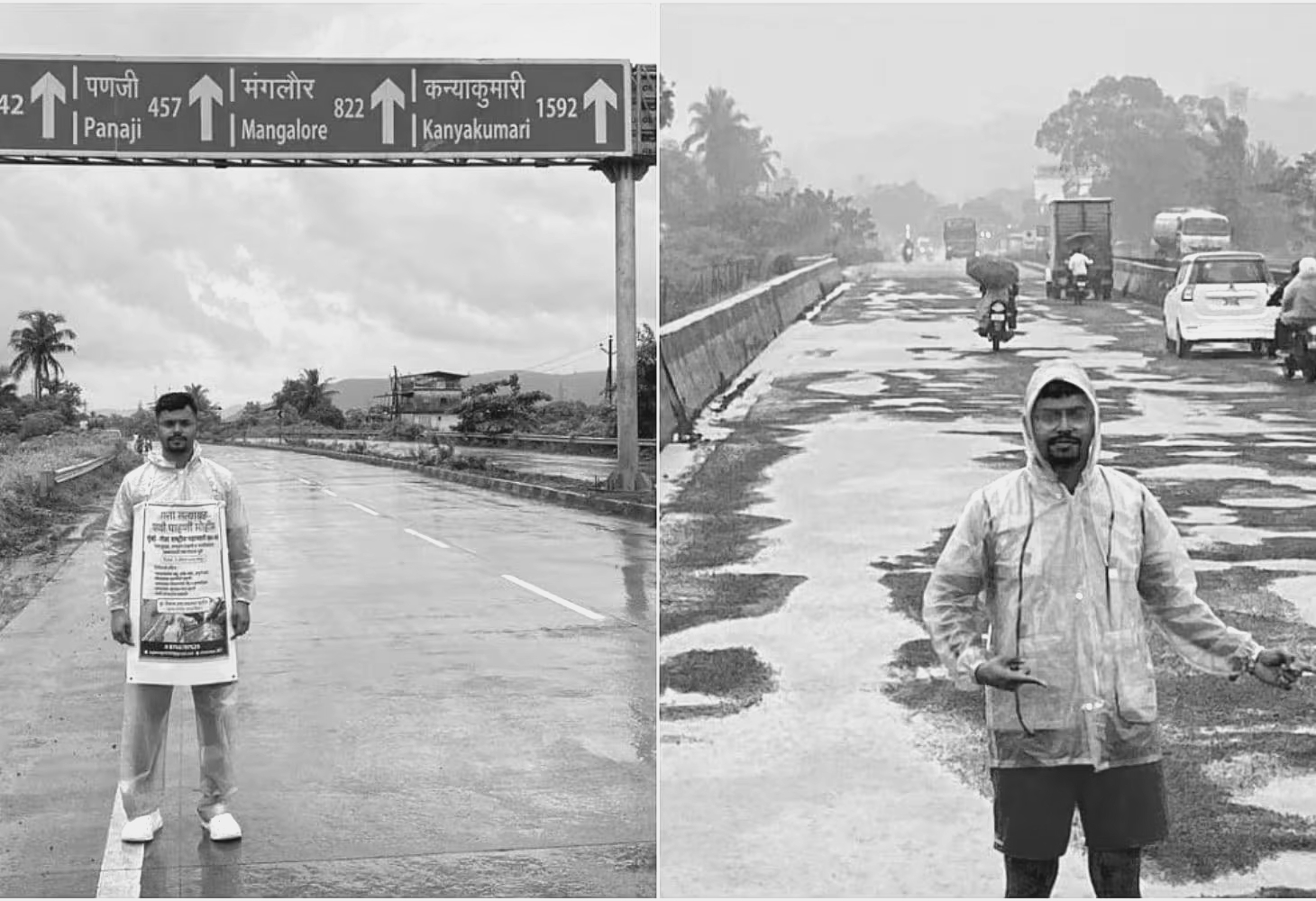
‘Rasta Satyagraha’: Young activist walks Mumbai-Goa highway to map hidden dangers
Armed with a camera, GPS device and a determination to make India’s highways safer, a young activist has walked the entire length of the Mumbai-Goa national highway to document threats that he says continue to endanger thousands of commuters every day.
Between August 9 and October 20 , Chaitanya Usha Lakshman Patil , a 28-year-old engineering graduate from Raigad district, covered nearly 490 km of NH-66 , systematically recording 59 hazardous locations along the crucial coastal artery. His findings include deep potholes, missing or damaged signboards, unfinished bridges, broken dividers, exposed steel rods and debris capable of puncturing tyres, all captured with photographs and precise GPS coordinates.
Patil named his initiative “Rasta Satyagraha” , describing it as a form of peaceful protest rooted in documentation rather than slogans. The idea, he said, was to remove any scope for denial by presenting authorities with verifiable, location-specific evidence of road defects. Each hazard was logged in a structured digital format, complete with QR codes that link visual proof to exact coordinates.
“This road has been under construction for years, but people are forced to travel on unsafe stretches daily. Complaints often get lost in files. I wanted to present facts that cannot be ignored,” Patil said.
The Mumbai-Goa highway campaign is not Patil’s first effort. Since 2019 , he has been tracking safety issues on parts of the same corridor, particularly the Palaspe-Mangaon stretch. In earlier instances, Patil had shared GPS-tagged photographs of potholes and damaged sections with local authorities and highway officials. According to him, some of those complaints resulted in temporary repairs within days, reinforcing his belief that precise data can trigger faster action.
The latest walk, however, is his most extensive effort so far, both in distance and detail. Covering the highway on foot over multiple weeks allowed him to closely inspect stretches that are often overlooked during vehicle-based inspections, especially in rural and forested sections.
Patil’s campaign comes against the backdrop of long-standing delays in the widening of the Mumbai-Goa highway, a project initiated more than a decade ago. Despite repeated assurances and revised deadlines, several portions remain incomplete, with unfinished bridges, uneven surfaces and temporary diversions posing risks, particularly during the monsoon.
While authorities have set March 2026 as the latest target for completion, frequent rains continue to damage newly laid surfaces, undoing repair work and worsening existing defects. Road users and local residents have repeatedly raised concerns about accidents, vehicle damage and travel delays linked to poor road conditions.
Patil submitted his comprehensive report to Union Road Transport and Highways Minister Nitin Gadkari through Shiv Sena (UBT) MP Arvind Sawant , urging immediate attention to the most dangerous points while the larger project remains underway.
Beyond highlighting problems, Patil has also pointed to solutions adopted elsewhere. He has cited models such as Andhra Pradesh’s rapid-response road repair units, often referred to as “pothole busters”, which carry equipment and materials to fix damaged stretches quickly, especially during the monsoon.
“Until the highway is fully completed, there needs to be a system for fast, on-the-spot repairs. Lives are being lost because temporary dangers become permanent,” he said.
Road safety activists say Patil’s work underscores the role citizens can play in holding agencies accountable, especially on large infrastructure projects that span years. By combining traditional protest with modern technology, his “Rasta Satyagraha” has drawn attention to how unfinished infrastructure can quietly turn into daily hazards.
As authorities reiterate their commitment to completing the highway, commuters and residents along the Mumbai-Goa corridor will be watching closely to see whether the 59 danger points flagged by Patil translate into swift remedial action and whether his data-driven activism sets a precedent for safer roads elsewhere.