
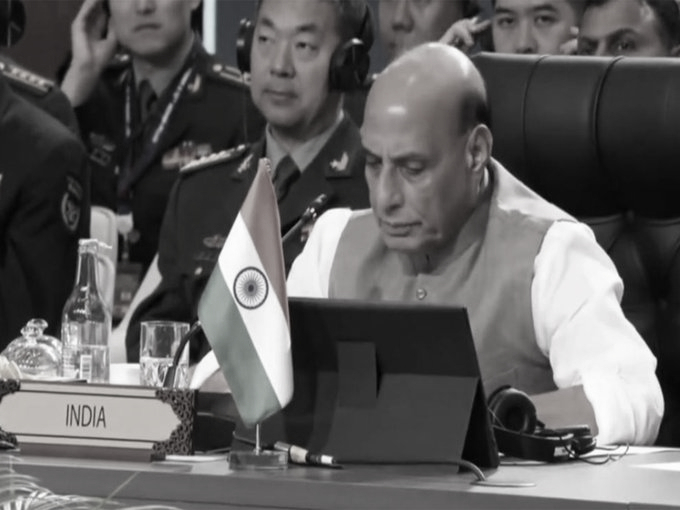
Rajnath Singh champions inclusive Indo-Pacific vision at ASEAN Summit
India, represented by Defence Minister Rajnath Singh, participated in the 12th ASEAN Defence Ministers’ Meeting-Plus (ADMM-Plus) in Kuala Lumpur, Malaysia, on the second day of his three-day visit to the country. Calling for collective responsibility in maintaining peace, Singh asserted that the Indo-Pacific must remain open, inclusive, and free from any form of coercion, amid rising concerns over China’s assertiveness in the region.
The ADMM-Plus is the highest defence consultative and cooperative mechanism in ASEAN, bringing together the ten ASEAN nations and eight dialogue partners - India, China, Japan, Australia, New Zealand, South Korea, Russia, and the United States. Singh reaffirmed that ASEAN-led mechanisms are vital for maintaining regional stability and a rules-based international order.
Rajnath hails ASEAN-led forum as cornerstone of Indo-Pacific peace
In his address, Singh described the ADMM-Plus as a cornerstone of peace and stability in the Indo-Pacific, reiterating India’s support for an ASEAN-centric regional architecture. He underlined that India stands for a free, open, and inclusive Indo-Pacific and emphasized adherence to international law and the UN Convention on the Law of the Sea (UNCLOS) as essential to maintaining freedom of navigation and overflight.
New India-ASEAN Initiatives Unveiled
Highlighting India’s commitment to deepening regional cooperation, Rajnath Singh announced two forward-looking initiatives under the ASEAN-India Comprehensive Strategic Partnership and the ASEAN-India Plan of Action (2026–2030):
• ASEAN–India Initiative on Women in UN Peacekeeping Operations, aimed at promoting gender equality and capacity-building.
• ASEAN–India Defence Think-Tank Interaction, designed to enhance collaboration between defence research institutions and policy experts across the region.
He also unveiled India’s MAHASAGAR Vision - standing for Maritime Cooperation, Harmony, Security, and Growth for All in the Region, which seeks to strengthen maritime domain awareness, humanitarian assistance and disaster relief (HADR), and technological cooperation.
ASEAN ministers praise India’s leadership role
During the India–ASEAN Defence Ministers’ Informal Meeting, several ASEAN defence ministers hailed India’s growing strategic influence.
• The Malaysian Defence Minister, as ADMM chair, described India as a responsible superpower whose defence innovation and self-reliance can benefit ASEAN’s security ecosystem.
• The Philippines’ Defence Minister lauded India’s commitment to international law and multilateralism, praising its example under UNCLOS and welcoming India’s role as a first responder in the region.
• The Cambodian Defence Minister expressed gratitude for India’s contributions in UN Peacekeeping, humanitarian assistance, and military medicine.
• The Singaporean Defence Minister proposed greater joint activities, policy dialogues, and youth-level exchanges, emphasizing trust-building among future generations.
• The Thai Defence Minister supported India’s defence technology ecosystem and called for regional self-reliance in production.
All ASEAN ministers collectively welcomed India’s initiatives, reaffirming their support for advancing the ASEAN–India Strategic Partnership.
Series of bilateral meetings on sidelines
On the sidelines of the ADMM-Plus, Rajnath Singh met his counterparts from Singapore, New Zealand, South Korea, and Vietnam, where discussions focused on expanding bilateral defence cooperation, technology partnerships, and maritime security coordination. His meeting with Singapore’s Defence Minister Chan Chun Sing particularly emphasized future collaboration in cyber defence and joint exercises.
Strengthening India’s Act East Policy
Singh reiterated that the ADMM-Plus is an integral part of India’s Act East Policy, which prioritizes ASEAN at the heart of India’s strategic outreach. He underlined that India’s partnership with ASEAN goes beyond trade, it encompasses shared values of freedom, openness, and respect for sovereignty.
He called for enhanced defence industry collaboration, inviting ASEAN nations to co-develop and co-produce defence technologies with India under the Aatmanirbhar Bharat initiative, promoting a regional ecosystem of innovation and self-reliance.
During the visit, Singh also highlighted the recently signed India–US 10-year Defence Framework Agreement, describing it as a fruitful step toward long-term regional stability. The pact aims to deepen cooperation in defence technology, innovation, and information-sharing, reflecting India’s broader push for global partnerships built on trust and mutual benefit.
Proposals at the core of India’s vision
Rajnath Singh’s key proposals at the summit reflected India’s long-term strategic vision:
• Keeping the Indo-Pacific free, open, and rules-based.
• Strengthening the ASEAN-led security architecture.
• Launching women’s peacekeeping and defence think-tank initiatives.
• Promoting maritime security under the MAHASAGAR Vision.
• Enhancing defence manufacturing collaboration for regional self-reliance.
• Deepening youth, military, and policy-level exchanges between India and ASEAN.
As the ASEAN Defence Ministers’ Meeting-Plus marked 15 years of success, Malaysia’s Defence Minister called it “proof that dialogue works, trust can be built, and unity remains ASEAN’s greatest defence.” Rajnath Singh’s engagements and proposals reaffirmed India’s position as a trusted partner and responsible stakeholder in shaping a secure and inclusive Indo-Pacific region.