
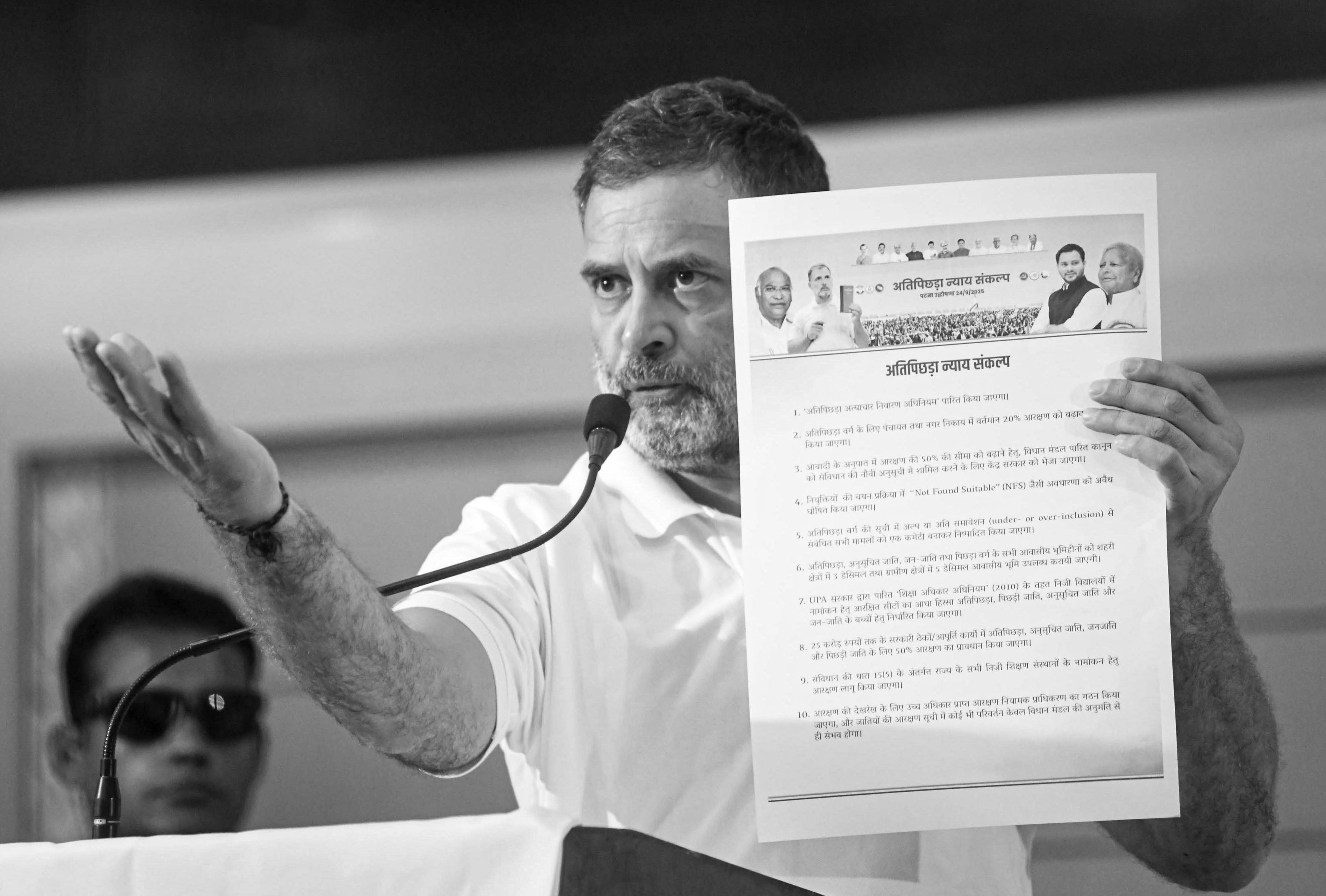
Rahul Gandhi pledges rights for backward and marginalised groups
Congress leader Rahul Gandhi on Thursday launched the Ati Pichhda Nyay Sankalp, a manifesto aimed at ensuring social justice, equality, and empowerment for Bihar’s Extremely Backward Classes (EBCs), Dalits, tribals, minorities, and other marginalized communities (The Ati Pichhda Nyay Sankalp - translated as "Pledge for Justice to Extremely Backward Classes"). The announcement, made alongside Congress president Mallikarjun Kharge, RJD leader Tejashwi Yadav, and other Mahagathbandhan allies, comes ahead of the Bihar Assembly elections scheduled for October–November 2025.
The Mahagathbandhan in Bihar is a grand alliance primarily comprising the Rashtriya Janata Dal (RJD), led by Tejashwi Yadav, and the Indian National Congress, represented nationally by Rahul Gandhi and party president Mallikarjun Kharge. It also includes the Left parties, such as the Communist Party of India (CPI), the Communist Party of India (Marxist) [CPI(M)], and other smaller regional Left outfits. The initiative underscores the Mahagathbandhan’s focus on targeted welfare, education, and representation, while positioning itself as the champion of marginalized communities in contrast to the ruling NDA.
Ten-point Ati Pichhda Nyay Sankalp agenda
• EBCs Prevention of Atrocities Act – Legal safeguards against discrimination and violence.
• Reservation in Private Colleges and Universities – Ensuring access to higher education for marginalized students.
• Private School Quotas – Half of reserved seats in private schools earmarked for SC/ST/OBC/EBC children.
• End of ‘Not Found Suitable’ Clause – Removing barriers to government appointments for reserved category candidates.
• Enhanced Quotas in Local Bodies – EBC representation in panchayats and urban local bodies raised from 20% to 30%.
• 50% Reservation in Government Contracts – Reserved share for SC/ST/OBC/EBC communities in contracts up to ₹25 crore.
• 50% Quota in Private Institution Admissions – Ensuring fair access in private education.
• Land Allotment for Landless Families – Three decimals in urban areas, five decimals in rural areas, for deprived castes.
• Access to Education – Special resolutions to increase opportunities for marginalized students.
• Strengthening Participation – Enhancing EBC involvement in governance and decision-making to ensure their voices are heard.
Rahul Gandhi described the initiative as “not just a fight for education, but a fight for equality, dignity, and true social justice.”
Political strategy behind the Sankalp
The Mahagathbandhan’s election strategy in Bihar focuses on several key priorities. With Extremely Backward Classes (EBCs) constituting 36% of the state’s population, the alliance aims to consolidate this crucial vote bank, challenging JD(U)’s traditional hold. By emphasizing a social justice narrative, the Mahagathbandhan positions itself as a pro-justice, inclusive alternative to the BJP. The strategy also highlights youth and education, with promises of reservations and land allotment designed to appeal to young voters and landless families. Additionally, the alliance projects unity, with Congress, RJD, and Left parties presenting a coordinated front and Tejashwi Yadav as the Chief Ministerial face, while ensuring that Congress maintains relevance in Bihar politics.
Promises and Welfare Initiatives
The ten-point agenda of the Ati Pichhda Nyay Sankalp also functions as a package of tangible welfare measures. It includes enhanced educational access through quotas and reservations, provisions for land ownership for landless families, opportunities for economic empowerment via government contracts, and legal protection against atrocities and discrimination. Collectively, these promises are designed to translate socio-economic initiatives into concrete electoral support among marginalized communities.
Context - SIR controversy
Parallel to the Ati Pichhda Nyay Sankalp , the Election Commission of India (ECI) has conducted a Special Intensive Revision (SIR) of electoral rolls in Bihar. While the exercise is intended to clean and update voter lists, it has sparked controversy, with around 65 lakh voters flagged as deceased, duplicates, shifted, or untraceable. Opposition parties have alleged that this process may disenfranchise marginalized communities, including migrants and the poor. The ECI, however, maintains that the revision is a routine procedure and provides a claims and objections window to restore any wrongly deleted voters.
The Sankalp itself represents a strategic, caste- and welfare-oriented initiative by the Mahagathbandhan, aimed at mobilizing EBCs, Dalits, and minorities through concrete promises of education, land, and legal safeguards. Its ultimate success will depend on effective ground-level outreach and the resolution of SIR-related controversies in the lead-up to the Bihar elections.