
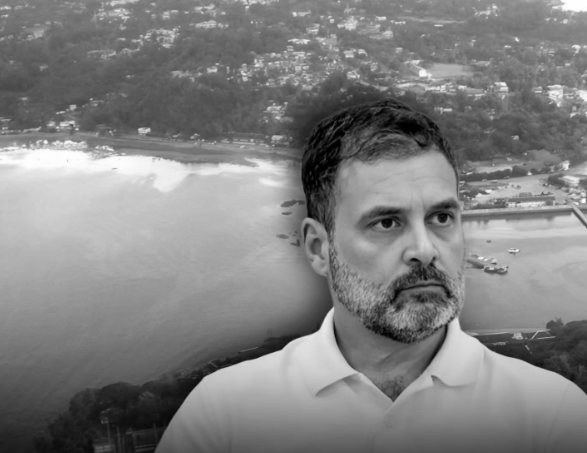
Rahul Gandhi Begins Three-Day Andaman Visit, To Raise Concerns Over Great Nicobar Project
Rahul Gandhi , the Leader of Opposition in the Lok Sabha , will begin a three-day visit to the Andaman and Nicobar Islands from April 26 , during which he is expected to raise concerns over the Centre’s Rs 81,000-crore Great Nicobar Holistic Development Project and engage with local stakeholders.
The Congress leader is scheduled to arrive in Sri Vijaya Puram (Port Blair) on April 26 morning, where he will meet senior party leaders before travelling later the same day to Great Nicobar Island by helicopter , according to party sources.
As per the detailed itinerary, Gandhi is expected to traverse key stretches of the island, including the North–South road corridor up to Indira Point , and interact with local communities. He is also likely to stay overnight at Campbell Bay on April 26 , where meetings with local representatives and community members are planned.
On April 27, he is expected to return to Sri Vijaya Puram , where the Congress party will hold a Pradesh Congress Convention , along with a roadshow from the helipad to the Dr. B.R. Ambedkar Auditorium , where he is scheduled to address party workers and leaders.
On April 28, Gandhi will conclude his visit after further engagements in the islands.
A key focus of the visit is expected to be the Great Nicobar Holistic Development Project , which includes proposals for a transshipment port, international airport, township development and power infrastructure across a large ecologically sensitive zone. The project has drawn sustained debate over its environmental impact and implications for indigenous communities, including the Nicobarese and Shompen tribes , both recognised as vulnerable tribal groups.
Congress leaders said the visit follows Gandhi’s recent meeting in New Delhi with members of the Great Nicobar Tribal Council and the Campaign Committee of the Andaman and Nicobar Territorial Congress Committee (ANTCC) , who had urged him to assess conditions on the ground.
During that interaction, tribal representatives raised concerns over ecological disruption, displacement risks and lack of transparency in the project’s implementation.