
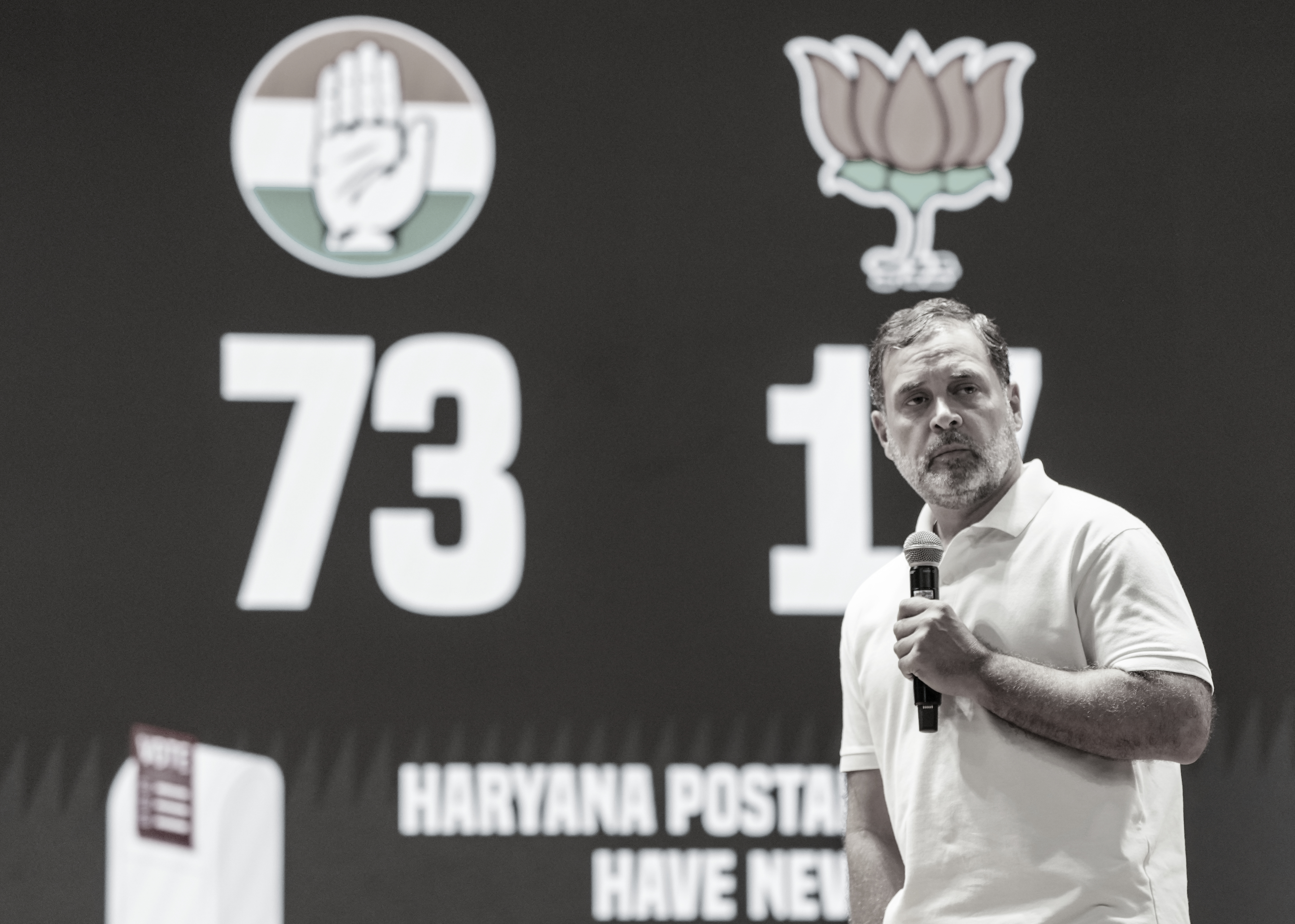
Rahul Gandhi claims 25 lakh fake voters in Haryana, questions EC oversight
Congress leader Rahul Gandhi on Wednesday alleged that the 2024 Haryana Assembly elections were “stolen,” claiming that around 25 lakh entries in the state’s voter lists were fake. He asserted that the Election Commission (EC) colluded with the BJP to ensure the ruling party’s victory, and presented data including multiple instances of duplicate voters, invalid addresses, and bulk entries. Highlighting one example, Gandhi showed a photograph of a Brazilian model allegedly used 22 times across polling booths in Rai assembly constituency.
Gandhi also recalled his previous “vote chori” presentation in September, where he had highlighted similar patterns of voter manipulation in Karnataka and other states during the 2024 Lok Sabha and assembly polls. He claimed the Congress was on course for a landslide victory in Haryana, citing exit polls and postal ballots, but alleged that a centralized operation called “Operation Sarkar Chori” reversed the outcome. According to him, one in eight voters in Haryana were fake, and despite this, the Congress lost by just 22,779 votes, the margin in eight key constituencies.
He raised concerns over the “house number zero” loophole, pointing out that addresses without official house numbers could be manipulated for fraudulent voting. Gandhi also warned that the Special Intensive Revision system (SIR) may be used similarly in Bihar ahead of the state elections.
However, several observers have questioned the timing of these allegations. As the saying goes, “Once everything is done and control has shifted, what is the point of raising concerns?” Congress, as an organisational party with access to voter lists, could have rigorously analysed these entries at the time, flagging suspicious cases for review, rather than waiting until after the results.
The episode also highlights a structural weakness in voter verification. In 2015, the EC had proposed linking voter IDs to Aadhaar to ensure that each ID corresponded to a real person. While the Supreme Court later declined to make this mandatory, citing privacy and citizenship concerns, experts note that linking voter IDs with verified identity or residence documentation could have prevented many duplicate or fake entries. At the same time, the Court has repeatedly clarified that Aadhaar is not proof of citizenship, so any verification system must avoid disenfranchising eligible voters while preventing fraud.
The Election Commission, meanwhile, dismissed Gandhi’s claims as unsubstantiated. Officials pointed out that Congress did not file any appeals against Haryana’s electoral rolls and questioned why booth agents did not flag multiple votes at the time. In the 2024 Haryana polls, the BJP won 48 seats, Congress 37, INLD 2, and independents 3 in the 90-member House.
While Gandhi’s allegations bring attention to the critical issue of electoral integrity, analysts say that preventive safeguards, such as linking voter IDs to verified identity at registration, remain far more effective than retrospective claims. The debate underscores the importance of strengthening verification mechanisms without compromising privacy or eligibility, ensuring that only genuine voters are registered.