
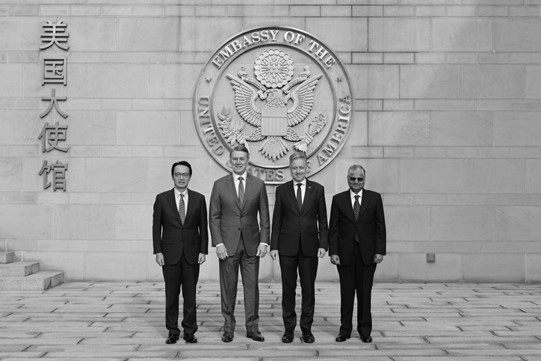
QUAD Sends a Message to Beijing, From Beijing
In a pointed diplomatic signal, envoys of the Quadrilateral Security Dialogue (QUAD) the United States, India, Australia and Japan held a rare, publicised joint meeting in Beijing on Tuesday, underlining the grouping’s resolve on a free and open Indo-Pacific even as tensions with China remain high.
The meeting was hosted at the United States Embassy in Beijing and brought together David Perdue , Pradeep Kumar Rawat , Graham Fletcher and Hideo Tarumi . Perdue confirmed the gathering by posting a photograph of the four diplomats, calling the QUAD “a force for good in maintaining a free and open Indo-Pacific,” and adding that relations among the four countries “continue to be stable and strong.”
India’s envoy Pradeep Kumar Rawat said the QUAD’s emphasis remained on cooperation and regional stability rather than confrontation, stressing the importance of working with like-minded partners to uphold a free, open and inclusive Indo-Pacific and to address shared challenges such as maritime security and economic connectivity.
The QUAD, an informal strategic grouping of the US, India, Australia and Japan seeks to promote a rules-based order, freedom of navigation and regional stability across the Indo-Pacific. Leaders of the four nations last met at the heads-of-government level on the sidelines of the G7 summit in Apulia, Italy , where they reaffirmed commitments to deeper cooperation in security, infrastructure, technology and resilient supply chains.
The envoys’ Beijing meeting comes amid heightened regional tensions. China’s People’s Liberation Army recently conducted large-scale exercises Justice Mission 2025 around Taiwan, involving naval, air and missile forces. While Beijing said the drills were aimed at deterring separatism and external interference, Taiwan and several regional players described them as destabilising. Separately, the United States and Japan have expanded the scale and frequency of joint military drills in 2025, reflecting growing concern over security in the East China Sea, South China Sea and the Taiwan Strait.
Chinese President Xi Jinping has repeatedly criticised groupings such as the QUAD, warning against “small cliques” and a Cold War mindset, and arguing that cooperation should not target third parties. China has not officially reacted to the ambassadors’ meeting.
Analysts say the decision to meet publicly in Beijing itself was the message underscoring the QUAD’s intent to remain united and visible while pressing for open seas, a rules-based order and stability across the Indo-Pacific.