
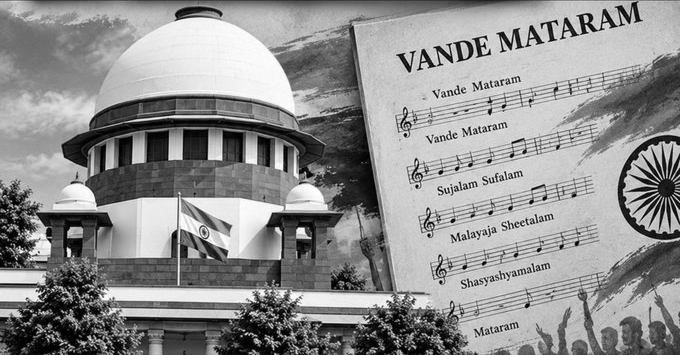
SC Examines Constitutional Challenge to Mandatory Singing of Six-Stanza Vande Mataram
The Supreme Court on Tuesday agreed to examine fresh petitions challenging the law mandating the singing of all six stanzas of Vande Mataram, issuing notices to the Centre and other respondents.
A bench comprising Chief Justice Surya Kant and Justices Joymalya Bagchi and V Mohana tagged the petitions filed by Bhimrao Duryodhan Borkar and former IAS officer Balakrishnan Sathyabhama Mavoji with similar pleas and scheduled the next hearing for November 30.
Borkar has challenged Ministry of Home Affairs orders dated January 28 and July 9, 2026, arguing that they unlawfully replace the longstanding practice of singing a standalone, two-stanza version of the national song with its complete six-stanza composition.
His petition contends that the additional stanzas contain objectionable religious references and anti-Muslim content, raising concerns about constitutional secularism. He has argued that the government cannot impose a revised version of the national song under the guise of issuing directions on its official performance.
Mavoji, meanwhile, has contended that prescribing the six-stanza version amounts to an attempt to transform India into a religious state. The petition also raises concerns over penalising individuals who refuse to sing the song on grounds of conscience.
The latest proceedings follow the Supreme Court's September 22 hearing on a similar petition filed by Carnatic vocalist T M Krishna, who challenged the mandatory singing of all six stanzas, arguing that the last four verses conflict with India's secular character.
During that hearing, the bench told the Centre that a conscientious objector should not be punished for declining to sing Vande Mataram. It also asked the government to consider the principles established in the court's 1986 judgment in Bijoe Emmanuel vs State of Kerala.
In that landmark ruling, the Supreme Court protected schoolchildren who respectfully refused to sing the national anthem on grounds of conscience.
The fresh petitions will now be considered alongside the pending challenges. The court's notice does not constitute a final ruling on the validity of the government's orders or the mandatory singing requirement.