
Putin signals use of frozen assets for Ukraine rebuilding as Trump drops Greenland tariff threat
Ahead of talks with US President Donald Trump’s special envoy Steve Witkoff, Russian President Vladimir Putin said Russia was ready to allow its frozen assets to be used for rebuilding war-torn Ukraine after a peace treaty is concluded between the two countries. Addressing a meeting of Russia’s Security Council late Wednesday, Putin also said Russia would donate $1 billion from the frozen funds to the Trump-promoted Board of Peace to oversee the Gaza ceasefire plan.
“Incidentally, the remaining funds from our frozen assets in the US could be used to rebuild territories damaged by the fighting after a peace treaty is concluded between Russia and Ukraine,” Putin said, adding that the proposal was being discussed with representatives of the US administration. American envoys Steve Witkoff and Jared Kushner are expected to meet Putin on Thursday to explore a possible settlement to the Ukraine conflict. Western countries froze about $300 billion in Russian assets following Moscow’s invasion of Ukraine, and any use of the funds would require their approval.
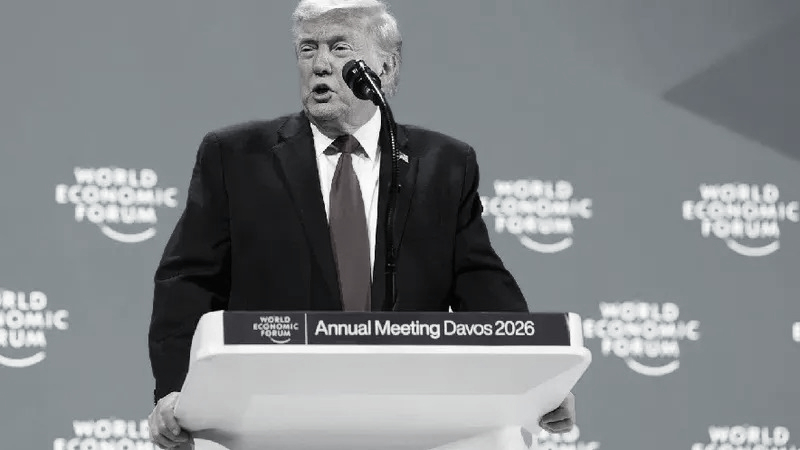
Putin’s remarks came as Trump announced at the World Economic Forum in Davos that the United States was dropping its threat to impose tariffs on several European countries, citing what he described as a new “framework” deal with NATO on Arctic security linked to Greenland. The abrupt reversal followed Trump’s assurance that the US would not use force to pursue control of Greenland, an autonomous territory of Denmark.
Asked how long the deal would last, Trump said it was permanent. “It’s a deal that’s forever,” he said. “It’s what’s called an infinite deal.” He added that the framework would meet US national security concerns and said details would be released soon.
Despite backing down on tariffs, Trump reaffirmed his ambition to secure “right, title and ownership” of Greenland and urged NATO allies not to stand in the way, warning that refusals would carry consequences for the alliance. He declined to name a price for Greenland, saying the true cost involved “safety and security and national security and international security”.
European leaders reacted sharply. European Commission President Ursula von der Leyen called Trump’s tariff threat over Greenland a “mistake” and questioned his trustworthiness, while French President Emmanuel Macron said the European Union could retaliate using one of its most powerful trade defence tools, often described as a trade “bazooka”. Sweden’s Deputy Prime Minister Ebba Busch said Europe should “hold the line” and not be bullied or blackmailed into giving up territory.
Financial markets welcomed the de-escalation. US stocks rebounded after Trump called off the Greenland-related tariffs, with the S&P 500, Dow Jones Industrial Average and Nasdaq composite each rising about 1.2 per cent, recovering roughly half of the previous day’s losses. Treasury yields eased as fears of a broader US–EU trade confrontation receded.
US officials said European governments and financial markets were not alone in feeling relief. Some officials had privately worried that Trump’s hardline rhetoric toward Greenland, Denmark and other NATO allies was straining alliance unity and distracting from other diplomatic priorities, including efforts to launch the Board of Peace to oversee the Gaza ceasefire.
The developments underscored the increasingly interconnected diplomacy spanning Ukraine, the Middle East and Arctic security, as world leaders sought to dial down tensions amid economic and geopolitical uncertainty.