
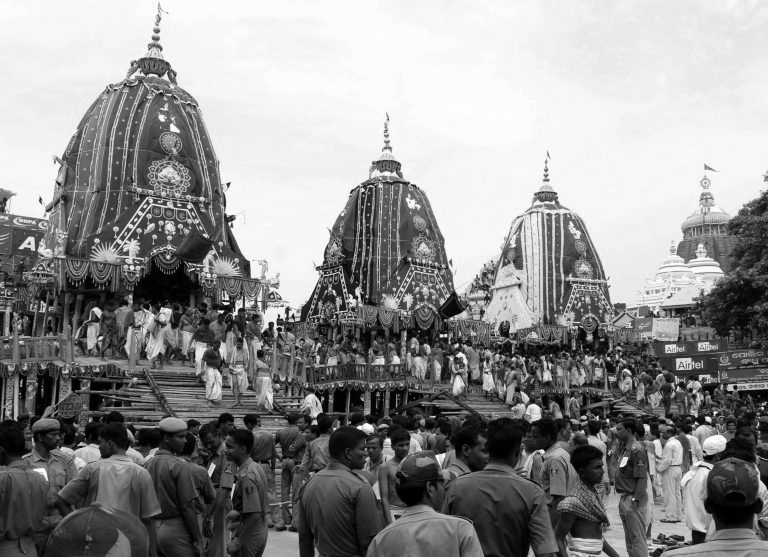
Puri Jagannath conclave flags scriptural violations in ISKCON Rath Yatra
A three-day global conclave held in Odisha’s Puri, attended by devotees of Lord Jagannath from over 24 countries, has resolved to launch a worldwide awareness campaign against what it described as the “untimely” conduct of Rath Yatra celebrations by the International Society for Krishna Consciousness (ISKCON).
The conclave, organised by Shree Jagannath Chintan and Chetana Worldwide (SJCCW), concluded on Sunday. It was inaugurated by the Puri Shankaracharya and addressed by Gajapati Maharaja Dibyasingha Deb , the titular king of Puri and chairman of the Shree Jagannath Temple Managing Committee (SJTMC).
According to organisers, the campaign aims to educate devotees globally about the scriptural framework governing the annual Rath Yatra of Lord Jagannath. As per Hindu scriptures and Puranas, the Rath Yatra is held once a year on Asadha Shukla Paksha Dwitiya Tithi (June-July), marking the ceremonial journey of Lord Jagannath, Lord Balabhadra and Goddess Subhadra from the Puri temple to the Gundicha Temple . The tithi, temple rituals and sequence of ceremonies are considered integral to the observance.
“We will create awareness against the untimely conduct of Lord Jagannath’s Rath Yatra abroad, which deviates from the Hindu scriptures and Puranas,” said Bhagaban Panda, trustee of SJCCW. He emphasised that while devotion may be universal, ritual observances must adhere to scriptural prescriptions.
Kalaindi Tripathy , a participant from Japan, said that conducting Rath Yatra outside India is not objectionable in principle, but added that the festival should follow the date, rituals and sanctity laid down in the scriptures. “Deviation in timing or ritual framework undermines the tradition,” he said.
The issue has long been a point of contention between the Puri temple administration and the Mayapur-headquartered ISKCON. Temple authorities allege that ISKCON organises Rath Yatra processions in different countries on varying dates based on convenience and logistics, rather than the prescribed tithi, effectively turning a once-a-year sacred observance into multiple events across the calendar.
ISKCON has earlier maintained that holding the festival on a single date globally is impractical due to logistical constraints, time zones and local conditions. However, the Puri temple management argues that scriptural injunctions do not permit such flexibility.
Addressing the conclave, Gajapati Maharaja Dibyasingha Deb expressed strong concern over ISKCON’s stance. “The ISKCON has denied holding Rath Yatra abroad as per the scriptures. This attitude is not acceptable to any Sanatani Hindu,” he said.
Deb also criticised the naming of the Jagannath temple at Digha in West Bengal as ‘Jagannath Dham’. He asserted that, according to tradition, only Puri qualifies as a ‘dham’ as it is the original and eternal abode of Lord Jagannath. The Digha temple, built by the West Bengal government as a replica of the Puri shrine, is managed by ISKCON.
The conclave concluded with a resolution to engage scholars, religious leaders and devotees worldwide to uphold what participants described as the scriptural sanctity and singularity of Lord Jagannath’s Rath Yatra.