
Punjab’s stubble burning challenge, balancing farmer livelihoods and Delhi’s air quality
Punjab Chief Minister Bhagwant Mann has emphasized his government’s efforts to curb stubble burning through awareness campaigns and the provision of crop residue management (CRM) machinery. The move comes amid ongoing concerns that stubble burning in Punjab and Haryana contributes significantly to Delhi’s severe air pollution during October-November.
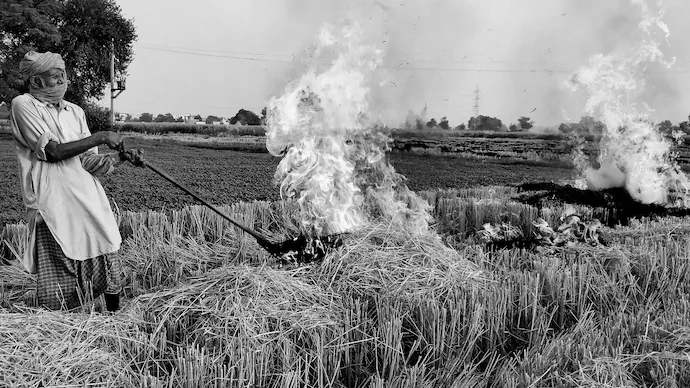
Stubble burning occurs when farmers set fire to leftover paddy stalks after harvest to quickly prepare their fields for the next crop, usually wheat. The short sowing window for Rabi crops, combined with the high cost of machinery and labor shortages, makes burning the fastest and most cost-effective solution for many farmers. While the method is convenient, it releases massive amounts of smoke, particulate matter, and pollutants, which are carried by winds to northern India, worsening air quality in Delhi and surrounding regions.
CM Mann highlighted that Punjab has made progress in reducing farm fires, noting a 70% drop in 2024,from 36,663 incidents in 2023 to 10,909. He stressed that the government is motivating farmers through awareness camps and distributing CRM machinery to facilitate sustainable alternatives. He also invoked the teachings of Guru Nanak Dev, urging farmers to respect the environment: “Pawan Guru, Pani Pita, Mata Dharat Mahat.”
Despite progress, challenges remain. Farmers face tight timelines, financial constraints, and limited access to machinery, making stubble burning a difficult habit to break. Strict enforcement, such as fines or arrests ordered by the Supreme Court, risks penalizing farmers struggling to plant wheat on time, while incentives and subsidies have shown higher compliance without harming livelihoods. Programs that provide shared village machinery, training, and financial rewards for non-burning fields have proven effective in pilot schemes.
The issue is compounded by other environmental factors. Even with interventions, Delhi continues to experience pollution spikes due to simultaneous stubble burning across multiple states and cooler winter atmospheric conditions that trap pollutants. CM Mann’s approach, therefore, emphasizes a balance between environmental responsibility and protecting farmer incomes, with a combination of awareness, incentives, accessible machinery, and monitored enforcement.
This nuanced approach reflects the reality that stubble burning is not negligence but a practical challenge for farmers under time and financial pressure. With continued support and strategic measures, Punjab aims to reduce pollution while ensuring farmers can sow timely wheat crops without jeopardizing their livelihoods.