
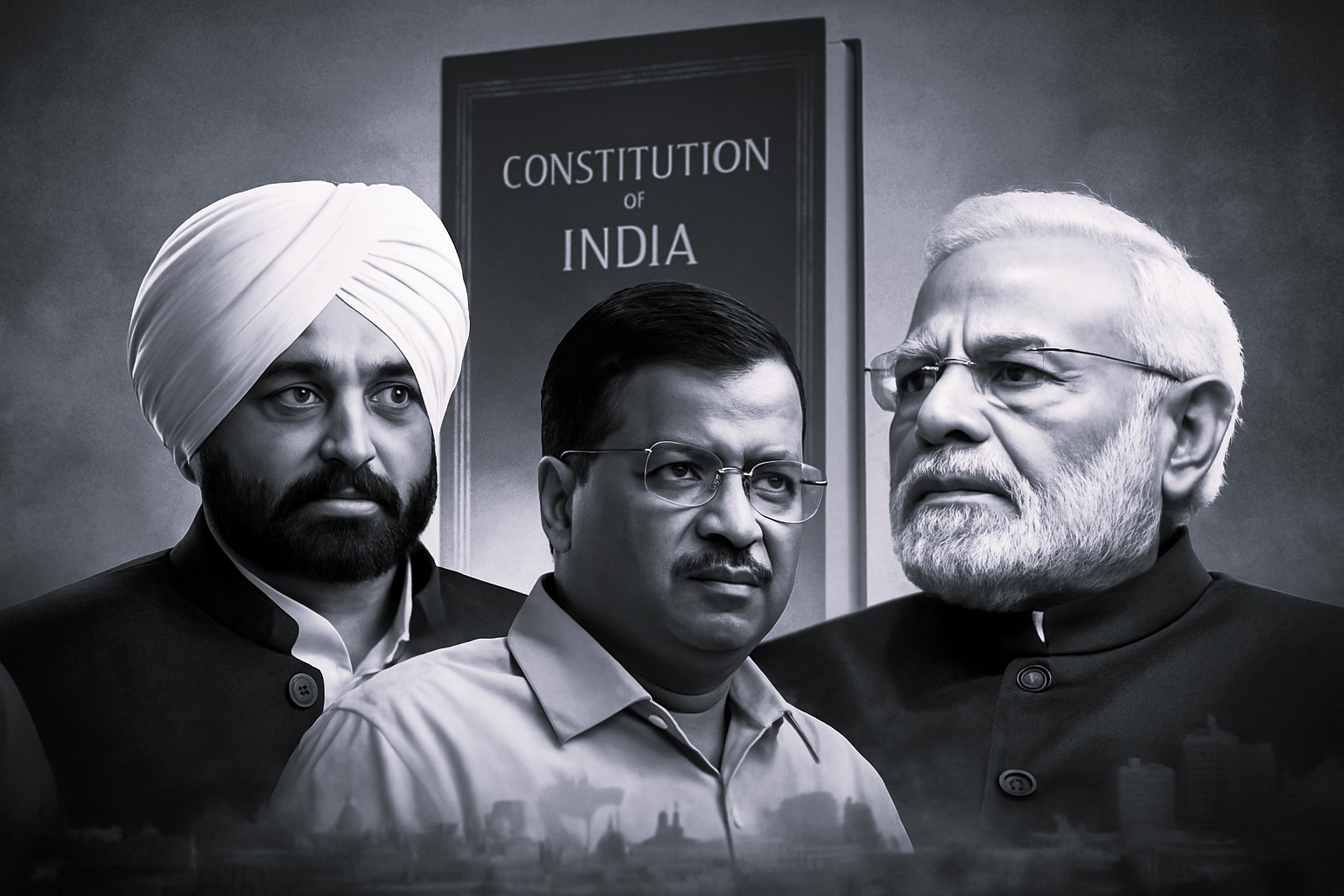
Punjab-AAP leaders accuse centre of ‘Backdoor Attempt’ to control Chandigarh after Delhi power shift
The confrontation between Punjab’s AAP leadership and the Centre escalated sharply on Monday, with Chief Minister Bhagwant Mann and AAP national convener Arvind Kejriwal accusing the Union government of attempting a “backdoor takeover” of Chandigarh through the proposed Constitution (131st Amendment) Bill, 2025. The amendment, whose official text is not yet publicly available on government websites, has triggered fresh political tensions over federal control, state rights and the future governance structure of the Union Territory.
The criticism comes amid claims by AAP that, after “stripping and centralising” key administrative powers of the Delhi government through a series of ordinances and amendments, the Centre is now seeking to extend similar control to Chandigarh. AAP leaders allege that moving the amendment quietly, without public access to the draft, reflects an attempt by the Modi government to push the change through the Winter Session without scrutiny.
Chief Minister Mann warned that the Centre is “playing with fire,” recalling the massive year-long agitation by Punjab’s farmers against the now-repealed farm laws. He said any move that weakens Punjab’s historic and administrative claim over Chandigarh would provoke a strong public response. “This is a direct attempt to separate our capital from us. We will not allow Punjab’s rights to be taken away through secrecy and backdoor methods,” Mann said.
He reiterated that Chandigarh was built on land acquired from razed Punjabi villages and remains the rightful capital of Punjab. Mann further accused the Centre of attempting to impose unilateral constitutional changes without stakeholder consultation, calling it an “assault on federalism.”
Arvind Kejriwal, whose government in Delhi saw significant powers reassigned to the Centre and the Lieutenant Governor in recent years, framed the Chandigarh move as part of a political pattern. He alleged that the Modi government was acting out of “continuing animosity” towards him and towards AAP-ruled states. “After taking control of Delhi’s administration through laws and notifications, the same playbook is being used for Chandigarh,” he said. Kejriwal added that the absence of the amendment text on official portals raised “serious questions” about transparency and intent.
Opposition parties in Punjab, including Congress and Shiromani Akali Dal, have also demanded clarity on the amendment, saying that any attempt to modify Chandigarh’s governance structure must be fully disclosed and debated in Parliament.
The Governor of Punjab, who also serves as the Administrator of Chandigarh, has not commented publicly on the matter, despite the amendment’s direct implications for the current administrative arrangement.
As the Winter Session approaches, the political temperature in Punjab continues to rise, with AAP leaders framing the Chandigarh move as part of a broader struggle over federal rights and democratic autonomy. The controversy is expected to intensify unless the Centre officially clarifies whether the amendment will indeed be introduced and releases the draft text for public scrutiny.