
Punjab Rolls Out ₹10 Lakh Universal Health Cover, Budget Parity with Telangana on Per-Family Cost
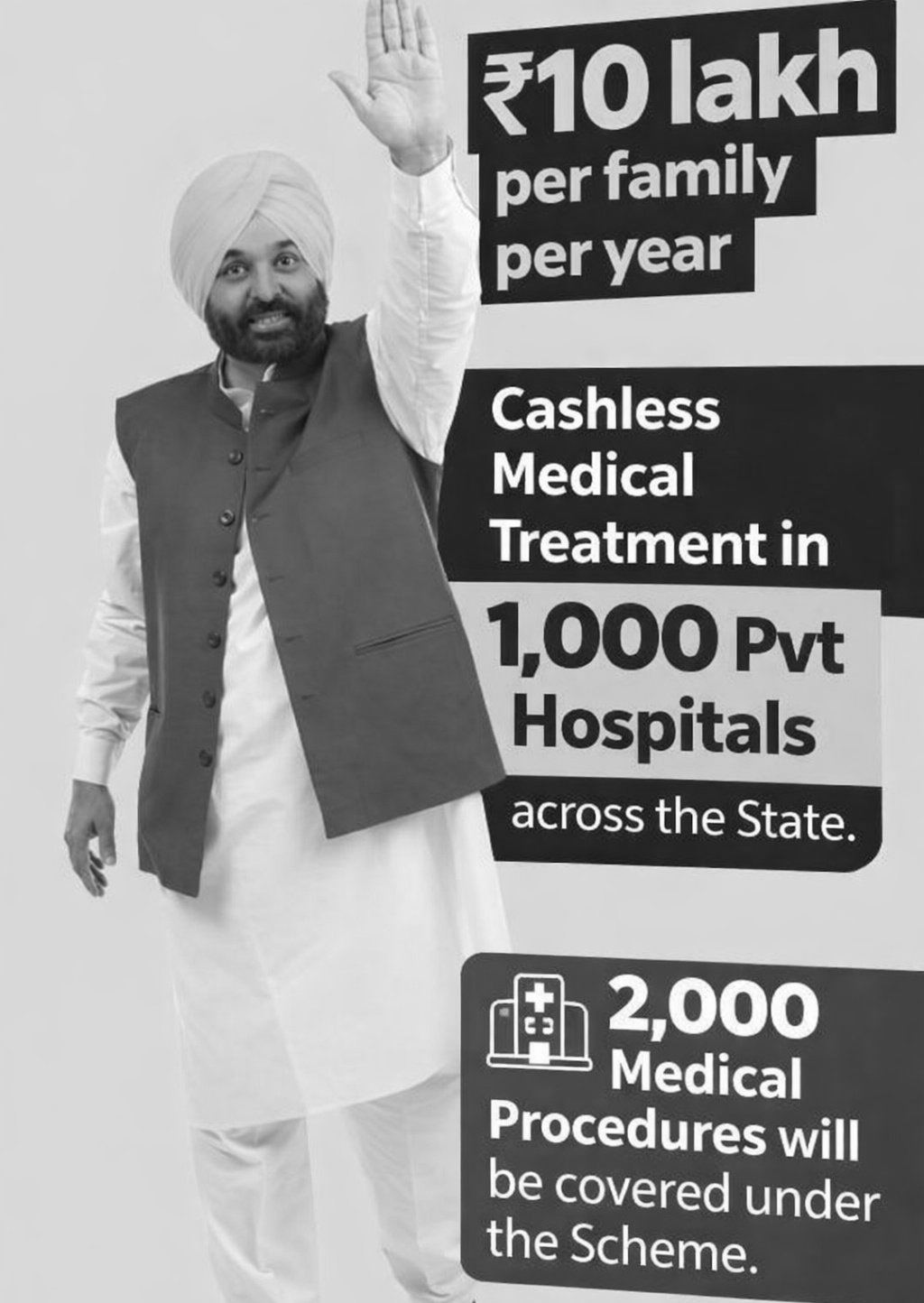
The Punjab government has approved the launch of the Mukh Mantri Sehat Yojna , a universal health insurance programme that will provide cashless medical treatment up to ₹10 lakh per family starting January 2026. The scheme will cover around 65 lakh families across the state and will be administered by United India Insurance Company Limited (UIIC) , a public sector insurer selected through a competitive process.
Under the scheme, beneficiaries will receive treatment through a CM Health Card , covering nearly 2,000 medical procedures at government hospitals and over 1,000 empanelled private hospitals . Registration will begin shortly, with initial enrolment camps planned in Taran Taran and Barnala districts.
For the scheme’s rollout, the Punjab government has earmarked ₹778 crore in the state budget. Spread across the estimated 65 lakh families , this translates to an implied annual allocation of roughly ₹1,200 per family . While this is not a premium in the commercial insurance sense, it provides a useful benchmark for comparing public health insurance expenditure.
A similar approach is seen in Telangana , where the Aarogyasri health scheme covers about 90 lakh families with a budget allocation of approximately ₹1,215 crore , resulting in an average per-family outlay of around ₹1,300–₹1,400 per year . The comparison suggests that Punjab’s universal scheme is broadly aligned with Telangana’s spending levels on a per-family basis , despite Punjab offering coverage to all households irrespective of income.
The Punjab scheme follows a hybrid model . Insurance coverage up to a defined threshold is managed by United India Insurance Company Limited , while higher-value claims beyond that limit will be met directly by the state government under an assurance framework. Officials say this structure allows tighter cost control while ensuring high-value treatments are not denied.
Health policy experts note that such per-family allocations are typical of large public health insurance programmes and that actual spending depends on utilisation , with most families making minimal claims and a smaller proportion accounting for high-cost tertiary care. They add that if Punjab’s model is implemented effectively, it could serve as a template for other states considering universal health coverage .
With a budgetary commitment comparable to Telangana’s on a per-family basis and a significantly wider eligibility base, the Mukh Mantri Sehat Yojna positions Punjab among the more ambitious states in public healthcare financing.