
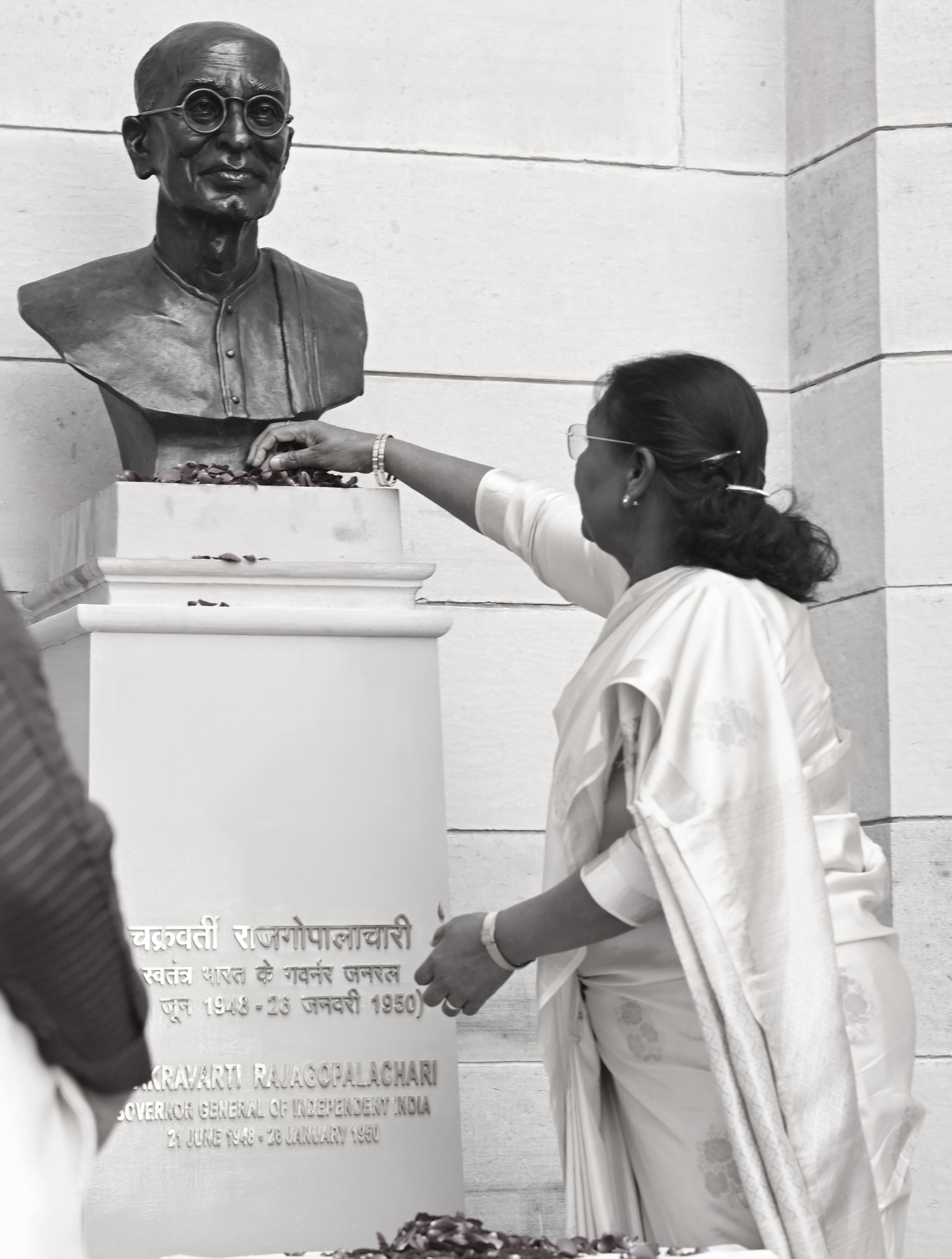
Prez unveils bust of Rajagopalachari at Rashtrapati Bhavan, marking decolonisation push
President Droupadi Murmu on Monday unveiled the bust of Chakravarti Rajagopalachari , the first and only Indian Governor General of independent India, at Rashtrapati Bhavan , underscoring the government’s continuing efforts to shed vestiges of the colonial past.
The bust has been installed at the grand open staircase near Ashok Mandap, a prominent ceremonial space within the Rashtrapati Bhavan complex. It replaces the bust of British architect Edwin Lutyens , who designed several colonial-era structures in the national capital.
Rajagopalachari, popularly known as Rajaji , was a close associate of Mahatma Gandhi and one of the foremost leaders of India’s freedom movement. He played a key role in the Non-Cooperation Movement, Civil Disobedience Movement, and Salt Satyagraha, and was imprisoned multiple times by the British for his participation in the struggle for independence. A lawyer, administrator, thinker, and writer, Rajagopalachari was also known for his advocacy of ethical politics and public morality.
After Independence, Rajagopalachari served as Governor General from 1948 to 1950, becoming the first Indian to hold the office. His tenure marked a crucial transition from colonial rule to sovereign governance, during a period when India was grappling with post-Partition challenges and the framing of its Constitution. The position was later replaced by the office of the President with the adoption of the Constitution in 1950.
In a statement shared on X, the President’s Secretariat said the initiative was part of a series of steps aimed at “shedding the vestiges of a colonial mindset and embracing, with pride, the richness of India’s culture, heritage, and timeless traditions, while honouring those who served Bharat Mata with extraordinary contributions.”
Historians and scholars have described the move as a symbolic rebalancing of historical memory. While acknowledging Lutyens’ architectural legacy, many have noted that placing Indian national leaders in such central and symbolic spaces reinforces India’s post-colonial identity and foregrounds the contributions of those who shaped the nation’s democratic foundations.
The choice of location is seen as significant, as the Ashok Mandap area is associated with state ceremonies and constitutional authority. Installing Rajagopalachari’s bust there places him firmly within the narrative of India’s nation-building journey.
The event was attended by Vice President C P Radhakrishnan , Health and Family Welfare Minister J P Nadda , External Affairs Minister S Jaishankar , Education Minister Dharmendra Pradhan , Culture and Tourism Minister Gajendra Singh Shekhawat , Minister of State for Information and Broadcasting L Murugan , and members of Rajagopalachari’s family.
The unveiling is being viewed as part of a broader public symbolism of decolonisation, aimed at reclaiming national spaces and narratives by honouring Indian leaders who played decisive roles in the country’s freedom struggle and early governance.