
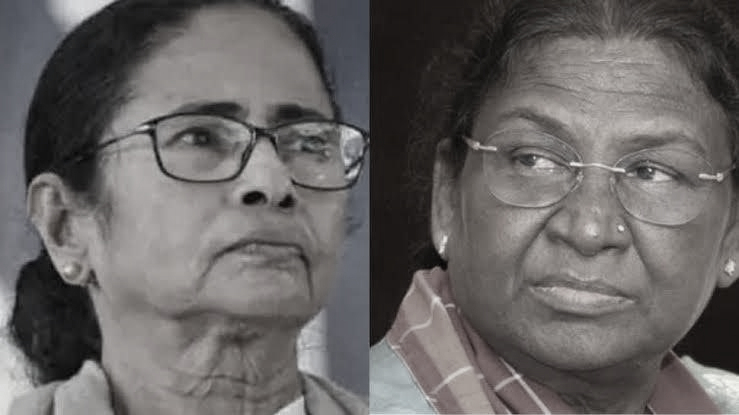
President withholds assent to Bengal bills seeking to make CM chancellor of state universities
President Droupadi Murmu has withheld assent to three amendment Bills passed by the West Bengal Assembly that sought to replace the governor with the chief minister as chancellor of state-run universities, effectively bringing an end at least for now to the Mamata Banerjee government’s attempt to overhaul the governance structure of higher education in the state.
With the President’s decision, Governor C V Ananda Bose will continue to function as the chancellor of state-aided universities in accordance with existing laws. The Bills had been reserved for the President’s consideration in April 2024 by Bose, who had succeeded Jagdeep Dhankhar as governor.
The three Bills the West Bengal University Laws (Amendment) Bill, 2022, the Aliah University (Amendment) Bill, 2022, and the West Bengal University of Health Sciences (Amendment) Bill, 2022 were passed by the Assembly in June 2022. All of them sought a common and far-reaching change: removing the governor as the ex-officio chancellor and vesting that role in the chief minister.
The move followed a prolonged and often bitter tussle between the Trinamool Congress government and the Raj Bhavan over the administration of state-run universities. The state government had accused successive governors of delaying key decisions, including the appointment of vice-chancellors, approval of statutes, and routine administrative matters, leading to what it described as paralysis in university functioning.
Arguing in favour of the amendments, the Mamata Banerjee administration maintained that making the chief minister the chancellor would facilitate faster decision-making, smoother coordination with the higher education department, and more effective governance. It also claimed that the governor’s role as chancellor had increasingly turned interventionist, going beyond a largely ceremonial position.
However, the proposed changes triggered strong opposition. Critics, including the governor and the Union government, argued that the amendments would undermine the constitutional role of the governor, who is traditionally seen as an authority above active politics in the university system. They also warned that placing the chief minister and an elected political executive at the helm of universities could lead to politicisation, compromise academic autonomy, and concentrate excessive power in the hands of the state government.
Concerns were also raised about conflict of interest, as the state government both funds and regulates universities. Opponents said removing the governor as chancellor would eliminate an important institutional check and balance in higher education governance.
Given the constitutional implications, the Bills were reserved for the President under Article 200 of the Constitution. After examination at the central level, the President withheld assent, a decision communicated to the West Bengal government through the Raj Bhavan.
As a result, the principal Acts governing state-aided universities which state that “the governor shall, by virtue of his office, be the chancellor of the university” will continue to remain in force.
The decision underscores the wider Centre–state friction over the role of governors and the limits of state power in higher education, a subject that falls under the Concurrent List. While the West Bengal government has defended its move as necessary for administrative efficiency and accountability, the withholding of assent signals that any such restructuring of university governance will face close constitutional scrutiny.