
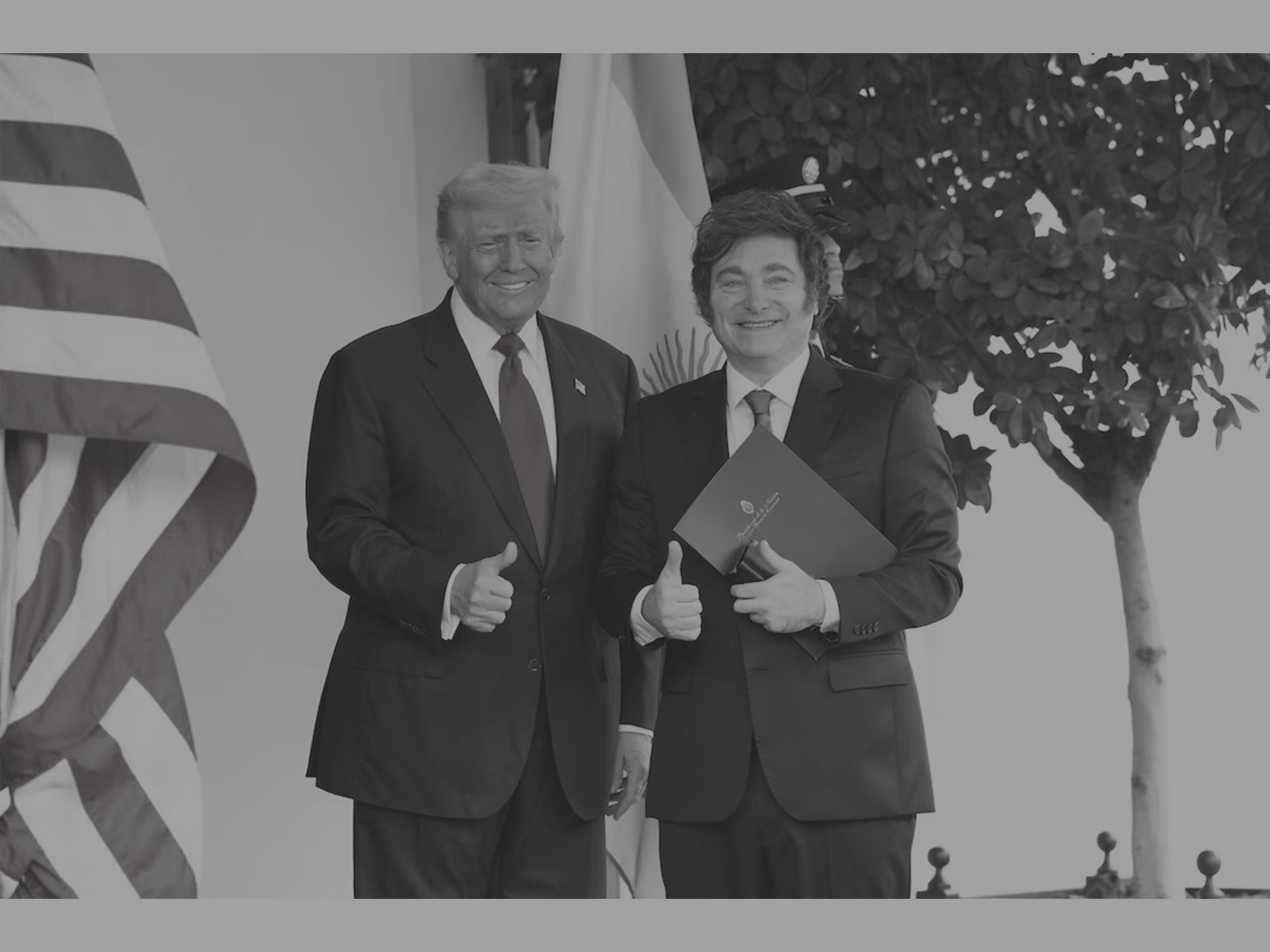
President Trump welcomes Argentine President Javier Milei to the White House
U.S. President Donald Trump and Argentine President Javier Milei met at the White House to discuss a proposed $20 billion currency-swap agreement aimed at stabilizing Argentina’s struggling economy. The deal would allow the U.S. Treasury to exchange dollars for Argentine pesos, providing crucial liquidity to prevent a peso collapse and complementing Argentina’s existing swap with China.
Trump made his position unmistakably clear, saying: “If he wins, we are staying with him. If he doesn’t win, we are gone. If he loses, we are not going to be generous with Argentina.” He added, referring to Argentina’s upcoming elections: “The elections are coming soon, and we are watching closely”. Trump may have misunderstood the schedule, since the midterm legislative elections are set for October 26, 2025, and Milei himself is not on the ballot, but Milei’s libertarian coalition, La Libertad Avanza, seeks to expand its hold in Congress. Though he is not on the ballot, the results will determine whether he can continue his sweeping market reforms or face resistance from opposition parties. Trump’s overt endorsement of Milei, whom he called “a great leader” and “MAGA all the way”.
Argentina’s ongoing currency-swap agreement with China provides similar financial relief in yuan, with an active line worth around US $5 billion currently in use. That swap has helped Argentina cover import payments and sustain foreign reserves amid severe shortages of U.S. dollars. The proposed U.S. arrangement would partially replace or complement that support, but also reposition Argentina geopolitically closer to Washington, outcompeting Beijing’s financial diplomacy by offering a dollar-based alternative tied to stricter economic reforms and pro-U.S. alignment.
Trump’s conditional remarks triggered volatility in Argentine markets. Stocks dipped and the peso came under pressure as investors feared that U.S. aid could evaporate if Milei’s coalition underperforms. In Buenos Aires, opposition leaders including former President Cristina Kirchner criticized the deal as a “political trap” that compromises Argentina’s sovereignty. Economists and civil society groups argue that threatening to withdraw aid based on political outcomes is a flawed strategy, risking deeper social polarization and undermining democratic choice.
U.S., holding pesos isn’t inherently profitable. The advantage lies in stabilizing a key regional economy, preserving trade flows, and maintaining influence. The swap also gives the U.S. a stronger say in Argentina’s monetary policy and regional financial architecture, indirectly benefiting U.S. investors and companies operating there. By denominating part of the swap in pesos, the U.S. limits the need for direct dollar outflows while signaling confidence in Milei’s reforms.
The United States remains one of Argentina’s largest trading partners, with bilateral trade exceeding US $26 billion in 2024. U.S. exports (~US $16.5 billion) include petroleum and coal products, pharmaceuticals, chemicals, aerospace components, and computer equipment, while U.S. imports (~US $9.8 billion) include crude oil, nonferrous metals, agricultural goods, fishery products, and aluminum. The U.S. generally runs a trade surplus, although competition in soybean exports especially to China creates occasional friction.
Trump last visited Argentina in December 2018 for the G20 Summit in Buenos Aires, meeting then-President Mauricio Macri. U.S.- Argentina relations stretch back over two centuries, fluctuating with each administration. Right-leaning, market-friendly governments, like those of Macri and Milei, have enjoyed closer ties with Washington, while Peronist administrations often emphasized sovereignty and diversified alliances, including China and Russia. Under Milei, relations are closer than in previous decades, united by pro-market ideology and a shared skepticism of socialism. The $20 billion currency-swap plan symbolizes that renewed partnership but also exposes its fragility, as Trump’s conditional support blurs the line between economic diplomacy and political interference.
Many U.S. farmers, a key base of support for Trump, may have mixed reactions to the proposed currency-swap deal with Argentina. On one hand, stabilizing Argentina’s economy could reduce volatility in global commodity markets, benefiting American exporters of soybeans, corn, and wheat. Trump’s personal backing of the deal also makes it more palatable to his loyal supporters. On the other hand, Argentina is a major competitor in agricultural exports, and a stabilized peso could make its crops cheaper on the world market, potentially hurting U.S. farmers’ profits.