
Pope Leo XIV and Archbishop Sarah Mullally Hold Historic Vatican Meeting
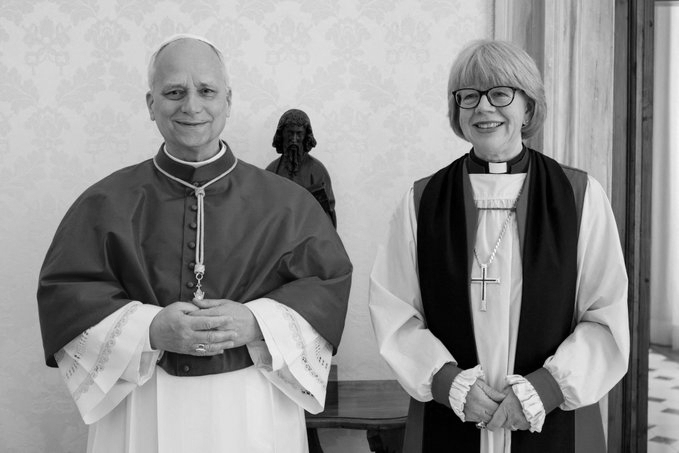
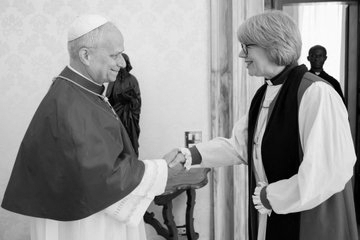
Pope Leo XIV has reiterated his commitment to strengthening relations with the Anglican Communion during a landmark Vatican meeting with Archbishop of Canterbury Sarah Mullally , the first woman to lead the Church of England and global Anglican community.
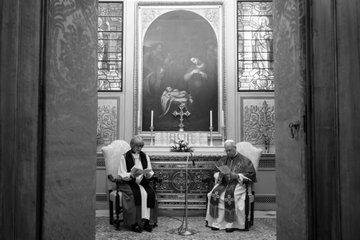
The encounter at Vatican City’s Apostolic Palace included private talks, an exchange of gifts, and a joint prayer in the Urban VIII Chapel , marking one of the most symbolically significant Catholic–Anglican engagements in decades. Both leaders prayed together for unity, a gesture described by Vatican sources as a “moment of shared devotion.”
Pope Leo acknowledged that while decades of ecumenical dialogue have produced progress, “new problems” have emerged alongside long-standing doctrinal differences. He urged continued efforts to remove barriers to full communion and stressed that Christian divisions weaken the global proclamation of the Gospel.
The Anglican Church separated from Rome in 1534 under King Henry VIII, and despite formal theological dialogue since the 1960s, key differences remain, particularly over women’s ordination , which is accepted in Anglicanism but rejected by the Roman Catholic Church.
Archbishop Mullally, on her first foreign visit since her installation, described the meeting as a call to renewed mission. She emphasized peace, human dignity, and global solidarity , urging both churches to act as “bridge builders, not wall builders” in a divided world.
The Vatican also highlighted that this visit follows earlier correspondence in which Pope Leo congratulated Mullally on her installation and called her ministry a “challenging responsibility” requiring wisdom and guidance.
The meeting comes amid ongoing tensions within parts of the Anglican Communion, where conservative groups, including Gafcon , have criticised her appointment, reflecting internal divisions.
Despite these challenges, both leaders reaffirmed their shared commitment to dialogue, cooperation, and the long-term goal of visible Christian unity, building on decades of theological engagement and recent symbolic acts of reconciliation.