
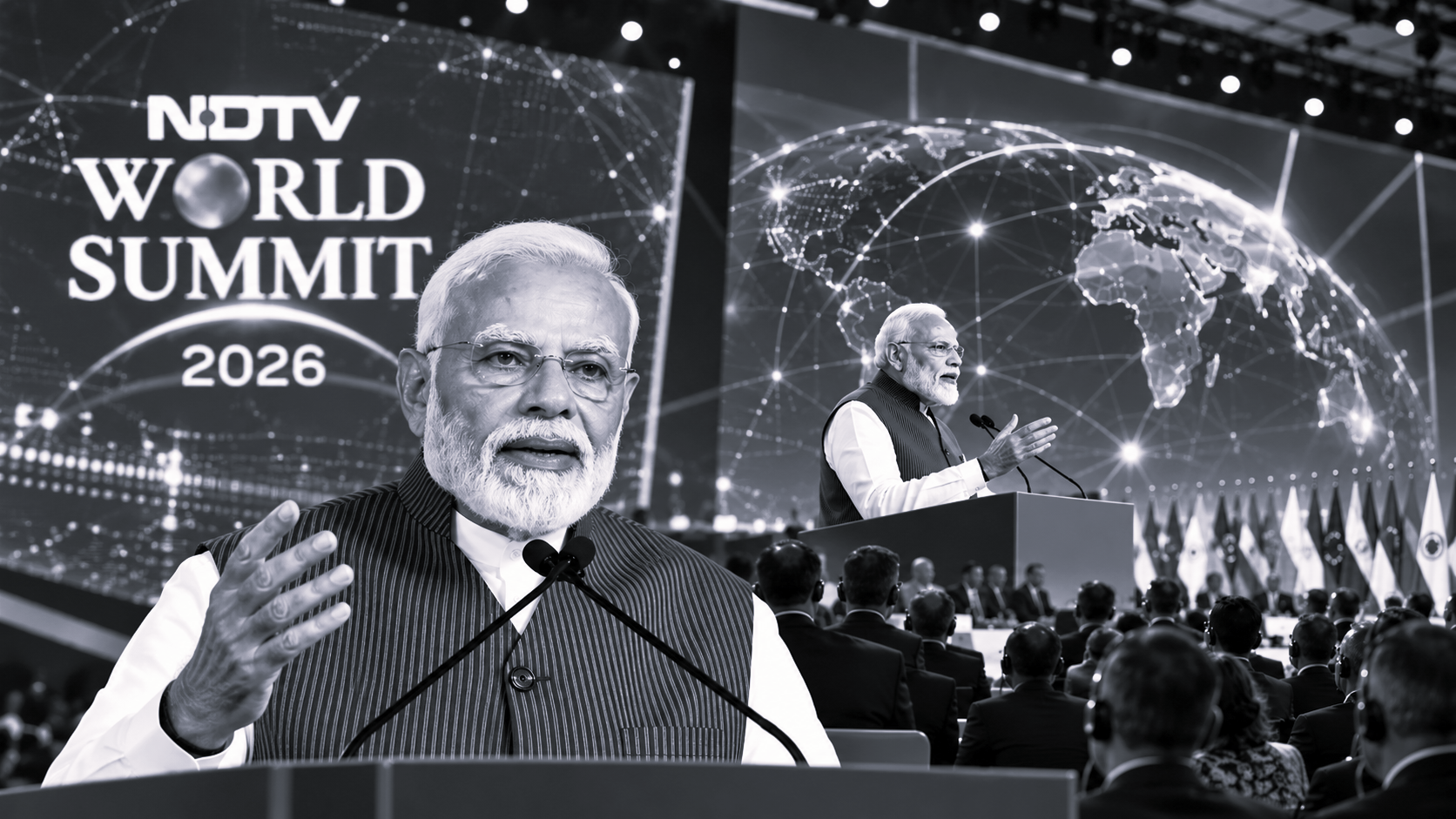
PM Modi Seeks Greater Global South Representation, Calls for UN Reforms at NDTV Summit 2026
Prime Minister Narendra Modi has said the world is undergoing a profound transformation, with established international institutions struggling to address emerging geopolitical, economic and technological challenges, while warning that some people are seeking to create “disorder” in India. Addressing the NDTV World Summit 2026 in New Delhi on October 22, Modi called for reforms in global institutions, greater representation for developing countries and stronger international cooperation, while launching a sharp political attack on the Congress and its leadership.
Modi questioned why the existing world order had failed to resolve emerging challenges and argued that institutions established after the Second World War must adapt to changing global realities. He stressed that multilateral institutions, including the United Nations, need reforms to reflect the growing influence of emerging economies and give the Global South a stronger voice in international decision-making.
The debate over global governance centres on the structure of the UN Security Council, where five permanent members - China, France, Russia, the United Kingdom and the United States - hold veto powers. India has long sought permanent membership, arguing that the existing arrangement does not adequately reflect contemporary geopolitical and economic realities. Modi maintained that international cooperation must remain effective during wars, pandemics and economic crises, rather than functioning only in favourable circumstances.
He also warned that trade, technology and maritime routes were increasingly becoming instruments of geopolitical competition. For India, which depends heavily on imported crude oil and international supply chains, disruptions to shipping corridors can raise transportation costs, affect energy security and put pressure on domestic economic activity. Modi invoked the ancient concept of Matsya Nyaya, in which the strong prey upon the weak when effective order breaks down, to argue for a more balanced international system.
Highlighting India's ambitions, Modi pointed to developments in artificial intelligence, semiconductor design, digital services, green energy and manufacturing. He cited nearly 1.5 lakh patent filings in 2025, India's contribution to the global chip-design workforce and progress in non-fossil electricity capacity. He also referred to the revival of domestic Penicillin G production in Kakinada, Andhra Pradesh, supported by the Production Linked Incentive scheme, as an example of efforts to strengthen supply-chain resilience.
The Prime Minister also highlighted India's G20 presidency, during which the African Union became a permanent G20 member in 2023, as an example of expanding representation for developing countries.
Turning to domestic politics, Modi accused the Congress of undermining India's achievements and damaging its international reputation. In an apparent reference to Rahul Gandhi, he compared the party's repeated attempts to promote its leader with rocket launches from Sriharikota, alleging that the Congress leadership had become a burden on its own party.
Modi further accused opposition leaders of seeking foreign intervention and used the term “Dimagi Naxals” to criticise elements he claimed were influencing Congress. These were political allegations made during his speech.
The address combined India's ambition to shape the emerging global order with Modi's warning against what he described as domestic efforts to weaken the country's standing. The challenge for India, he argued, is to strengthen its economic and technological capabilities while securing a greater role in international decision-making.