
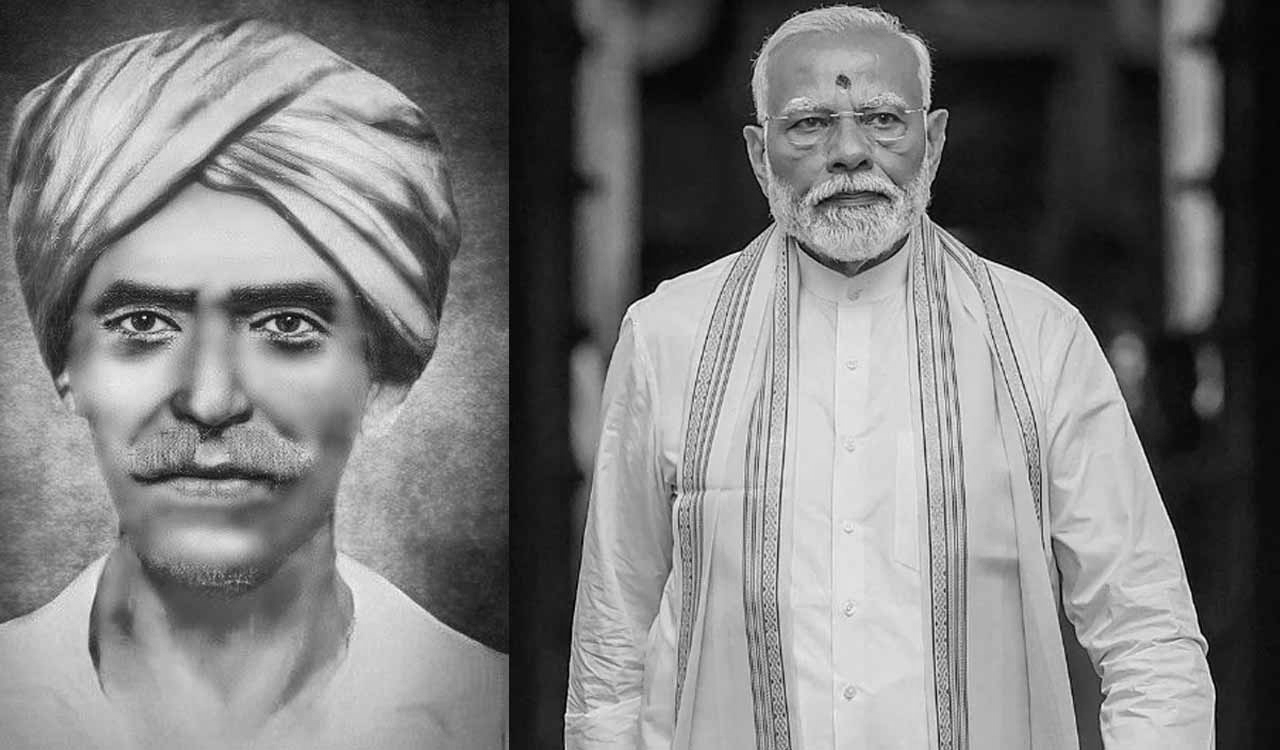
PM Modi remembers tribal icon Komaram Bheem on Mann Ki Baat
Prime Minister Narendra Modi, during the 127ᵗʰ edition of his monthly radio programme Mann Ki Baat, paid rich tributes to the legendary tribal leader Komaram Bheem, describing him as “a symbol of courage, self-respect, and the spirit of resistance.” Modi’s remarks came on the 85ᵗʰ anniversary of Bheem’s martyrdom, highlighting his enduring influence on India’s tribal rights movements and cultural identity.
Born on 22 October 1901 in Sankepalli village near Asifabad in the then Hyderabad State, Bheem grew up in the forests of the Chanda and Ballalpur regions. Deprived of formal education, he experienced firsthand the exploitation faced by the Gond people under zamindars (feudal landlords) and forest police. His father was killed by forest officials, an incident that profoundly shaped his resistance against injustice.
Komaram Bheem (1901–1940), also known as Kumram Bheem, was a revolutionary leader from the Gond community who led an armed rebellion against the oppressive rule of the Nizam of Hyderabad during the 1930s. His struggle for land, forest, and water rights inspired generations of Adivasis and contributed to the later Telangana Rebellion of 1946.
After his father’s death, Bheem moved with his family to Sardapur near Karimnagar, where he clashed with authorities enforcing illegal taxes on tribal farmers. In October 1920, during a dispute over crop confiscation, he reportedly killed a Nizamate officer named Siddiquesaab and fled to Chanda, where a local publisher named Vitoba took him in. Working in Vitoba’s printing press, Bheem learned English, Hindi, and Urdu while assisting in the publication of anti-British and anti-Nizam materials.
Following Vitoba’s arrest, Bheem escaped to Assam, where he worked on a tea plantation for four and a half years and became involved in labour union activism. After returning to Hyderabad, he married Som Bai and began organising the tribal population in Adilabad, uniting them under the slogan “Jal, Jangal, Zameen” (Water, Forest, Land) symbolising the fight for indigenous rights over natural resources.
In 1928, Bheem convened a council of Gond leaders from twelve districts at Jodeghat, forming a guerrilla force to defend tribal lands. The Nizam’s administration attempted negotiation, but Bheem’s demands for regional autonomy, land rights, and prisoner releases were rejected. His rebellion continued for a decade until he was killed in an encounter at Jodeghat in 1940 by forces led by Abdul Sattar, the talukdar of Asifabad. Although the official date of his death is 27 October 1940, Gond communities commemorate it on 8 April each year.
After his death, Bheem was immortalised in Adivasi folklore and deified as Bheemal Pen, a protector deity among the Gonds. His struggle inspired the Hyderabad Tribal Areas Regulation Act of 1946, drafted after anthropologist Christoph von Fürer-Haimendorf studied the causes of the rebellion, leading to greater legal protections for tribal land rights.
In his Mann Ki Baat address, Prime Minister Modi urged citizens to learn about Bheem and other tribal icons like Birsa Munda, noting that their sacrifices “shaped India’s identity and strengthened the spirit of national unity.” He also encouraged the celebration of India’s indigenous heroes whose legacies continue to guide modern movements for equality and environmental justice.
In 2014, the Telangana government renamed Adilabad district as Komaram Bheem–Asifabad district and sanctioned ₹25 crore for the construction of a museum and memorial at Jodeghat, inaugurated in 2016. The site has since become an important centre of tribal history and tourism.
Komaram Bheem’s life and legacy have been widely represented in literature and cinema. The 1990 Telugu biopic Komaram Bheem, directed by Allani Sridhar and starring Bhoopal Reddy, won two Nandi Awards, including Best Film on National Integration. The 2022 film RRR, directed by S. S. Rajamouli, introduced Bheem’s story to a global audience, with N. T. Rama Rao Jr. (Jr NTR) portraying him as one of the central characters. Several books, including The Life and Times of Komuram Bheem by Bhoopal Reddy and Forests, Blood & Survival: Life and Times of Komuram Bheem, document his life and his fight for tribal dignity and autonomy.
Prime Minister Modi’s tribute reaffirmed Komaram Bheem’s lasting message of self-reliance, justice, and empowerment for India’s tribal communities. His legacy rooted in the call for “Jal, Jangal, Zameen” continues to resonate as a powerful symbol of indigenous identity, environmental stewardship, and resistance against oppression.