
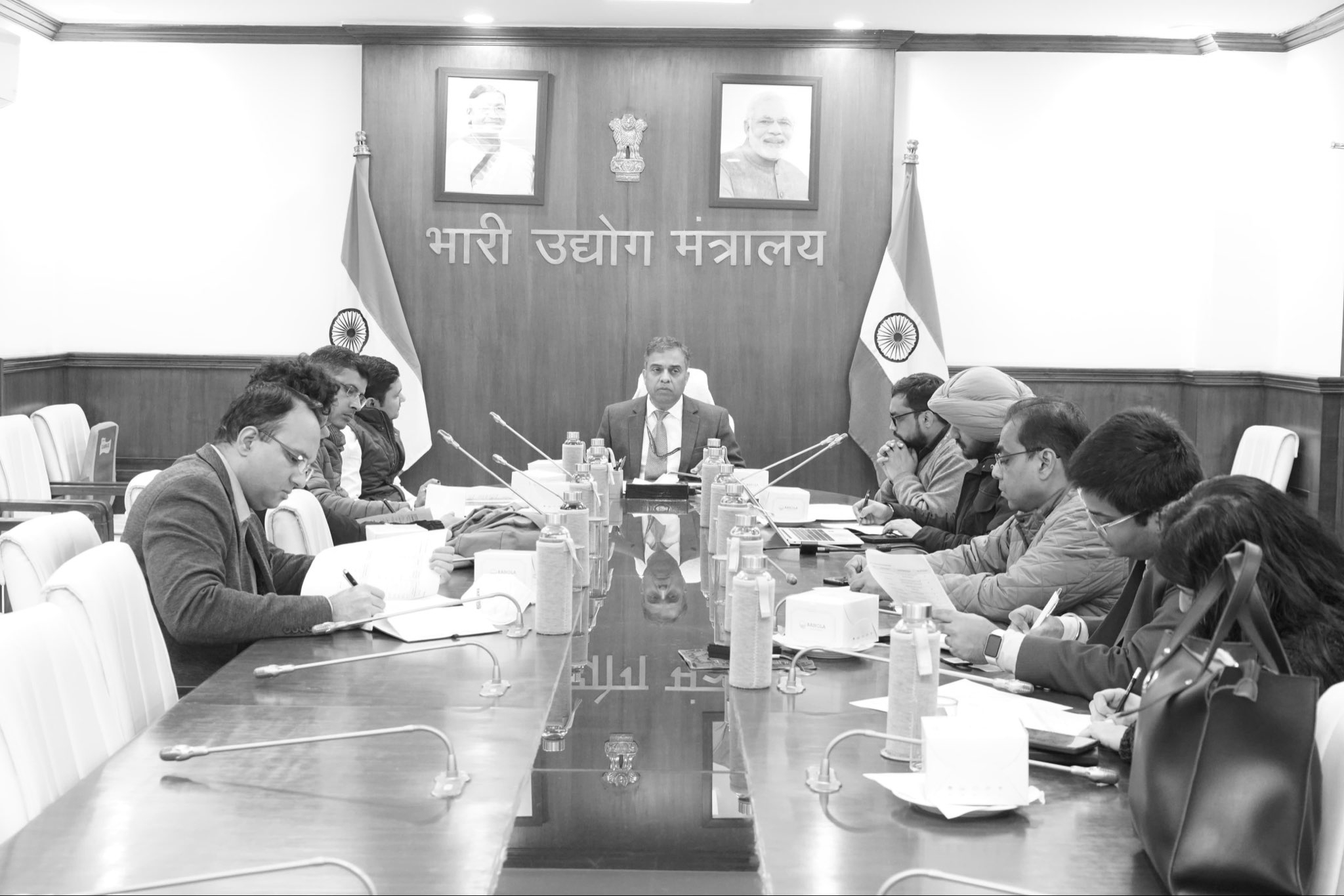
PLI–Auto scheme drives ₹35,657 Cr investment, boosts EV manufacturing and localisation
The Production Linked Incentive (PLI) Scheme for the Automobile and Auto Components sector has emerged as a key driver of India’s transition towards advanced and clean mobility, with cumulative investments touching ₹35,657 crore and incentives worth ₹2,321.94 crore disbursed as of December 31, 2025, the Ministry of Heavy Industries said.
Introduced to address long-standing gaps in India’s automotive manufacturing ecosystem, the PLI–Auto Scheme aims to strengthen domestic capabilities in Advanced Automotive Technology (AAT) products and reduce dependence on imported high-value components. The scheme, with a total outlay of ₹25,938 crore, covers a five-year performance period from FY 2023–24 to FY 2027–28.
India’s automobile industry has traditionally been strong in volume-driven manufacturing of conventional vehicles but lagged in emerging technologies such as electric mobility, power electronics, advanced components and new-age vehicle platforms. The scheme was designed to shift the sector towards technology-led manufacturing, higher value addition and global competitiveness, in line with the government’s AtmaNirbhar Bharat vision.
FY 2023–24 marked the first performance year under the scheme, during which ₹322 crore was disbursed to four approved applicants in FY 2024–25. For the subsequent performance year 2024–25, incentives amounting to ₹1,999.94 crore have been released so far to five approved applicants.
Electric two-wheelers have emerged as the largest beneficiaries under the scheme, with incentives extended for over 10.42 lakh units, reflecting faster adoption and a relatively mature manufacturing base. Electric three-wheelers followed with incentives for 2.38 lakh units, driven by strong commercial demand in last-mile transport. Electric four-wheelers and buses accounted for 79,540 units and 1,391 units respectively, reflecting higher costs, longer development cycles and capital-intensive procurement processes.
A core feature of the scheme is the mandatory requirement of at least 50 per cent Domestic Value Addition (DVA), ensuring that incentives are linked to genuine manufacturing rather than assembly of imported kits. As of now, eight applicants under the Champion OEM category have received DVA certification for 94 variants, while ten Component Champion applicants have secured certification for 37 variants. The ministry said this localisation push is helping build resilient domestic supply chains and supporting Indian component manufacturers.
The ministry added that cumulative determined sales of ₹32,879 crore have been achieved under the scheme till September 30, 2025, while employment generation has reached 48,974, largely in high-skill manufacturing and engineering roles.
By encouraging scale, localisation and technology upgradation, the PLI–Auto Scheme is expected to strengthen India’s position in the global EV and auto components market. Officials said the scheme is enabling Indian manufacturers to integrate into global value chains, attract foreign investment, and position India as a competitive hub for next-generation automotive manufacturing.