
Plastic Waste to Purpose: How SBM and Communities Drive Recycling Across India
The Swachh Bharat Mission (SBM) has expanded plastic-waste management through source segregation, collection, material recovery and recycling, with urban and rural programmes involving local bodies and communities.
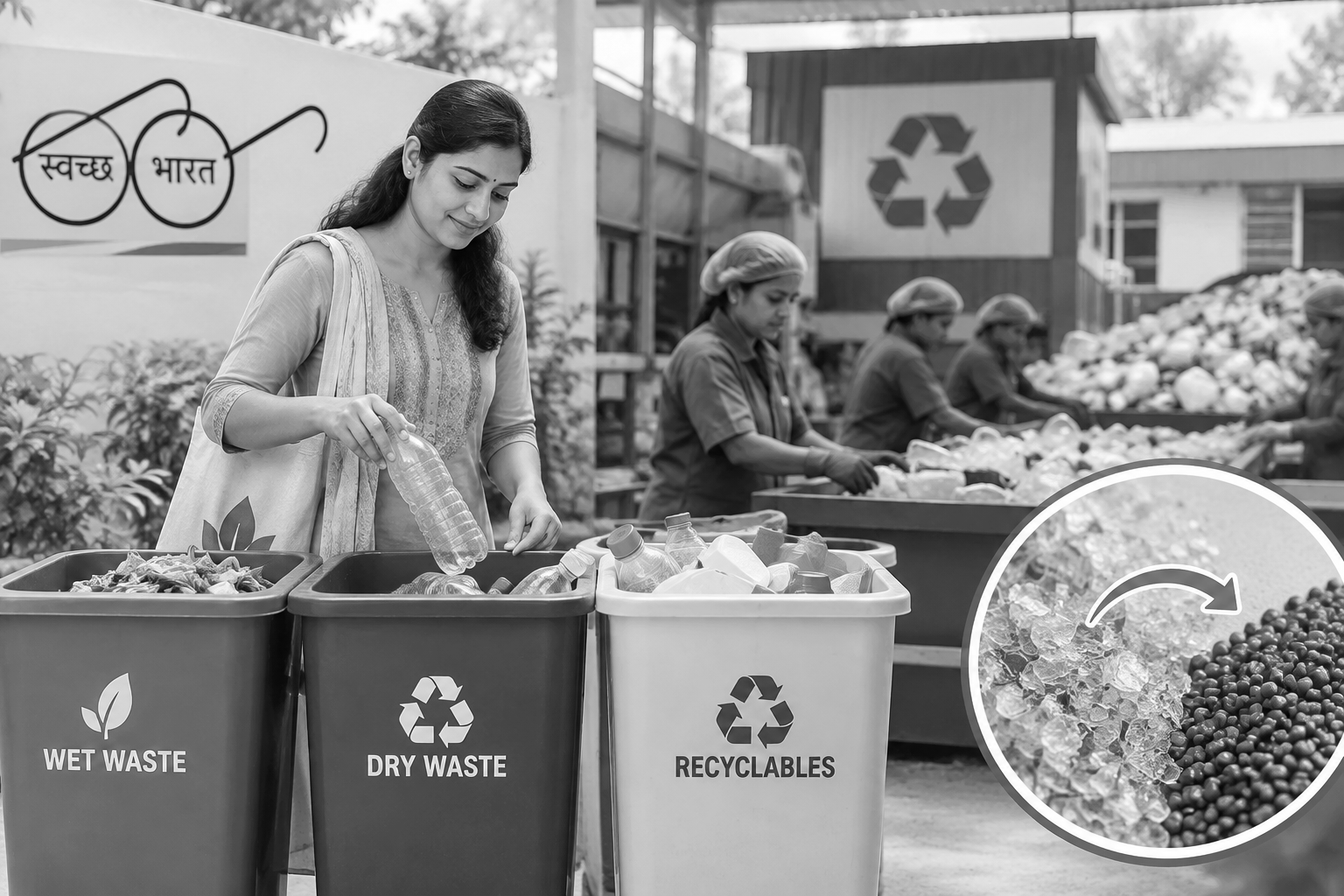
Under SBM-Urban 2.0, cities are required to promote source segregation, segregated collection and transportation, processing of dry waste and access to Material Recovery Facilities (MRFs). Plastic is treated as part of the dry-waste stream and is sorted at recovery facilities before recyclable material is sent for recycling or further processing.
Local bodies also work with residents, schools, market associations, NGOs, Resident Welfare Associations and volunteers to promote segregation and improve waste-management practices.
In rural areas, SBM-Grameen Phase II provides for greater involvement of women Self-Help Groups (SHGs) in plastic-waste collection and segregation. Plastic collected by Gram Panchayats can be taken to village segregation sheds and subsequently moved to Plastic Waste Management Units or MRFs for sorting, storage and recycling.
The role of community groups can be seen in Maharashtra’s Sasewadi cluster, where mobilisation efforts encouraged households to segregate waste. The collected plastic was then transported to a recycling company. Other initiatives have involved SHGs in collection drives, resource-recovery centres and MRF operations.
The government’s approach combines collection infrastructure with public participation. Door-to-door collection helps maintain segregation before material reaches recovery facilities.
The SBM framework also uses cleanliness assessments to encourage improved waste-management practices. These measures are accompanied by campaigns aimed at reducing dependence on prohibited single-use plastic items and promoting reusable alternatives.
As the mission continues to focus on source segregation, door-to-door collection, scientific processing and material recovery, plastic waste is handled through organised systems rather than being mixed with other waste.
The measures cover both urban and rural areas, with local collection systems feeding material into recovery facilities. MRFs provide points where collected plastic can be sorted and directed towards recycling. The framework connects household-level segregation with downstream recovery and processing of recyclable plastic for further processing.