
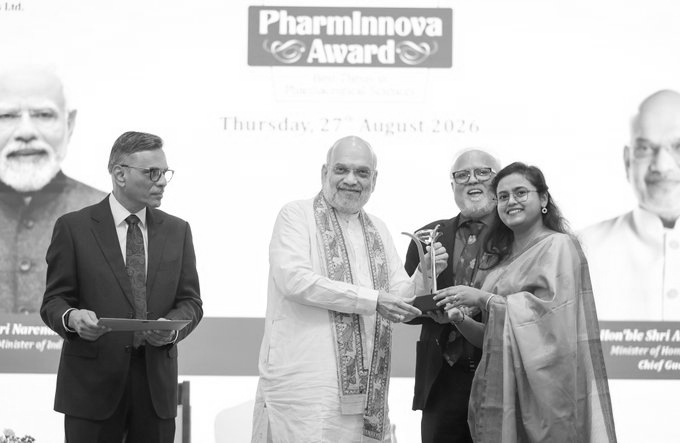
Pharma Is India’s Strategic Asset, Says Amit Shah, But Can It Stay One if Everything Goes Private?
Calling India’s pharmaceutical industry a “national strategic asset”, Union Home Minister Amit Shah has urged drug companies to invest more in research and innovation, saying the country must move beyond self-reliance and emerge as a major supplier of medicines to the world.
Speaking at the PharmInnova Awards 2026, Shah said India had once held a stronger position in pharmaceuticals before China emerged as a dominant force. He expressed confidence that initiatives such as the Production-Linked Incentive (PLI) scheme and Bulk Drug Parks would help strengthen domestic manufacturing and reduce China's dominance in critical parts of the supply chain.
The larger challenge, however, lies in converting investment and manufacturing capacity into long-term technological leadership. India remains a major exporter of generic medicines, but its pharmaceutical industry continues to face significant dependence on imported raw materials and critical ingredients. The government has responded with incentives for domestic production, research programmes and infrastructure projects aimed at building a more self-reliant ecosystem.
Shah said pharmaceutical companies must now play a bigger role by supporting research, students and scientists, while smaller firms could collaborate and share the costs and benefits of innovation. He also spoke of building domestic capacity in medical products ranging from basic supplies to advanced equipment such as CT and MRI machines before 2028.
Yet, Shah’s description of pharma as a strategic asset comes alongside another important shift in government policy. In May 2026, the Centre approved the 100% strategic sale of Indian Medicines Pharmaceutical Corporation Ltd (IMPCL), along with management control, to Skymap Pharmaceuticals Pvt Ltd for ₹121.01 crore. The government has also pursued closure, restructuring, strategic disinvestment or asset monetisation in several other state-run pharmaceutical companies over the years.
This does not necessarily mean the government is stepping away from the pharmaceutical sector. Its broader approach increasingly appears to combine public incentives and infrastructure support with private-sector investment and selective restructuring of state-owned enterprises.
The real test of this strategy will be whether India can translate policy support into stronger domestic supply chains, deeper research capabilities and globally competitive innovation. As Shah pushes the industry to challenge China’s dominance, India’s pharmaceutical future may depend not only on how much it manufactures, but also on what it develops, controls and innovates at home.