
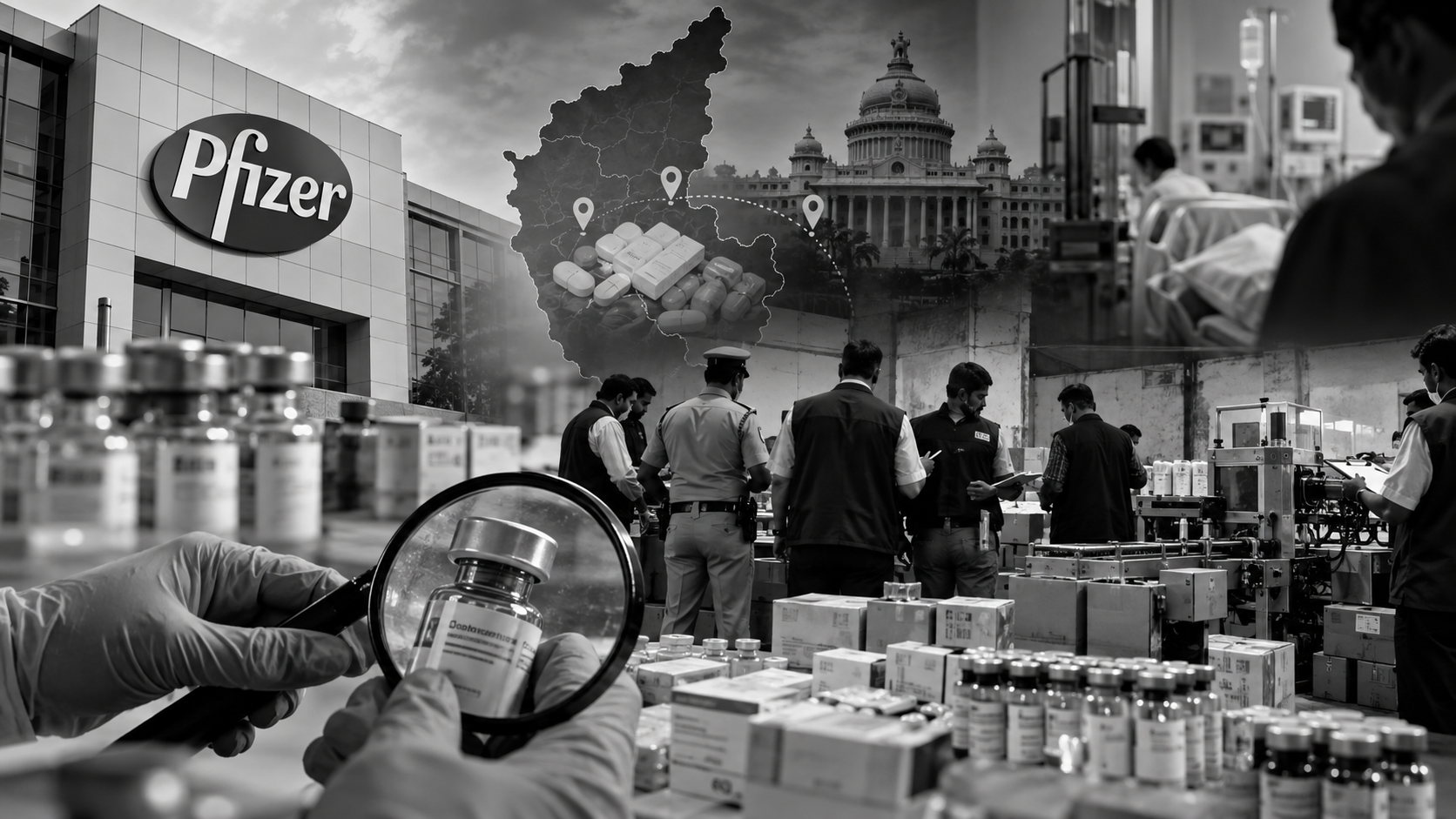
Pfizer Backs Karnataka Investigation Into Suspected Counterfeit Medicines
Pfizer has said patient safety and product quality remain its highest priorities, as Karnataka authorities intensify a probe into an alleged counterfeit medicine network involving products purportedly carrying the labels of multinational pharmaceutical companies.
The statement came after the Karnataka Food and Drug Administration (FDA) cancelled the licences of 16 retailers and wholesalers and suspended eight others over the alleged distribution and sale of spurious medicines. The action followed a raid on August 18 at a farmhouse in Kurubarakeranahalli near Bidadi, where officials uncovered an alleged illegal repacking and relabelling operation.
Investigators said cheaper medicines allegedly procured from other states were being repackaged in new vials and relabelled as expensive, life-saving medicines. Products purportedly carrying the Pfizer brand were among those identified. Officials seized medicines, machinery, packaging material, forged labels and printing equipment worth around ₹5.05 crore. The seizure included 5,640 vials of Cefiavigent 2.5 injection, 1,531 Hizlam vials, 264 suspected counterfeit Emblaveo vials, 30 boxes of expired medicines and other injectable drugs. Some labels reportedly carried non-functional QR codes. Samples have been sent for laboratory testing.
Pfizer said it has been cooperating with authorities for about a month, including removing genuine batches whose numbers were allegedly copied, helping distinguish authentic products from counterfeits and providing technical information on affected batches. The company said it remains focused on protecting patients and safeguarding public health.
The probe has since widened beyond the Bidadi facility. A Special Investigation Team (SIT) is examining alleged supplies to more than 90 hospitals and clinics, with eight people reportedly arrested. Investigators are also examining the alleged involvement of more than 15 medical representatives, invoices, financial transactions and interstate supply links. Authorities are reportedly investigating suspected spurious medicines worth about ₹12 crore supplied since February 2025.
The FDA has also suspended Pfizer’s C&F depot at Nelamangala as part of the regulatory action, while authorities investigate the wider supply chain. Karnataka Health Minister U T Khader has ordered action against an Assistant Drug Controller over alleged regulatory lapses and has sought central assistance because of suspected interstate links.
The case has highlighted broader concerns over pharmaceutical traceability. Under India’s drug regulations, spurious medicines are prohibited, while QR and barcode requirements are being expanded to strengthen authentication. Government data show that 1,16,323 drug samples were tested in 2024-25, including 245 classified as spurious or adulterated.
The investigation remains ongoing, with laboratory reports and supply-chain records expected to determine the full scale of the alleged racket and individual responsibility.