
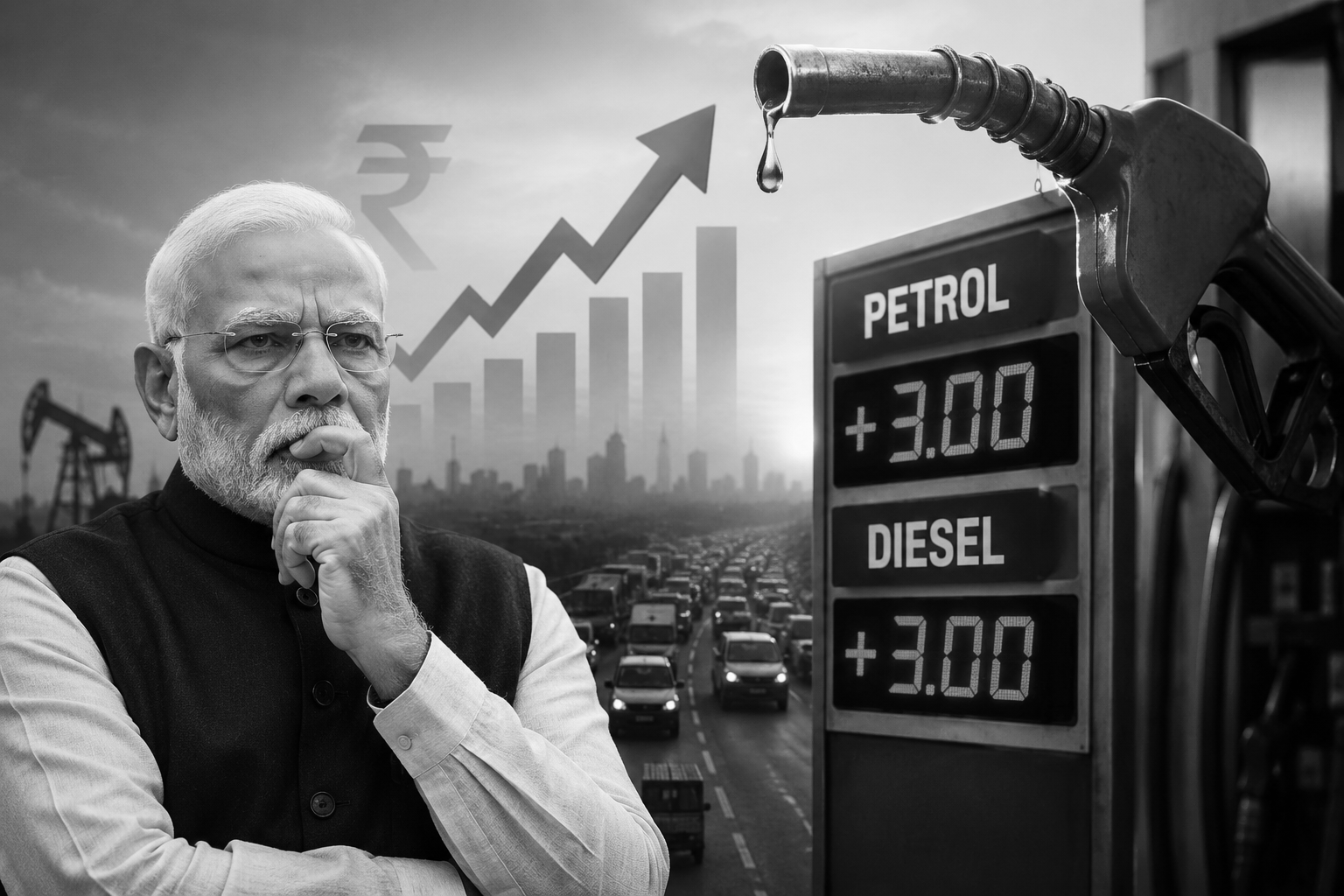
Petrol, Diesel Up ₹3/Litre After Four-Year Freeze, Sparks Inflation Fears and Political Storm
India saw its first fuel price hike in more than four years on Friday, with petrol and diesel prices raised by ₹3 per litre each , ending a prolonged freeze that had kept retail rates unchanged despite repeated global shocks.
The revision took immediate effect across the country. In Delhi , petrol now costs ₹97.77 per litre compared to ₹94.77 earlier, while diesel has risen to ₹90.67 from ₹87.67. Mumbai recorded petrol at ₹106.68 and diesel at ₹93.14, Kolkata saw higher revisions, and Chennai reported petrol at ₹103.67. Prices continue to vary across states due to differences in Value Added Tax (VAT) structures, leading to sharp regional gaps in retail fuel costs. CNG prices were also revised upward in several cities, adding to household transport expenses.
The primary driver behind the hike is the sharp surge in global crude oil prices , which have risen by over 50 per cent amid geopolitical tensions in West Asia . Disruptions in key supply routes and uncertainty around shipping lanes such as the Strait of Hormuz have kept global oil markets volatile. Brent crude has remained elevated around or above the $100 per barrel mark in recent months, significantly increasing India’s import bill. A weaker Indian rupee against the US dollar has further compounded pressure on import costs.
State run fuel retailers, Indian Oil Corporation (IOC) , Bharat Petroleum Corporation Limited (BPCL) , and Hindustan Petroleum Corporation Limited (HPCL) , have reportedly been facing heavy under recoveries , with losses mounting due to the gap between retail selling prices and international crude costs. Industry estimates suggest significant per litre losses on petrol and diesel, along with large losses on LPG , forcing a partial pass through of global price pressures after a long period of stability.
The timing of the revision has triggered strong political reactions. Opposition leaders accused the government of shifting the burden of rising global prices onto citizens immediately after elections, alleging that fuel prices were kept stable during the polling period and revised only after voting concluded. Congress leaders blamed policy failures and rising inflation, while other opposition voices questioned the timing and economic management. The ruling party maintained that the revision reflects global market conditions , not political considerations, noting that domestic prices had remained largely unchanged despite sustained volatility.
Transport associations have warned that the hike could increase freight costs by around 3 per cent , potentially pushing up prices of essential goods through higher logistics expenses. Economists note that fuel price changes typically have a cascading inflationary effect across agriculture, manufacturing, and retail, with the impact becoming clearer over the coming months.
Analysts further point out that India’s dependence on imported crude oil makes domestic fuel prices highly sensitive to global shocks, especially during periods of geopolitical instability. While the current revision is described as calibrated to avoid a sudden inflation spike, uncertainty in global energy markets means further adjustments cannot be ruled out if crude prices remain elevated.
The hike adds fresh pressure to an already sensitive inflation environment , where fuel and transport costs play a crucial indirect role in shaping overall price trends across the economy.