
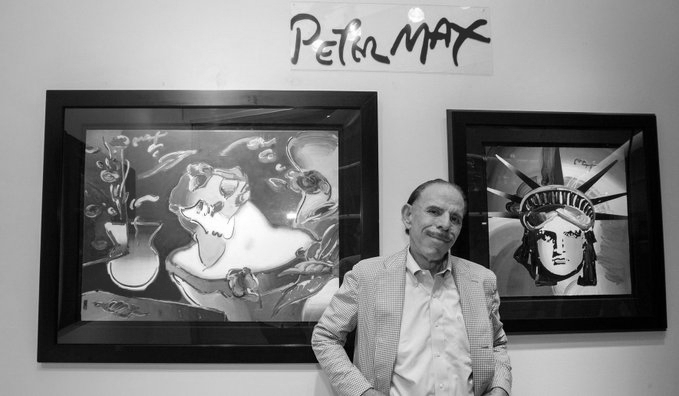
Peter Max, Psychedelic Artist Who Defined 1960s Counterculture, Dies At 88
Peter Max, the German American artist whose vivid psychedelic paintings became synonymous with the 1960s flower power movement, has died at 88. Max died on Monday, September 14, at a hospital in Manhattan, his son Adam Max said in a statement. His cause of death was not disclosed by the family. Recent reports said Max had been living with advanced dementia in his later years.
Max became one of the most recognisable faces of American pop culture through his colourful images of rainbows, flowers, planets, stars and cartoon-like figures. His work appeared on posters, clothing, household products, postage stamps, airplanes and cruise ships. His designs were especially popular among young Americans in the late 1960s and early 1970s, when his posters became a familiar sight in college dorm rooms.
His career eventually expanded far beyond commercial design. Max served as the official artist for major events including the Olympics, Super Bowl, World Cup and World Series. He also created artwork for a Boeing 777 and a Norwegian Cruise Line ship and painted portraits of several prominent figures, including US presidents and Taylor Swift.
Born Peter Max Finkelstein in Berlin in 1937, Max was the son of a Jewish family that fled Nazi persecution when he was a baby. The family moved to Shanghai and later lived in Israel and Paris before settling in New York when Max was 16. His early exposure to American comics, movies, jazz and astronomy influenced the distinctive visual language that later made him famous.
Max studied at New York's Art Students League, School of Visual Arts and Pratt Institute. He opened a graphic design studio in 1961 and quickly found success with advertising agencies, publications and major companies. His work eventually appeared across dozens of product lines, but he later stepped away from the commercial business because, as he put it, he was no longer painting.
His return to art included a celebrated 1981 project at the White House, where he painted a series of Statue of Liberty works at the invitation of first lady Nancy Reagan. His art later appeared in exhibitions around the world, while New York's Museum of Modern Art owns seven of his works.
Max also faced controversies. He pleaded guilty to tax fraud in 1997 after authorities accused him of concealing more than $1 million in income. His later years were marked by a bitter family and business dispute involving his second wife, Mary Max, and his son. Mary Max died in 2019.
Max's connection with the Beatles is also often misunderstood. His work is sometimes credited with the Yellow Submarine album and film, but those designs are officially credited to Heinz Edelmann. Max said he had worked on an earlier concept, while his longtime gallery described his role as early consulting work.
Despite the controversies surrounding his career, Max's brightly coloured imagery became an enduring part of American visual culture. “I see everything through rainbow eyes,” he once said.
He is survived by his son Adam Cosmo Max and daughter Libra Astro Max.