
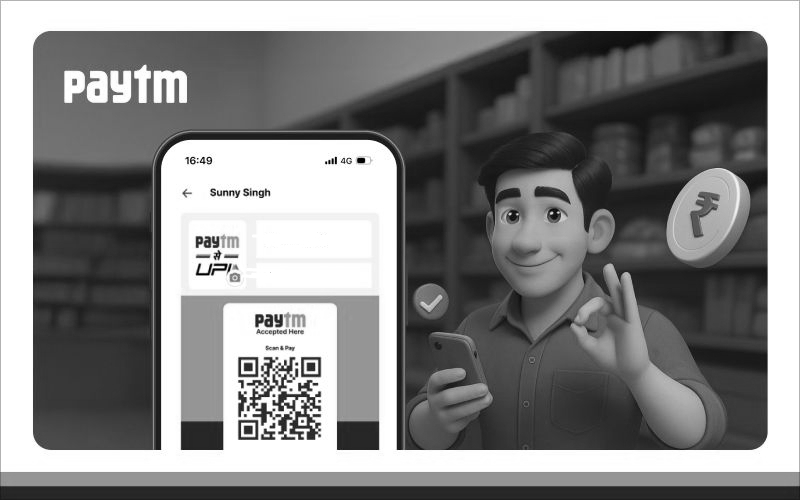
Paytm up 2% after RBI clears payments subsidiary for aggregator after 2 years pause
Paytm-parent One 97 Communications saw its stock rise nearly 2% on November 27 after the Reserve Bank of India granted final approval for its subsidiary, Paytm Payments Services Ltd (PPSL), to operate as a payment aggregator. The stock was trading at ₹1,309.10 in morning trade, reflecting fresh investor confidence following the regulatory clearance.
In a late-evening exchange filing on November 26, Paytm announced that the RBI had issued the Certificate of Authorisation (CoA) under the Payment and Settlement Systems Act, 2007. This approval allows PPSL to fully resume its payment aggregation operations. Most importantly, it enables the company to restart onboarding merchants, a key business activity that had been under an RBI freeze since November 2022. Paytm also attached the official authorisation certificate issued by the central bank’s Department of Payment and Settlement Systems.
This approval is significant because a major part of Paytm’s business is built on merchant transactions. While most users see Paytm as a UPI app, the company earns a large share of its revenue from shops, restaurants, small businesses, online sellers and enterprises that use Paytm to accept digital payments. Merchants who were onboarded before 2022 continued using Paytm’s services, but the freeze meant the company could not add new shops or businesses for nearly two years. With the licence now in place, Paytm can once again offer new QR codes, payment gateways, settlement services and POS devices, reopening a critical growth channel that was stalled.
The RBI also confirmed that PPSL paid a nominal fee of ₹10,000 plus GST as part of the authorisation process, a regulatory formality rather than a significant operational cost. While the amount may seem tiny for a company of Paytm’s scale, it is merely a statutory fee required to obtain official approval as a payment aggregator, with the real costs lying in compliance, technology, and operational infrastructure. The positive sentiment around Paytm’s stock was further bolstered by ICICI Securities, which recently raised its target price from ₹1,240 to ₹1,450 while maintaining a Buy rating. The brokerage believes Paytm is well-positioned for strong earnings growth, driven by improvements in its payments business, expansion in loan distribution, product upgrades, and international scale-up. It estimates that Paytm’s net revenue could reach ₹12,523 crore by FY28, supported by the company’s growing presence across the digital payments ecosystem.
Despite today’s gains, Paytm’s stock has slipped 0.5% over the past month. However, it has delivered a sharp rally of 50% in the last six months and is up 30% in 2025. From a 52-week low of ₹651.50 in March, the stock surged 108% to hit a high of ₹1,353.80 on November 10, before correcting slightly by over 3%.
A payment aggregator acts as a middleman that helps businesses accept digital payments securely. When a customer pays through QR, UPI, card or a payment link, the money is first received by the aggregator, which then transfers it to the merchant’s bank account. PhonePe already has this licence, while Google Pay doesn’t need one because it functions as a third-party app on top of NPCI’s UPI system rather than operating as a full payment processor.
For Paytm, the license clearance is vital because it governs a core revenue-generating function, merchant payments, wallets, and other payment services. Earlier, the freeze was imposed by the Reserve Bank of India (RBI) on its payments-bank arm due to serious compliance issues: lapses in KYC/anti-money-laundering norms, many unverified or dormant accounts, data-governance and cybersecurity concerns, and fears of improper related-party or intra-group transactions. When the freeze hit in early 2024, Paytm’s parent company One97 Communications Ltd. saw its share price plummet from near ₹1,000 to hit ₹608–609, with further declines in the following months as investor confidence eroded.
Today, the picture is improving. In Q1 FY26, One97 Communications posted a net profit of ₹122.5 crore, translating to an EPS of ₹1.92 (basic). That turnaround comes after cost optimisation and renewed confidence following regulatory clearance. The recovery, along with the resumption of merchant onboarding and payment processing, underlines how critical the RBI licence and overall business stability are for Paytm’s resurgence, helping the company regain growth momentum and strengthen financial performance.