
Parliament Session From Nov 30: BJP Confident, Opposition Faces Numbers Challenge
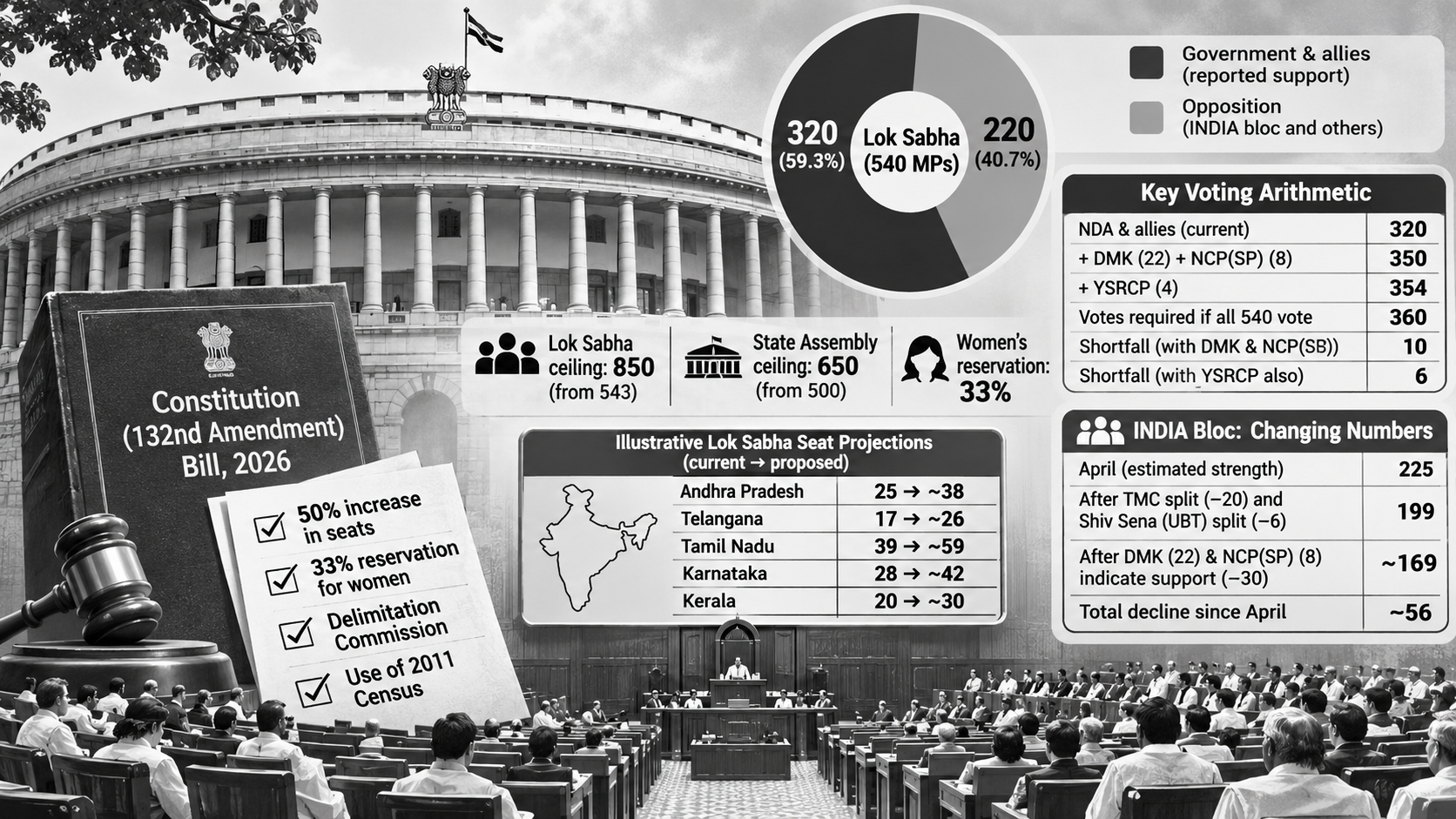
The Centre’s revised delimitation proposal has intensified political negotiations ahead of Parliament’s special sitting beginning November 30, with the BJP-led National Democratic Alliance (NDA) seeking the numbers required to pass the constitutional amendment. The ruling alliance has an estimated 320 MPs, against the 360 votes required if all 540 sitting Lok Sabha members participate. The support indicated by the DMK and Sharad Pawar-led NCP(SP) has raised the government’s projected strength to 350, bringing it closer to the special majority required under the Constitution. Meanwhile, the Congress-led INDIA bloc is attempting to formulate a common response, despite differences among its regional constituents.
The Union Cabinet has cleared three draft legislations, including the Constitution (132nd Amendment) Bill, 2026, the Delimitation (Second) Bill, 2026, and a related amendment concerning Union Territories. The proposals seek to increase Lok Sabha and State Assembly seats by 50 per cent and facilitate 33 per cent reservation for women ahead of the 2029 general elections. The proposed constitutional ceiling for the Lok Sabha would rise to 850 seats, comprising up to 815 representatives from states and 35 from Union Territories, while the maximum strength of State Assemblies would increase from 500 to 650.
The BJP has 241 MPs, while the remaining 79 in the reported government-side tally come from allies and other groups. These include the National Citizens Party of India (NCPI) with 20 MPs, Telugu Desam Party (TDP) with 16, Eknath Shinde-led Shiv Sena with 13, Janata Dal (United) with 12 and Lok Janshakti Party (Ram Vilas) with five. The Rashtriya Lok Dal, Jana Sena Party and Janata Dal (Secular) have two MPs each. The Shiromani Akali Dal, Apna Dal (Sonelal), Assam Jatiya Parishad, AJSU Party, Hindustani Awam Morcha (Secular), Ajit Pawar-led Nationalist Congress Party and Sikkim Krantikari Morcha have one MP each. Together, these parties and groups account for the reported 320-member support tally.
The NCPI’s 20 MPs are former Trinamool Congress members who broke away and announced their merger with the party. The tally also reflects six Shiv Sena (UBT) MPs who joined the Shinde-led faction. However, the 320 figure represents a reported government-side support calculation and should not be interpreted as the formal membership of the NDA alone.
Under Article 368, a constitutional amendment requires a majority of the House’s total membership and at least two-thirds of members present and voting. With 540 sitting MPs, the government would need 360 votes if all participate, leaving the NDA 40 short. The DMK has 22 MPs and NCP(SP) eight. Their combined support could take the projected tally to 350, leaving a gap of 10. If the YSR Congress Party (YSRCP), with four MPs, also backs the proposal, the tally could reach 354, leaving six votes to be secured. These remain projections, not confirmed voting commitments. Absences and abstentions could reduce the two-thirds threshold, although the separate requirement of a majority of the House’s total membership would remain.
The DMK has indicated support after seeking safeguards to protect Tamil Nadu’s existing share of parliamentary representation, estimated at 7.18 per cent. It has sought a uniform 50 per cent increase across states and protection of relative representation until 2051. NCP(SP) senior leader Jitendra Awhad has also indicated support, complicating the INDIA bloc’s efforts to maintain a common position.
Illustrative projections suggest Andhra Pradesh’s Lok Sabha seats could increase from 25 to around 38 and Telangana’s from 17 to approximately 26. Tamil Nadu could rise from 39 to 59, Karnataka from 28 to 42 and Kerala from 20 to 30. These are estimates, not final allocations. The corresponding Assembly expansion could take Andhra Pradesh from 175 to 262–263 seats and Telangana from 119 to 178–179.
The legislation seeks to operationalise the 33 per cent women’s reservation provided under the Nari Shakti Vandan Adhiniyam, or the 106th Constitutional Amendment Act, 2023. A proposed Delimitation Commission would redraw constituencies and identify seats reserved for women and Scheduled Castes and Scheduled Tribes, considering population, geography, administrative boundaries and public convenience.
A major point of contention is the proposed use of the 2011 Census for delimitation, although the next Census is scheduled for 2027. The government aims to avoid delays in implementing women’s reservation before the 2029 elections. The revised framework also seeks to protect relative seat allocation among states until 2051. The next Census involves house-listing in 2026 and population enumeration in 2027, with final data expected to take time.
At its November 28 meeting, the INDIA bloc called for retaining the Lok Sabha’s existing strength of 543, implementing women’s reservation within the current House and protecting state-wise seat allocation for another 25 years. The Opposition’s position has weakened since the April 17 vote, when the earlier amendment was defeated with 230 votes against and 298 in favour. The DMK and NCP(SP), with a combined 30 MPs, have now indicated support for the revised proposal. The Opposition has also lost 20 former Trinamool Congress MPs to the NCPI and six Shiv Sena (UBT) MPs to the Shinde faction. These changes reduce the pool of MPs potentially available to oppose the Bill, although they do not establish how every member will vote. The Opposition can still challenge the legislation through debate and support from other parties, but its ability to defeat the proposal through numbers alone has become more difficult.