
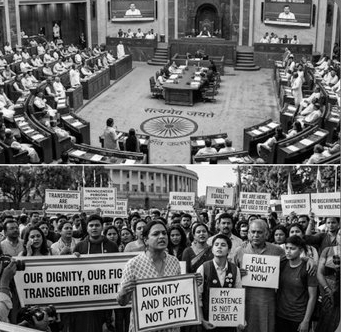
Parliament passes transgender rights amendment bill amid protests and criticism
The Parliament on Wednesday passed the Transgender Persons (Protection of Rights) Amendment Bill, 2026 , with both the Lok Sabha and Rajya Sabha approving it by voice vote. The legislation amends the Transgender Persons (Protection of Rights) Act, 2019 , redefining who qualifies as a “transgender person” and removing the provision for self-perceived gender identity . Recognition will now require medical board verification and approval by a District Magistrate , replacing the self-identification model upheld by the Supreme Court in the NALSA judgment (2014) .
Union Social Justice and Empowerment Minister Virendra Kumar defended the bill, stating it aims to protect individuals facing discrimination due to biological issues , while introducing graded punishments for offences such as harassment, abduction, or grievous bodily harm. The maximum jail term has been increased from two to 14 years , along with monetary penalties.
However, opposition leaders, activists, and civil society groups have condemned the legislation as regressive and a brazen attack on constitutional rights and identity . Critics argue the bill strips transgender people of their ability to self-identify , violates the Supreme Court’s NALSA judgment, erases the diverse cultural identities of communities across India, and forces dehumanizing medical examinations. They further warn that the law introduces criminal penalties and surveillance without safeguards, and was drafted without consulting the trans community, ultimately stigmatizing rather than protecting transgender individuals.
Protests erupted nationwide, including in Panaji , with demonstrators raising songs, slogans, and placards against the bill. Activists emphasized that vague penal provisions could criminalize family support, community assistance, and access to healthcare , while failing to ensure broader rights such as employment, education, and social inclusion .
The controversy also raises a broader concern: despite rapid economic and technological progress, India often lags behind other nations in social and legal recognition of marginalized groups . Historical stigma, colonial-era laws, conservative social attitudes, and political caution have slowed reforms, leaving the country struggling to fully uphold rights and dignity for transgender communities . Observers note that while countries like Canada, Argentina, and several European nations legally recognize self-identified gender, India continues to impose bureaucratic and medical gatekeeping , reflecting a cautious approach rather than full alignment with modern human rights standards.