
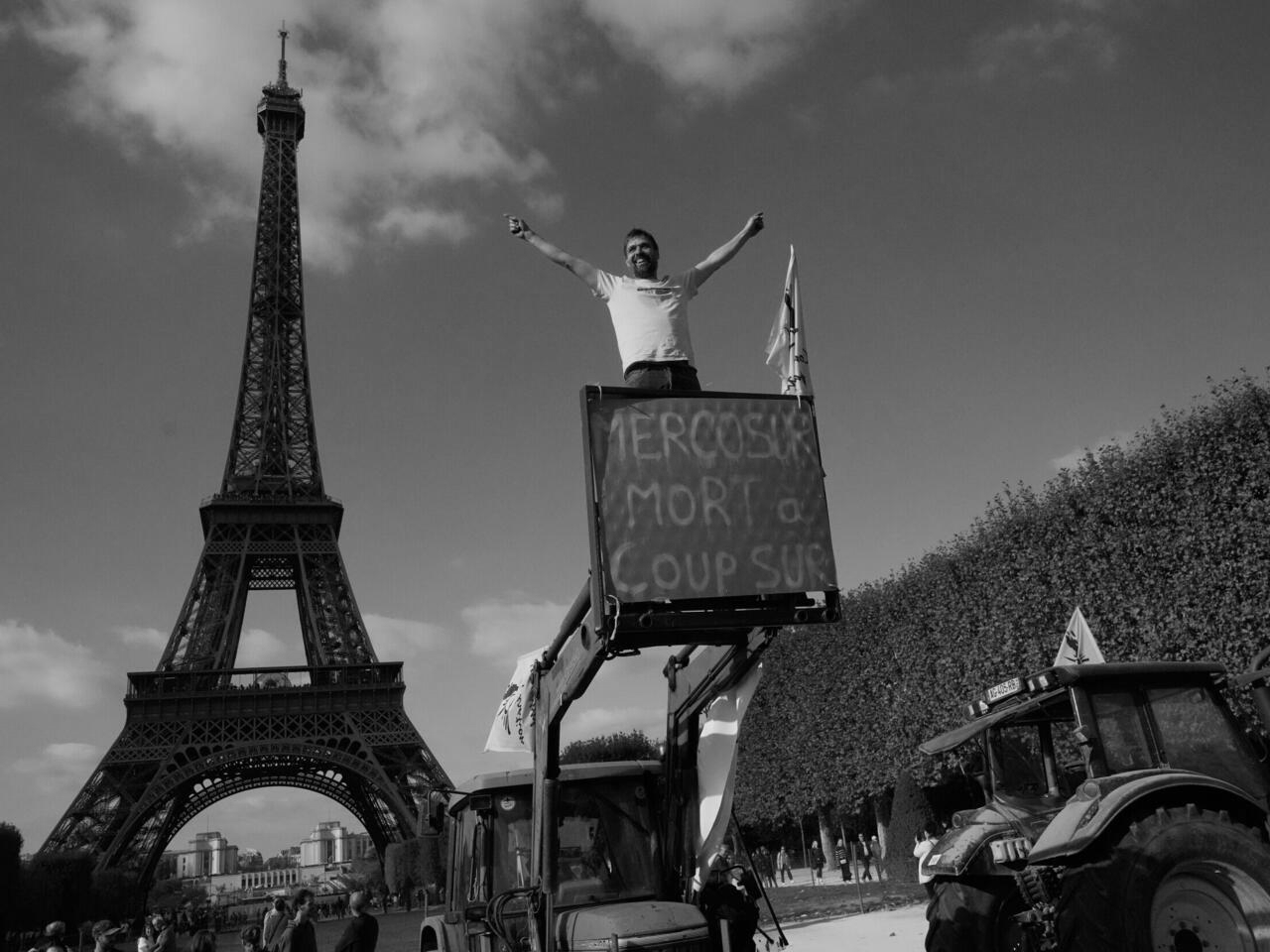
Paris streets blocked by farmers opposing EU-Mercosur agreement and low-cost imports
Farmers drove about a hundred tractors well before dawn into Paris on Thursday, forcing their way through police roadblocks and driving along major avenues, to protest the European Union ’s proposed free trade deal with South American nations and to voice broader discontent with government policies, authorities and unions said. About 20 tractors reached central Paris, with some parked near the Arc de Triomphe and others by the Eiffel Tower , while dozens more blocked highways leading into the city, including the A13 from the west, causing traffic jams that stretched up to 150 kilometres , officials said.
The demonstration was organized by the Rural Coordination (Coordination Rurale) union and other farm groups amid fears the Mercosur trade agreement , covering Brazil, Argentina, Bolivia, Paraguay and Uruguay , would flood the EU market with cheaper agricultural imports and severely impact French farming . Farmers argue that products from these Latin American nations, such as beef, chicken, sugar, ethanol and honey, are produced at lower cost because labour is cheaper, land and raw material expenses are lower, and regulatory standards are less stringent. In contrast, European farmers face high labour costs, strict environmental and sanitary rules, and significant production expenses, making it difficult to compete on price. Farmers fear that these differences will allow imported products to be sold at lower prices in the EU, undermining domestic production and threatening rural livelihoods.
“We are between resentment and despair. We have a feeling of abandonment, with Mercosur being an example,” said Stéphane Pelletier , a senior member of the Coordination Rurale union, speaking beneath the Eiffel Tower. Protesters carried signs warning that the deal would hurt French agriculture and displayed slogans such as “No to Mercosur.”
Farmers also expressed anger over the French government’s handling of a bovine disease outbreak, specifically the culling policy for cattle with lumpy skin disease and what they see as inadequate support and compensation for affected producers. Some farmers have called instead for increased vaccination and more administrative support for struggling farms.
The protest piled pressure on President Emmanuel Macron’s government just a day before EU member states are expected to vote on the controversial trade accord. While France and Poland have publicly opposed the deal, Brussels negotiators, backed by Germany and other countries, have sought concessions and may proceed with a signature as soon as January 12 in Paraguay, raising concerns among French farmers that Paris could be sidelined in EU decision‑making.
French agriculture minister Annie Genevard reiterated France’s opposition this week, saying the Mercosur pact would threaten domestic production and flood the market with cheaper imports, further squeezing farmers already grappling with high input costs and tight margins. In response to mounting protests, the government recently tightened import checks to ensure food entering France meets EU safety and environmental standards, including restrictions on products containing certain pesticides and chemicals.
Farmers’ tractor convoys stretched for kilometres on highways leading to Paris, and authorities warned that further demonstrations and blockades could continue if their demands are not addressed. The visually striking protest, with tractors driving through major avenues and forming long convoys has gained considerable attention online , where social media users have shared videos and photos praising the symbolic, peaceful but disruptive nature of the demonstration. Many have applauded farmers for highlighting the stark cost differences between European and Latin American production, showing in a dramatic way how trade deals can threaten local economies.
While some of today’s tractors were stopped at the city limits, the symbolic entry of agricultural vehicles into central Paris underscored deepening tensions between rural communities and policymakers over trade policy, regulatory standards and the future of European agriculture.