
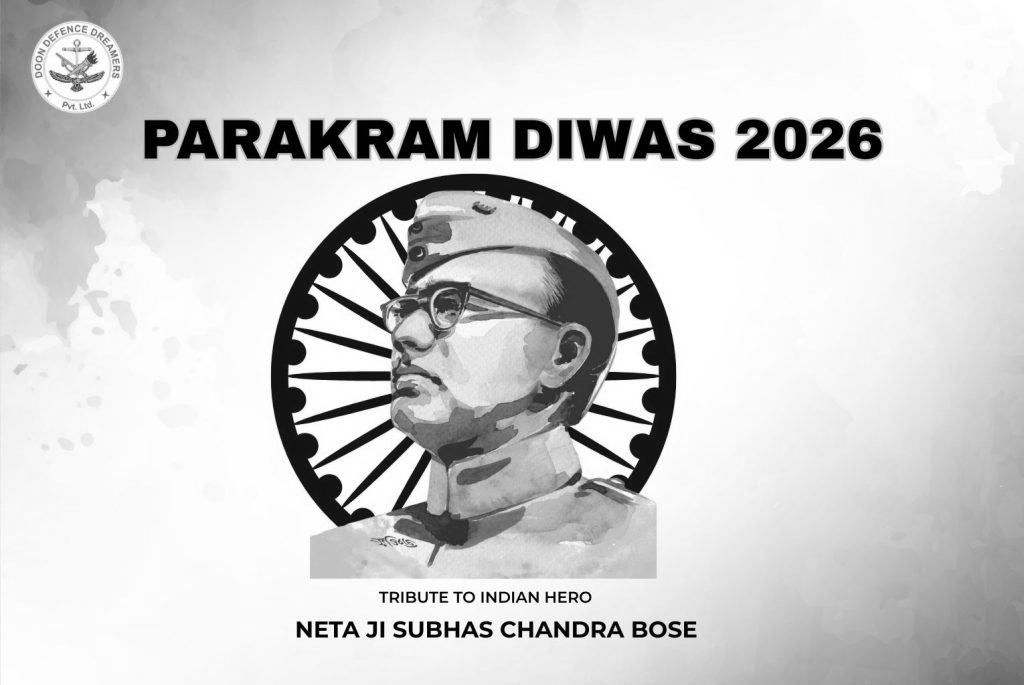
Parakram Diwas Tribute: Netaji - India’s Revolutionary Legend and Pride
In the long history of India’s freedom struggle, countless heroes sacrificed their lives for the nation. But among them, one leader stood apart from Netaji Subhas Chandra Bose , who declared that it is better to die fighting for freedom than to live as slaves. At a time when the British Empire was at its strongest, Netaji challenged the rulers directly and rattled the foundations of colonial power through his belief in armed resistance and fearless leadership.
Netaji Subhas Chandra Bose was a great Indian nationalist whose intense patriotism left an unforgettable mark on the hearts of Indians. He is remembered as the founder of the Azad Hind Fauj (Indian National Army) . His most famous slogan “Give me blood, and I will give you freedom” still inspires generations. Today, India commemorates his birth anniversary as Parakram Diwas , celebrating his courage and sacrifice. On the occasion of Netaji’s 129th birth anniversary , here is a special tribute to the legend.
An Extraordinary Genius
Netaji Subhas Chandra Bose was born on January 23, 1897 , in Cuttack, Odisha , into a prosperous family. His father, Janakinath Bose , was a well-known lawyer, and his mother Prabhavati Devi was a disciplined and devoted homemaker. Subhas was the ninth of fourteen children. From an early age, he displayed strong leadership qualities, sharp intelligence, and deep social awareness.
After completing his early education in Cuttack, he joined Presidency College, Kolkata . There, he could not tolerate a British professor insulting Indians and strongly protested against it. As a result, he was expelled from the institution. This episode played a crucial role in awakening the revolutionary within him. Later, he went to Cambridge University , where he achieved 4th rank in the Indian Civil Services (ICS) examination , one of the toughest competitive exams of that era. However, he refused to serve the British administration and resigned from the prestigious post, returning to India to dedicate himself to the freedom struggle.
Differences with Mahatma Gandhi
After returning to India, Bose entered politics under the guidance of Chittaranjan Das . In his early years, he worked actively within the Indian National Congress under the leadership of Mahatma Gandhi . However, he firmly believed that independence could not be achieved through Gandhi’s path of non-violence alone . Bose argued that when the British used guns and force to suppress Indians, responding only with peaceful protest would not be enough.
In 1938 , he was unanimously elected as the Congress President at the Haripura session . In 1939 , he won again at the Tripuri session , defeating Pattabhi Sitaramayya , who had Gandhi’s support. However, internal party conflicts intensified, and Bose eventually resigned from the Congress presidency. Later, he founded the Forward Bloc , aiming to build a more assertive and militant movement for India’s freedom.
A Daring Escape Abroad
With the beginning of the Second World War , Bose believed Britain’s weakness could be turned into India’s opportunity. Sensing this, the British government placed him under house arrest. Yet, in a daring move, Bose escaped on the night of January 16, 1941 , disguised as a Pathan, successfully evading British intelligence.
He travelled through Afghanistan and the Soviet Union before reaching Germany. There, he met Adolf Hitler and sought international support for India’s independence struggle. Bose believed that global alliances could strengthen India’s movement against British rule.
Azad Hind Fauj: The Armed Revolution
From Germany, Bose travelled by submarine to Japan and took charge of the Indian National Army (INA) , originally established by Rash Behari Bose . His leadership electrified the movement and brought a new sense of purpose and discipline to the army. His speech in Singapore became historic, especially when he declared: “Give me blood, and I will give you freedom.”
Under his command, the INA stood above divisions of caste, religion, and region. He also created the Rani of Jhansi Regiment , a women’s battalion, proving that women were equally capable of fighting for the nation. With the powerful slogan “Delhi Chalo” , INA troops advanced close to Indian borders, reaching the Manipur region and fighting fierce battles against British forces.
A Mystery That Still Remains Unsolved
On August 18, 1945 , it was officially announced that Netaji died in a plane crash while travelling via Taiwan. However, this remains one of the greatest unsolved mysteries in modern Indian history. Many people continue to believe that Bose may have survived and lived in secrecy. Several investigation commissions were formed over the years, but none could provide final evidence that settled the matter beyond doubt.
The Legacy of Netaji
Netaji was not only a courageous warrior but also a visionary leader. He had a clear idea of what independent India should look like and stressed the importance of national development through planning and strong institutions. Many historians credit him with influencing early ideas related to national planning.
In India’s freedom struggle, Bose remains a shining symbol of bravery, discipline, and sacrifice. His leadership inspired patriotic spirit in countless Indians, especially among soldiers. The freedom we enjoy today carries within it his struggle, sacrifice, and unbreakable determination.
Parakram Diwas
The Government of India officially declared Netaji’s birth anniversary as Parakram Diwas in 2021 . The decision was announced by the Ministry of Culture on January 19, 2021 , as part of Netaji’s 125th birth anniversary celebrations . The first Parakram Diwas was observed nationwide on January 23, 2021 . The purpose of the day is to honour Netaji’s courage and inspire India’s youth with values of patriotism, responsibility, and service to the nation.
In 2026 , on January 23 , the nation celebrates Netaji’s 129th birth anniversary as Parakram Diwas. On this day, schools, colleges, and government offices organise events to remember his legacy and spread awareness about his ideals. The government has also taken symbolic initiatives during Parakram Diwas, such as naming certain islands in the Andaman and Nicobar region after recipients of the Param Vir Chakra .
A Tribute from Today’s Youth
Netaji’s life is a reminder that patriotism is not just a slogan but a responsibility. While many people give up under small hardships today, Netaji sacrificed a prestigious career and a comfortable life without hesitation, only for the nation’s freedom and dignity. His slogan “Jai Hind” is not merely a phrase, it represents the pride and spirit of India.
Netaji Jayanti should not be limited to paying tribute with garlands and speeches. It should be a day to adopt his ideals in our lives, strengthen our sense of duty, and work towards building a stronger India. Let Netaji’s courage become our strength, and let his devotion to the nation inspire our actions.