
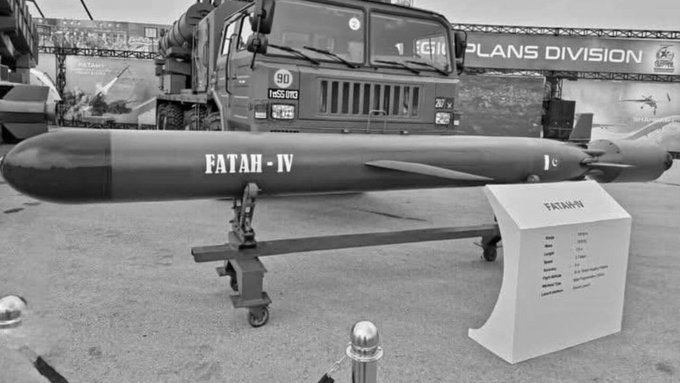
Pakistan Test-Fires Indigenous Fatah-4 Cruise Missile With 750-km Range
Pakistan conducted a successful training fire of the indigenously developed Fatah-4 ground-launched cruise missile on Thursday, with the Army Rocket Force Command overseeing the launch, confirmed by the Inter-Services Public Relations (ISPR). President Asif Ali Zardari, Prime Minister Shehbaz Sharif, Field Marshal Asim Munir, Chief of Naval Staff Admiral Naveed Ashraf, and Air Chief Marshal Zaheer Ahmed Babar Sidhu all commended the test.
The Fatah-4 carries a range of 750 km , cruises at Mach 0.7 , weighs 1,530 kg , carries a 330 kg conventional warhead , flies at a minimum altitude of just 50 metres , and achieves a circular error probable of under 5 metres , meaning it can strike a target the size of a small room from hundreds of kilometres away. The missile is a conventional derivative of the Babur cruise missile platform , previously reserved for Pakistan's strategic nuclear deterrence, making its adaptation for battlefield use a significant doctrinal step, giving the Army a deep-strike capability without crossing the nuclear threshold .
The Fatah family, developed by NESCOM and marketed by Global Industrial and Defence Solutions (GIDS) , now provides Pakistan a layered conventional strike range spanning 140 km (Fatah-1), 400 km (Fatah-2), and 750 km (Fatah-4) , covering targets from frontline formations to deep rear infrastructure. At Mach 0.7, it sits in the same speed category as the Russian Kalibr and the American Tomahawk .
Thursday's test follows the Fateh-II launch on April 28 and a Pakistan Navy firing of the Taimoor air-launched cruise missile a week prior, reflecting a deliberate, accelerated tempo of validation across all services. The ARFC was established in August 2025 directly after India's BrahMos missiles struck multiple Pakistani airbases during the four-day May 2025 conflict, exposing critical gaps in conventional deterrence.
Compared to India's Nirbhay cruise missile , which has an announced range of around 1,000 km but has suffered repeated development delays, the Fatah-4 stands out for having entered operational service rapidly and been integrated into army units with notable efficiency.