
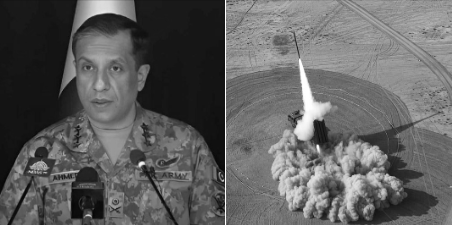
Pak Army Says It Successfully Conducts Fateh-II Missile Training Launch
Pakistan's army has announced the successful conduct of a training launch of the Fateh-II guided rocket system , in what Islamabad described as a demonstration of its strategic readiness and precision strike capabilities.
The Inter-Services Public Relations (ISPR) , the media wing of the Pakistani military, confirmed that the launch was carried out as part of a field training exercise aimed at ensuring the operational preparedness of troops handling the weapon system. The exercise was designed to validate the technical parameters of the missile as well as the combat readiness of the personnel involved.
The Fateh-II is an indigenously developed guided rocket system with an extended range compared to its predecessor, the Fateh-I. It is capable of engaging targets with high precision , making it a significant addition to Pakistan's conventional battlefield arsenal. The system is designed to strike ground targets at considerable distances, giving Pakistani forces the ability to hit deep into adversary territory without relying on air assets.
What makes the Fateh-II particularly notable is its guidance and navigation system , which allows for a level of accuracy unusual for rocket artillery. Pakistan has positioned it as a cost-effective deterrent that enhances its standoff strike capability — the ability to inflict damage on an enemy while staying out of immediate retaliatory range.
The timing of the launch carries geopolitical weight . Pakistan's missile and rocket tests are closely watched by India and by international observers, particularly given the fragile state of relations between the two nuclear-armed neighbors. While Islamabad has framed the exercise in purely technical and training terms, such demonstrations are widely understood as signals of military capability and resolve to potential adversaries.
Pakistan has in recent years invested heavily in indigenizing its defense technology , and the Fateh series represents one of the more visible fruits of that effort. The system was developed under the auspices of Pakistani defense scientists and is seen as a point of national pride within the country's military-industrial establishment.
The Director General ISPR stated that the launch successfully achieved all designated training objectives , with the rocket hitting its intended target with the required degree of accuracy. Senior military officials, including the Chairman Joint Chiefs of Staff and the Chief of Army Staff , were said to have witnessed the exercise.
India chose to let its own Agni, BrahMos, and Pralay missile programs speak for themselves. India's BrahMos supersonic cruise missile , already deployed with all three armed services, and the Pralay quasi-ballistic missile , specifically designed for battlefield precision strikes, offer India a qualitatively superior counter. Indian military doctrine emphasizes credible conventional deterrence , and by most assessments, India holds a decisive overall military edge over Pakistan.