
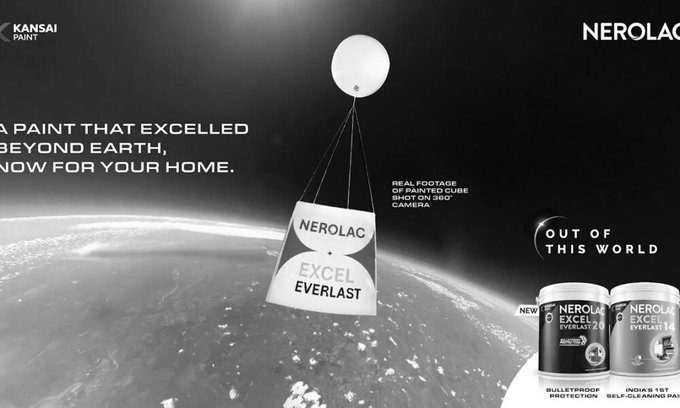
Paint That Survives Space? Nerolac Tests Durability at 86,000 Feet Above Earth
Kansai Nerolac Paints has carried out an unusual stratospheric experiment to test its Excel Everlast exterior paint range , sending a painted payload to an altitude of 86,000 feet above Earth using a high-altitude balloon. The initiative, developed with creative agency ULKA, exposed the coated surface to near-space conditions before it safely returned.
At that height, the payload faced extreme environmental stress, including temperatures below -64°C , intense unfiltered ultraviolet radiation, and extremely low atmospheric pressure. According to the company, the paint remained completely intact after the flight, with no visible damage.
The idea behind the test was to push the product beyond conventional laboratory simulations and expose it to conditions that accelerate material stress. Extremely low temperatures can make coatings brittle, while high UV exposure and pressure variations can weaken adhesion and cause fading or cracking over time. By surviving these extremes, the company claims the paint demonstrates strong resistance to weathering and long-term outdoor degradation.
However, experts note that while stratospheric conditions are far harsher than normal environments, they do not fully replicate real-world factors such as rain cycles, humidity, pollution, and surface wear. Instead, such tests are often used as symbolic demonstrations of durability rather than formal certification methods.
The paint industry typically relies on standardised laboratory tests and outdoor exposure studies because they are scientifically consistent, cost-effective, and widely accepted for measuring long-term performance. High-altitude balloon tests are rare due to their complexity and lack of regulatory relevance, making them more of a marketing-driven innovation than an industry norm.
The campaign, titled #OutofThisWorld , positions Excel Everlast as a high-durability exterior coating designed with nano-silica technology, crack-bridging capability, and a claimed 20-year warranty. Company officials said the stratospheric test was chosen to match the product’s promise of extreme resilience in a visually compelling way.