
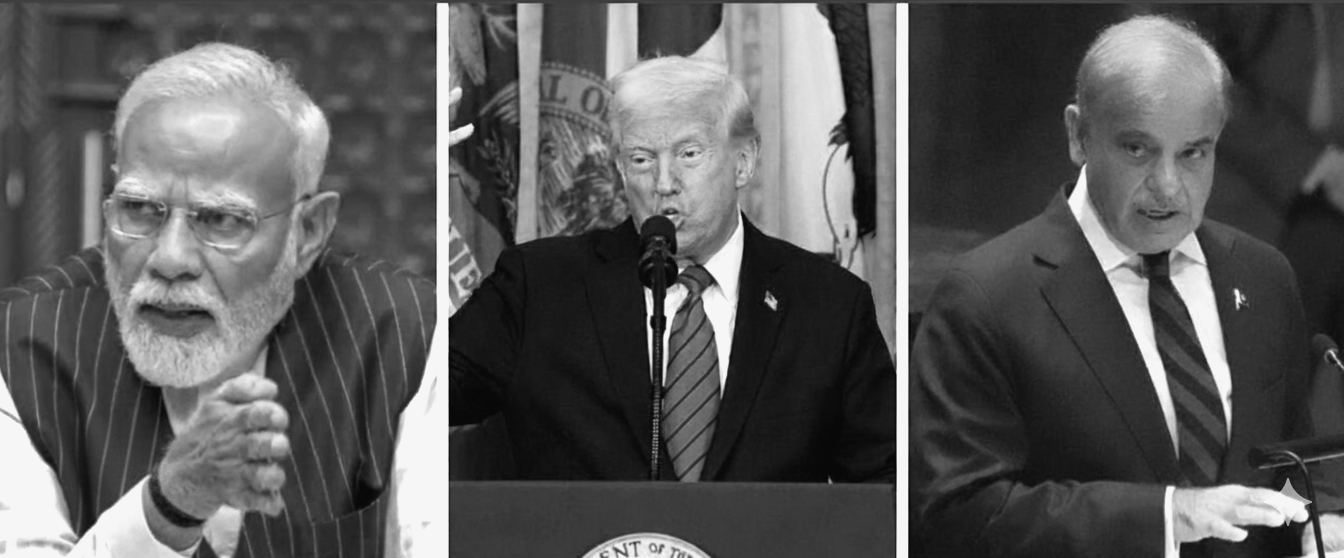
Over 60 claims later, Trump still credits himself for India-Pakistan Ceasefire, India disagrees
U.S. President Donald Trump has once again revived his narrative about preventing a major conflict between India and Pakistan, reiterating now more than 60 times that his threat of imposing 350 per cent tariffs on both nations forced them to step back from the brink of war. His latest remarks were made at the high-profile US–Saudi Investment Forum in Washington, attended by visiting Saudi Crown Prince Mohammed bin Salman.
Speaking at the event, Trump claimed that both countries had been warned that all trade with the United States would be halted and massive tariffs imposed if hostilities escalated. According to him, this economic pressure was presented as the decisive factor in preventing a potential nuclear confrontation. “They can go at it,” Trump said he told the two neighbours, “but I’m putting a 350 per cent tariff on each country. No more trade with the United States.” He added that both sides responded with alarm and urged him not to proceed.
Trump further asserted that Pakistan’s Prime Minister Shehbaz Sharif had phoned him to express gratitude for “saving millions of lives,” allegedly in the presence of White House Chief of Staff Susie Wiles. He also claimed that Prime Minister Narendra Modi had called to inform him that India had decided against going to war, saying that the conflict was “done.” Trump said he responded by thanking Modi and suggesting they move forward with a trade deal.
These remarks fit into a pattern of repeated commentary by the U.S. president, who has used several public platforms including rallies, press briefings, bilateral meetings, and campaign events to insist that his tariff strategy prevented a nuclear catastrophe in South Asia. He has argued that economic tools were deployed by his administration to resolve multiple global conflicts, and that such tactics were unique to his leadership.
Trump’s version of events traces back to May 10, when he announced on social media that India and Pakistan had agreed to a “full and immediate” ceasefire after what he called a “long night” of negotiations facilitated by Washington. The claim has been reiterated by him dozens of times since, including during his bilateral meeting with the Saudi Crown Prince at the White House a day earlier.
However, India has firmly and consistently rejected suggestions of any U.S. role. New Delhi has maintained that the cessation of hostilities on May 10 was achieved solely through direct military-level communication between the Directors General of Military Operations (DGMOs) of the two countries. The ceasefire agreement followed India’s launch of Operation Sindoor on May 7, which targeted terror infrastructure in Pakistan and Pakistan-occupied Kashmir in retaliation for the deadly Pahalgam attack that killed 26 civilians.
Officials in New Delhi have repeatedly underlined that India does not accept third-party mediation in matters concerning Pakistan, and that bilateral mechanisms were sufficient to manage and de-escalate tensions. Pakistan has also not issued any confirmation of the conversations described by Trump.
Despite India’s clear position, Trump continues to claim personal credit for preventing what he describes as an imminent nuclear confrontation. The narrative has become one of his frequently repeated talking points, used to highlight his administration’s ability to manage global crises through unconventional economic pressure.
As Trump continues to amplify this account at international forums, India’s stance remains unchanged: the de-escalation in May was achieved through direct talks between the two militaries, without any external intervention.